

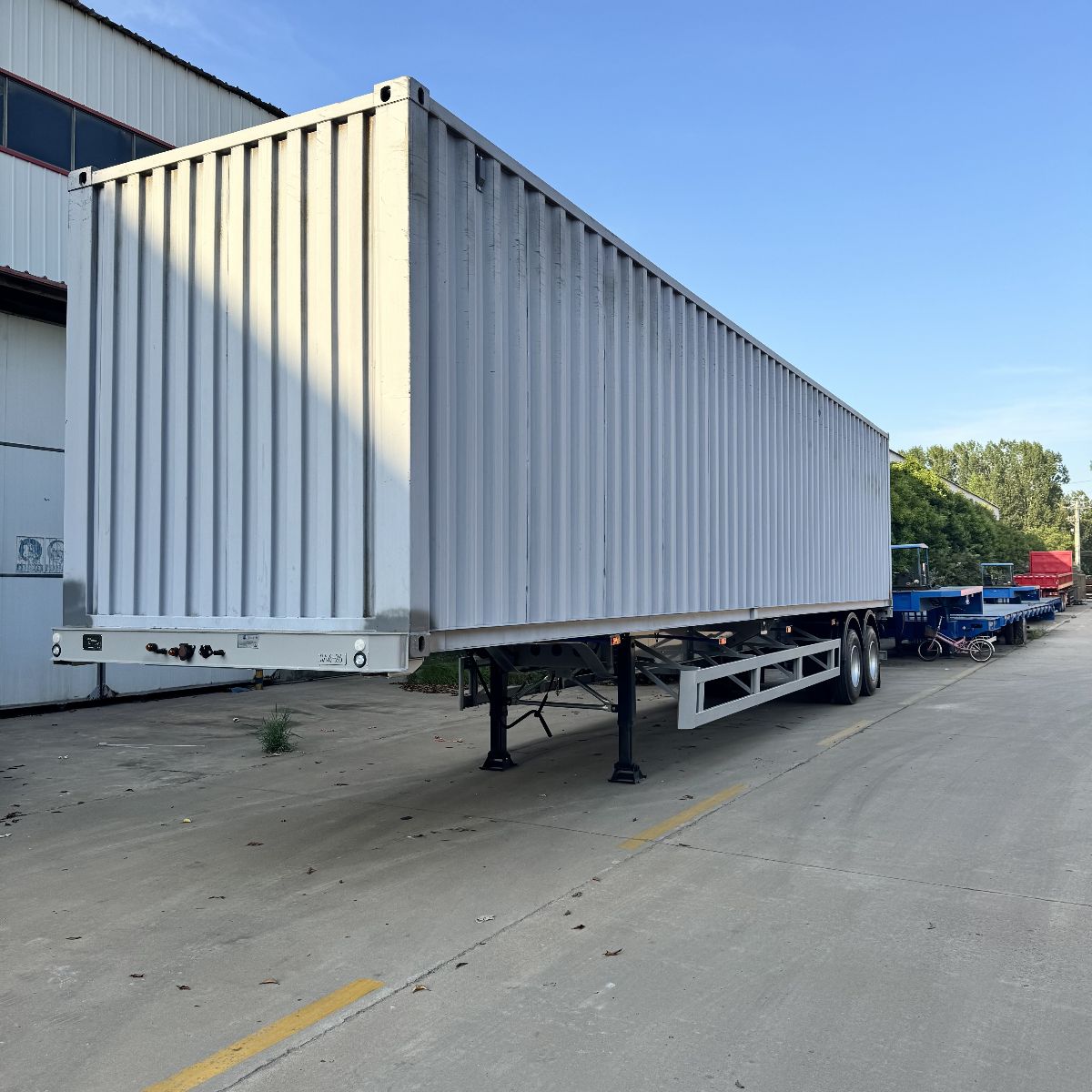
Main classification of semi-trailer for container transportation
- Skeleton container semi-trailer
No complete bottom plate, only frame main beam and crossbeam, light weight. Secure the container with a four corner twist lock.
-Applicable: 20/40/45 foot standard containers, ports, long-distance trunk lines, multimodal transport.
-Advantages: light weight, large cargo capacity; Disadvantage: Cannot transport loose cargo, can only be loaded into containers.
- Flat container semi-trailer
Equipped with a complete flat panel surface and container twist locks arranged on the panel surface.
-Applicable: It can transport both containers and ordinary goods such as pallets and large equipment, with strong versatility.
-Suitable for: short distance logistics, mixed transportation of multiple goods scenarios.
- Gooseneck container semi-trailer
The front section of the frame bends downwards to form a goose neck structure, and the front of the container sinks, resulting in a lower loading height.
-Applicable: refrigerated containers, ultra-high containers, low center of gravity, more stable driving.
Divided by number of axes
-Two axle container semi-trailer: light weight, suitable for standard load and short distance transportation in port yards
-Three axle container semi-trailer: mainstream in domestic trunk lines, with strong load-bearing capacity
-Equipped with a lifting axle: The empty vehicle can lift the axle to reduce tire wear and save fuel
Divided by loading box type
-20 foot skeleton semi-trailer: specialized transport small box
-40 foot skeleton semi-trailer: universal mainstream
-45 foot skeleton semi-trailer: transporting extended containers
According to the hanging form
-Steel plate spring suspension: heavy-duty and durable, low price, suitable for construction sites and harsh road conditions
-Air suspension: good shock absorption, adjustable height, protects the box and cargo, cold chain box is preferred