

Tank Trailer for Sale: Types, Specs & Prices from China Manufacturer (2026)
Quick summary: A tank trailer (also called tanker semi trailer or tank truck trailer) is a tank-shaped cargo semi trailer used to haul liquids, gases, or powdered bulk materials — diesel, gasoline, crude oil, chemicals, LPG, bitumen, milk, flour, cement, or pulverized coal. This guide explains the seven main tank trailer types, the real specifications that matter (capacity, axle load, material, valve system), what Chinese FOB prices look like in 2026, and how to import one without surprises. Pricing data is based on Shandong factory rates from January–July 2026.
What Is a Tank Trailer?
A tank trailer is a semi trailer whose cargo body is a pressure-rated cylindrical or shaped vessel rather than a flat deck or box. It is normally towed by a tractor unit (prime mover) and used for road transport of bulk fluids or powders. In most markets, capacity ranges from 20,000 L (5,300 gal) for a 2-axle model up to 60,000 L (15,850 gal) for a tri-axle tri-axle configuration. The heaviest 4-axle chemical and LNG tankers can exceed 75,000 L when the regulatory axle load permits.
The vessel is built from carbon steel, aluminum alloy, or stainless steel, depending on the cargo. Carbon steel (Q235B / Q345B) is the cheapest option and suits non-corrosive cargoes such as crude oil, bitumen, and heavy fuel oil. Aluminum alloy (5083, 5182, 5454) is roughly 30% lighter than carbon steel — a critical advantage when you run on weight-restricted roads in the U.S., Canada, or the EU. Stainless steel (304 or 316L) is the choice for food-grade liquids (edible oil, milk, beer) and aggressive chemicals.
Real-world example: a 3-axle 45,000 L diesel tanker built in Shandong with FUWA axles, a Mann Tek bottom valve, and a Cummins hydraulic pump typically weighs 7,800 kg empty, allowing a 33-ton payload within a 40-ton gross limit. The same vessel in aluminum drops to roughly 5,400 kg — a 2,400 kg payload gain on every load.
Types of Tank Trailer — Which One Fits Your Business?
There is no single “tank trailer” — the cargo dictates the design. The seven variants below cover about 95% of what is exported from China.
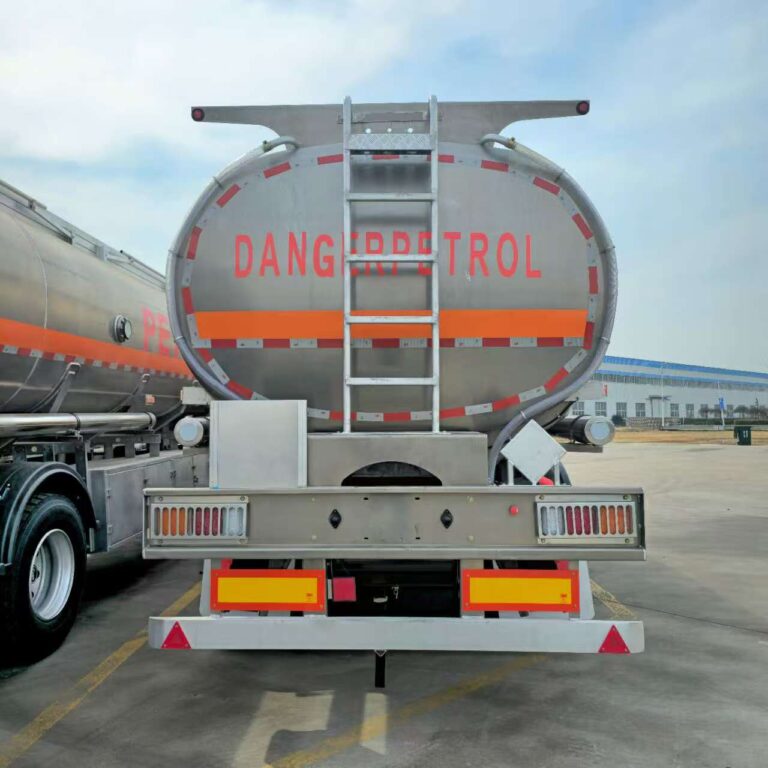
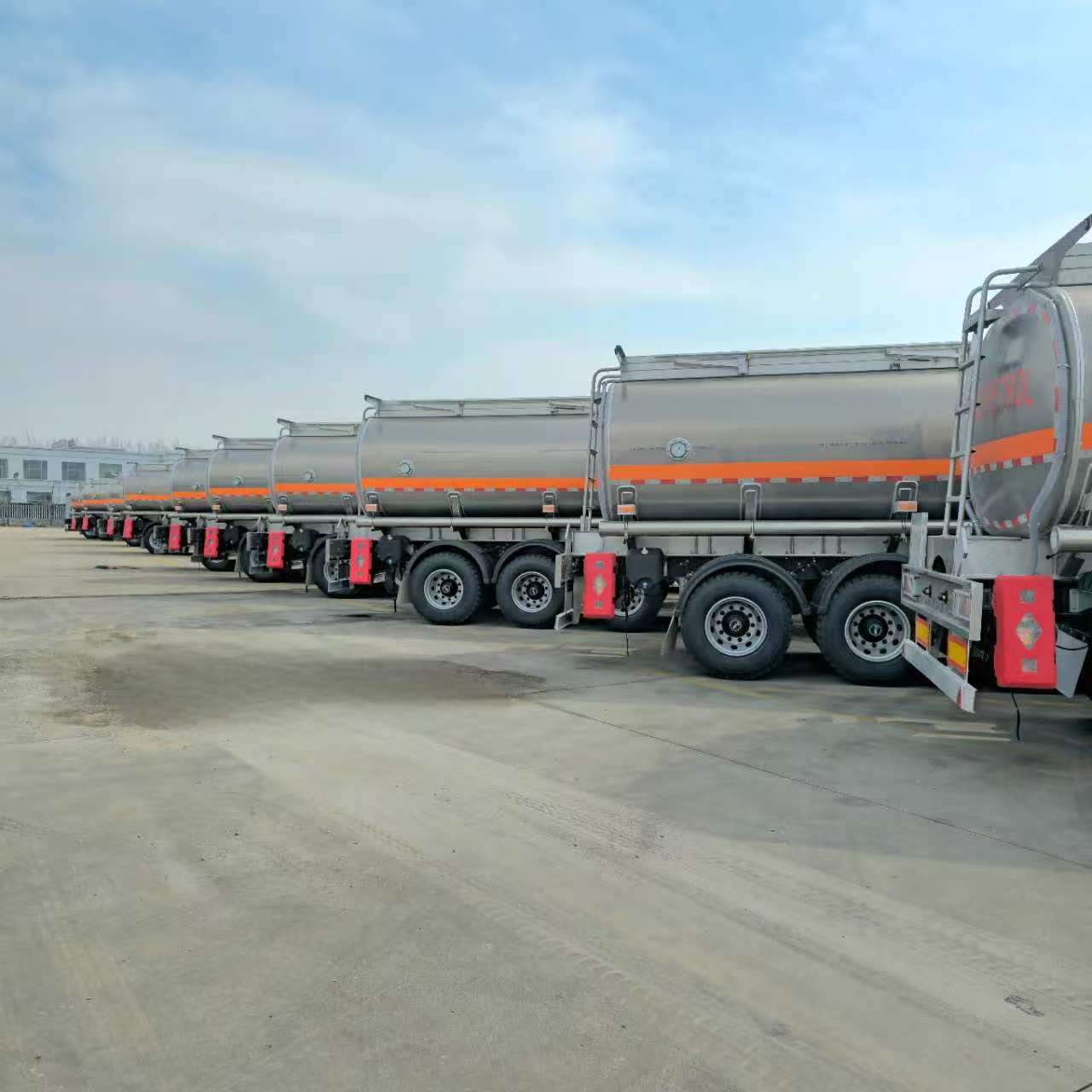
- Fuel / Oil Tanker Semi Trailer — carbon or aluminum vessel for diesel, gasoline, kerosene, crude. 30,000–55,000 L typical. Used by fuel distributors and mining haulage.
- Pulverized Coal / Bulk Powder Tanker — pressurized V-shaped or W-shaped vessel for cement, fly ash, flour, plastic pellets. Often called “bulk cement trailer” or “powder tank trailer.”
- Chemical Tank Semi Trailer — stainless steel 316L with PTFE-lined valves for acids (H₂SO₄, HCl, HNO₃) and caustic solutions. Requires ADR / DOT hazmat compliance.
- LPG Tank Trailer — pressure vessel rated 1.6–2.5 MPa for propane, butane, or ammonia. Built to ASME U-Stamp or PED 2014/68/EU.
- Stainless Steel Milk / Edible Oil Tanker — polished 304 or 316L interior, CIP cleaning ports, food-grade seals. Used for dairy, edible oils, syrup.
- Bitumen / Asphalt Tanker — insulated vessel with heating coils (diesel burner or electric) to keep bitumen at 150–180 °C during transport.
- Fuel Tank Truck (rigid) — a non-semi rigid truck chassis with tank body (8,000–25,000 L), common for last-mile fuel distribution in Africa and Southeast Asia.
Key Specifications & What to Look For
Skip the brochure adjectives and check the numbers that decide whether a tanker will work on your road network.
Spec Comparison Table — Common Tank Trailer Configurations
| Type | Capacity (L) | Axles | Vessel Material | Empty Weight (kg) | Typical GVWR |
|---|---|---|---|---|---|
| Fuel / Oil Tanker | 30,000 – 55,000 | 2 / 3 / 4 | Carbon steel Q345B / Aluminum 5083 | 6,800 – 9,500 | 40 – 80 t |
| Powder / Cement Bulk | 35,000 – 65,000 | 3 / 4 | Carbon steel Q345B | 8,200 – 11,000 | 40 – 80 t |
| Chemical Acid Tanker | 20,000 – 35,000 | 2 / 3 | Stainless steel 316L, lined | 7,500 – 10,500 | 40 t |
| LPG Tanker | 25,000 – 60,000 | 3 / 4 | 16MnR pressure vessel steel | 10,000 – 15,000 | 40 – 60 t |
| Milk / Edible Oil | 20,000 – 35,000 | 2 / 3 | Stainless steel 304 / 316L | 7,000 – 9,200 | 40 t |
| Bitumen / Asphalt | 30,000 – 45,000 | 3 | Carbon steel, insulated | 9,500 – 12,000 | 40 – 60 t |
Five Spec Points You Should Not Skip
- Axle brand and load rating. BPW, FUWA, or Chinese Yaxing axles at 13 t per axle are standard. If the destination is rough (Africa, Central Asia), ask for 14 t or 16 t heavy-duty axles — they cost about USD 600 per axle more but break less often.
- Manhole and bottom valve. A Mann Tek or OPW emergency bottom valve is the single most important safety feature. Chinese copy valves at USD 80 vs a genuine Mann Tek at USD 480 — the price gap is real, so is the failure rate difference.
- Discharge pump. Hydraulic-driven gear pumps (Cummins, Bosch Rexroth) at 50–80 m³/h are standard. For thick cargo (bitumen, heavy oil), specify a heated pump housing.
- Anti-surge / anti-wave baffles. Critical above 35,000 L to stop the liquid from shifting on cornering. Plastic baffles cost less than stainless but wear out faster.
- Tires. 12.00R20 or 315/80R22.5 radial. Avoid bias-ply unless the road is unpaved.
🚛 Get Your Tank Trailer Quote Today
Tell us your cargo, capacity, and destination port. You’ll get a custom spec sheet and FOB price within 24 hours.
💬 WhatsApp: +86 15315477956 📋 Online Inquiry Form📱 WeChat: +86 15315477956
Tank Trailer Price Guide — FOB China Costs in 2026
FOB prices below reflect Shandong factory rates for carbon-steel, 3-axle configurations with BPW or FUWA axles, Mann Tek bottom valves, and pneumatic discharge. Aluminum and stainless upgrades add roughly 18–35%. Prices exclude ocean freight, insurance, and destination port duties.
2026 FOB Price Reference Table (Shandong, China)
| Configuration | Capacity | Material | FOB Price (USD) | Notes |
|---|---|---|---|---|
| 2-axle Fuel Tanker | 30,000 L | Carbon steel Q345B | $18,500 – $22,000 | No pump; gravity drain |
| 3-axle Oil Tanker | 45,000 L | Carbon steel + hydraulic pump | $26,000 – $31,500 | Most exported configuration |
| 3-axle Fuel Tanker | 42,000 L | Aluminum alloy 5083 | $32,000 – $38,500 | +6 t payload vs steel |
| 4-axle Heavy Oil Tanker | 60,000 L | Carbon steel Q345B | $38,000 – $45,000 | 80 t GVWR configuration |
| 3-axle Powder Tanker | 45,000 L | Carbon steel V-shape | $28,000 – $34,000 | Cement / fly ash / flour |
| 3-axle Chemical Acid Tanker | 28,000 L | SS 316L + PTFE lining | $52,000 – $68,000 | ADR / hazmat certified |
| 3-axle Milk / Edible Oil | 30,000 L | SS 304, polished, CIP | $48,000 – $62,000 | Food grade |
| 3-axle LPG Tanker | 56,000 L | 16MnR pressure vessel | $85,000 – $120,000 | ASME / PED optional |
| 3-axle Bitumen Tanker | 40,000 L | Insulated carbon steel | $45,000 – $55,000 | Diesel burner heating |
Note: prices are FOB Qingdao / Tianjin / Liangshan in July 2026, based on hot-rolled coil at RMB 3,950/t and aluminum 5083 plate at RMB 22,800/t. Add USD 4,200–6,800 for 40HQ container export packing; bulk-ro-ro export can shave USD 800–1,200 if available.
How to Buy a Tank Trailer from China — 6-Step Checklist
- Lock down cargo and capacity. A fuel hauler running on Saudi Arabia’s 40 t gross limit needs a different tanker than a U.S. operator running 80,000 lb GVW. Capacity follows road limits, not the other way around.
- Pick vessel material and thickness. Carbon steel 5 mm is standard; 6 mm adds 800 kg but allows higher pressure washing. Aluminum at 6 mm equals steel at 5 mm in strength and saves 2–3 t empty weight. Stainless 304 / 316L is non-negotiable for food and aggressive chemicals.
- Decide destination certification. ADR (EU), DOT 407/412 (US), GCC SASO (Middle East), SONCAP (Nigeria), PVOC (Kenya), and UNECE markings all add documentation and inspection fees. Each cert adds USD 800–4,500 to the factory price.
- Confirm lead time and payment terms. Standard production is 25–35 working days after deposit, plus 30–35 days ocean freight from Qingdao to West Africa, 20–25 days to the Mediterranean, 18–22 days to the U.S. Gulf. Typical payment: 30% T/T deposit, 70% against B/L copy. LC at sight is standard for first-time buyers above USD 80,000.
- Ask for FAT video + third-party inspection. A factory acceptance test video should cover brake response, valve closure test, water-fill capacity check, hydraulic pump run, and a road test. SGS / BV / TUV inspections cost USD 350–600 per man-day — well worth it for the first shipment.
- Plan spare parts and after-sales. Airtac solenoid coils, Mann Tek valve seals, FUWA hub bearings, and LED tail-light assemblies are the consumables to stock. Order 2% spares on the first container.
Frequently Asked Questions
1. What is the average price of a tank trailer in 2026?
A 3-axle 45,000 L carbon-steel fuel tanker from a Shandong factory ships FOB Qingdao for roughly USD 26,000–31,500 in mid-2026. Aluminum builds (5083 plate) of the same capacity run USD 32,000–38,500. Stainless steel food-grade and chemical tankers range USD 48,000–68,000 depending on lining and polish grade. LPG pressure vessels are the most expensive at USD 85,000–120,000 per unit because of coded welding and inspection.
2. What’s the difference between a tank trailer and a tank truck?
A tank trailer is a semi-trailer — it has no front axle and is towed by a prime mover / tractor unit. A tank truck is a rigid (single-chassis) vehicle with the tank body bolted onto its own frame. Tank trucks are common in last-mile distribution and for smaller volumes (8,000–25,000 L). For long-haul work above 25,000 L, a tank trailer is more cost-efficient because the load sits on three or four axles instead of one drive axle.
3. Which certificate do I need to import a tank trailer?
The certificate depends on destination country and cargo type: ADR for European Union hazmat, DOT 407 / 412 for U.S. fuel haulage, SASO for Saudi Arabia / GCC markets, SONCAP for Nigeria, PVOC for Kenya / Tanzania, PVoC for Saudi pre-shipment verification, and pressure vessel certification such as ASME U-Stamp or PED 2014/68/EU for LPG. Plan 4–8 weeks extra for certification.
4. How long is the production lead time?
Standard production for a 3-axle fuel tanker is 25–35 working days after deposit, plus 7 days for sea-export packing. Larger orders (10+ units) need 45–60 days. Add 18–35 days for ocean freight depending on destination. Bulk LPG and chemical tankers that require coded welding and third-party inspection take 50–70 working days minimum.
5. Can a tank trailer carry more than one product?
Yes — multi-compartment tankers split the vessel into 2, 3, 4, or 5 independent chambers, each with its own manhole, valve, and pressure rating. Common configurations include 30,000 L split into 8,000 / 7,000 / 8,000 / 7,000 L compartments for delivering different diesel grades on the same trip. Multi-compartment builds add roughly USD 1,200–1,800 per compartment for piping and valves.
6. What is the difference between FOB, CIF, and CFR?
FOB (Free On Board): the seller delivers the tanker on board the vessel at the Chinese port — you pay ocean freight, insurance, and import duty yourself. CIF (Cost, Insurance, Freight): the seller pays freight and marine insurance to your destination port; you handle port clearance and inland transport. CFR (Cost and Freight): like CIF but the buyer takes the insurance risk. CIF prices for a 3-axle fuel tanker to Lagos are typically USD 2,800–3,500 higher than FOB.
7. How do I pick the right axle configuration?
Match the axle count to the gross vehicle weight (GVW) and your country’s road regulations. A 2-axle (20 t GVW) suits 20,000–30,000 L fuel payloads in markets with 40 t GVW limits (EU, China, Saudi Arabia). Three axles (24–27 t GVW) handle 40,000–55,000 L. Four axles (32 t GVW) push payloads up to 60,000 L and are required for LNG and bitumen where empty weight is high. Always check local axle-load rules: the EU permits 11.5 t per single axle and 18 t per bogie; many African states cap at 24 t on tri-axles.
Why Choose Nanou Trailer for Your Tank Trailer?
- 26 years of vessel fabrication in Shandong. Nanou’s facility in Liangshan industrial park operates 5 automated welding lines, X-ray and hydrostatic pressure testing stations, and a 12,000 m² paint and assembly hall. Monthly capacity is around 80 tanker units across all categories.
- International component sourcing. Standard builds use BPW or FUWA axles, JOST or FUWA landing gear, Mann Tek or OPW bottom valves, Cummins or Bosch Rexroth hydraulic pumps, and WABCO / Knorr-Bremse ABS / EBS brakes — the same brands your local haulage association already trusts.
- Documentation handled in-house. CE, ECE R105, GCC SASO, SONCAP, PVOC, ASME, and PED packages are issued from a dedicated engineering office — no subcontracted inspection company guesses at your paperwork.
- 26 product variants ready to ship. From 30,000 L carbon fuel tankers to 60,000 L 4-axle LPG pressure vessels — browse the Tank Truck / Tank Trailer category on nanou-trailer.com or jump straight to featured models such as the Ordinary Liquid Tank Truck, the Oil Tanker semi trailer, and the Stainless Steel Aluminum Alloy Tanker Truck.
🚛 Get a Custom Tank Trailer Spec & Price
Tell us what cargo, capacity, destination, and axle config you need. Your dedicated sales engineer will reply with a side drawing, FOB price, and lead time within one business day.
💬 WhatsApp: +86 15315477956 📋 Online Inquiry Form📱 WeChat: +86 15315477956
Related Articles & Browse Tank Trailers
- Tank Truck / Tank Trailer category (all 26 products)
- Ordinary Liquid Tank Truck — 3-axle carbon steel tanker
- Oil Tanker — 3-axle diesel / fuel semi trailer
- Stainless Steel Aluminum Alloy Tanker Truck — corrosion-resistant build
- Powder Tank Car — V-shaped cement / flour bulk trailer
- Powder Tanker Truck — high-pressure pneumatic discharge