

Skeleton Semi Trailer for Sale: Types, Specs & Prices from China Manufacturer (2026)
Every week, roughly 2.6 million TEU of containerized cargo moves through the world’s top 30 ports, and almost all of it leaves on a skeleton semi trailer. Whether you’re a Philippine-based freight forwarder moving 40HC boxes out of Manila, a Lagos fleet owner servicing the Apapa corridor, or a Dubai logistics operator feeding Jebel Ali’s daily throughput, the chassis your trucks run on decides how fast you turn cargo and how much margin stays with you.
This guide is built for that buyer. It distils what Chinese skeleton semi trailer factories have learned shipping into 40+ export markets — what’s spec’d, what fails, what pays back — and lays it out so you can shortlist a configuration and a supplier with confidence.
📌 Quick Summary
A skeleton semi trailer (also called a container chassis trailer) is an open-frame trailer purpose-built to haul ISO containers from port to inland destination. This guide walks fleet operators and freight forwarders through the five main types — 20ft, 40ft, 45ft, drop-deck and extendable — with realistic payload figures, axle configurations and 2026 FOB price ranges from Chinese manufacturers. You’ll also get a 6-step buying checklist, six frequently asked buyer questions, and pricing benchmarks based on actual Shandong factory output in July 2026.
What Is a Skeleton Semi Trailer?
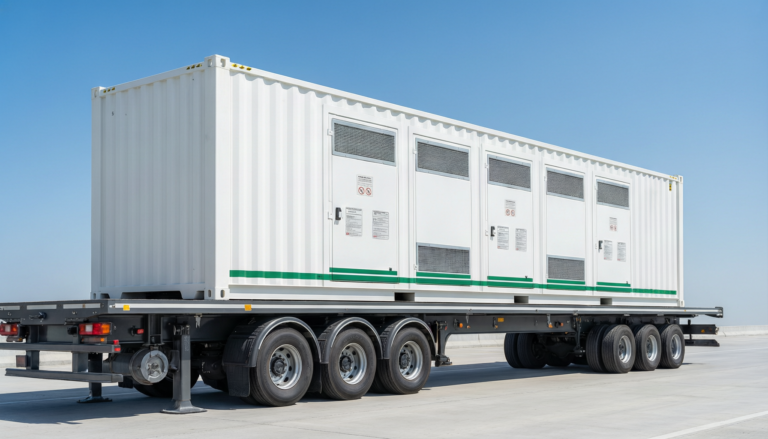
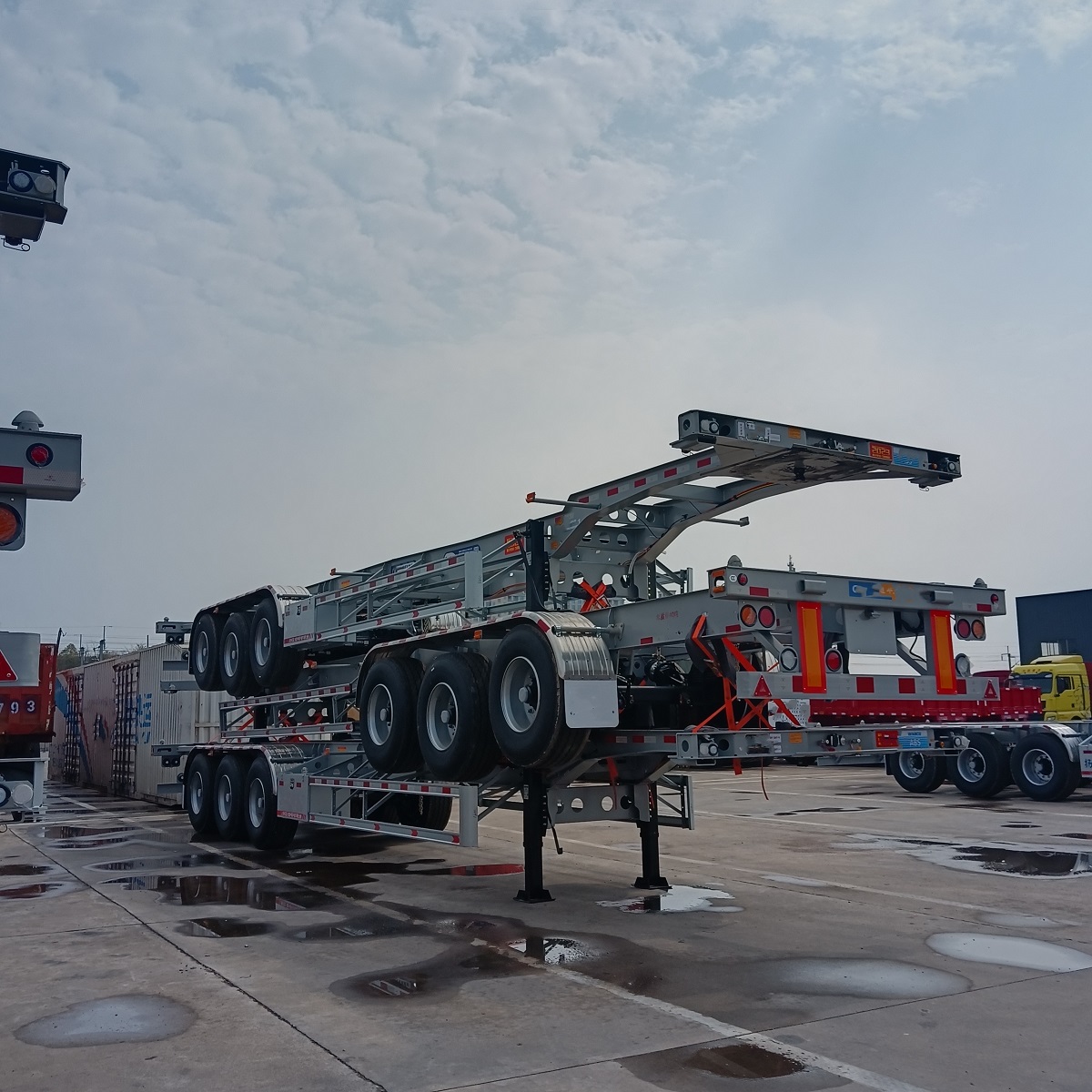
A skeleton semi trailer is a tractor-pulled platform with no floor and no box — just a reinforced steel main beam, a rear bogie, a goose-neck coupling at the front, and a set of twist locks that lock onto the four corners of an ISO container. The container itself becomes the “body” of the trailer for the journey.
The defining features:
- Open-frame design — 40–60% lighter than a flatbed or dry van, which means you can legally carry heavier containers before hitting road-weight limits.
- Twist-lock corner fittings — at least 4 ISO-compliant locks (one per container corner); 12-lock versions handle 20ft mid-chassis + 40ft combos.
- Gooseneck or straight-nose front — straight-nose is the classic chassis look; gooseneck drops the deck height so you can run a 40ft container inside a 4.0 m European height limit or feed a 53ft domestic USA box.
- Standard landing gear — single-speed JOST or Fuwa landing gear at the rear for uncoupled yard moves.
The trailer exists because containers move so much freight. Maersk’s annual reports regularly cite over 240 million TEU in global container trade for 2024–25, and even a small inland haul of 5,000 TEU per year justifies a dedicated chassis rather than renting pool equipment at the port.
You need a skeleton chassis if you’re:
- Moving containers between port and inland CFS / warehouse / rail terminal
- Running a B2B trucking arm of a freight forwarder
- Building a fleet for a country’s hinterland containerization programme
- Servicing an ISO-tank, reefer or open-top container requirement that a flatbed can’t fix-lock
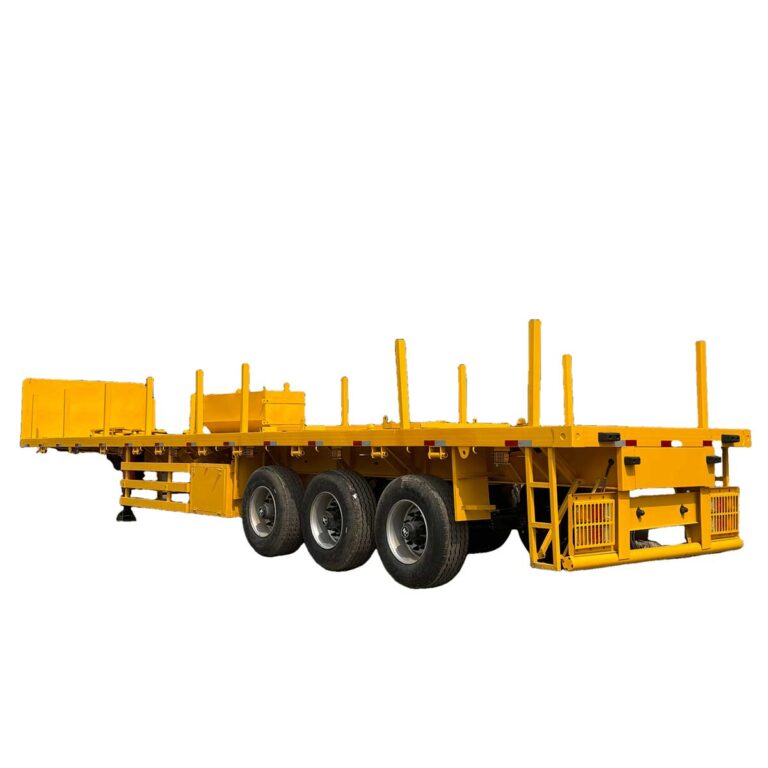
If you only haul loose cargo, break-bulk or palletized goods, you’re better off with a flatbed semi trailer or a box trailer. The skeleton chassis is a specialist tool, and it pays back only when paired with steady container volume.
🚛 Get Your Skeleton Semi Trailer Quote Today
Tell us your container size, payload target and destination port. You’ll get a custom spec sheet and FOB price within 24 hours.
💬 WhatsApp: +86 15315477956
📋 Online Inquiry Form
📱 WeChat: +86 15315477956
Types of Skeleton Semi Trailer — Which One Fits Your Business?
Not all container chassis are interchangeable. Choosing the wrong type costs you either payload, container compatibility, or highway compliance. Here are the five variants that Chinese factories actually build at scale.
1. 20ft Skeleton Semi Trailer (Single Container Chassis)
The simplest configuration: outer frame length matched to a single 20ft ISO container. Typical outline length 7,450 mm, tare weight around 3,200 kg, payload rating 30–32 tonnes. Used heavily in Asia for short-haul port drayage where the truck returns empty.
Typical buyer: small Philippine, Vietnamese and Indonesian trucking companies servicing 1–2 port terminals.
2. 40ft Skeleton Semi Trailer (Standard Container Chassis)
The workhorse. Around 12,400 mm long, tare 3,800–4,200 kg, payload 32–36 tonnes depending on axle count and axle rating. Comes in tandem-axle (2×13T) or tri-axle (3×13T / 3×16T) configurations. This is the dominant SKUs Chinese factories ship — 60–70% of skeleton semi trailer export volume is 40ft tandem.
Typical buyer: Nigerian, Kenyan, Saudi, and Mexican fleet operators moving 40HC to inland depots.
3. 40ft / 20ft Combo Chassis (Telescopic or Front-Extension)
An extended frame that lets you haul either a single 40ft container OR a single 20ft box. Extra length is achieved by an extendable rear section or front pull-out. Adds 300–600 kg tare weight but eliminates the need to buy two trailers for a mixed fleet. Common in Europe (90% of EU chassis are combo) and increasingly requested in African markets.
Typical buyer: mixed-load European operators, large African forwarders, Saudi Arabia Dammam-port fleets.
4. 45ft Skeleton Semi Trailer (High-Cube & Domestic Box)
Around 13,700 mm length, designed for 45ft domestic containers (USA & Canada) and 40ft high-cube loads where the extra cube matters. Requires careful attention to road-length regulation — at 13.7 m, some ASEAN markets cap it at 12.5 m. Usually tri-axle for the higher payload.
Typical buyer: US-Canada cross-border operators, Saudi Arabia domestic 45ft reefer movers.
5. Drop-Deck / Lowbed Skeleton (Gooseneck Type)
The gooseneck (or “drop-deck”) skeleton drops the deck height by 250–400 mm versus a straight-nose chassis. Critical for moving 40HC containers where European height laws (4.0 m) or US state laws cap total vehicle height. Adds fabrication cost (more welding, the gooseneck bend) but allows lawful passage for 9’6″ high boxes.
Typical buyer: European intermodal operators, Saudi importers of high-cube reefer, US West Coast drayage fleets.
🚛 Get Your Skeleton Semi Trailer Quote Today
Tell us your container size, payload target and destination port. You’ll get a custom spec sheet and FOB price within 24 hours.
💬 WhatsApp: +86 15315477956
📋 Online Inquiry Form
📱 WeChat: +86 15315477956
Key Specifications & What to Look For
Two skeleton semi trailers at the same nominal size can differ by 1,500 kg in tare weight and a full 5 tonnes in payload. Spec for spec, here’s what actually matters on a buyer’s checklist.
Main Beam & Frame
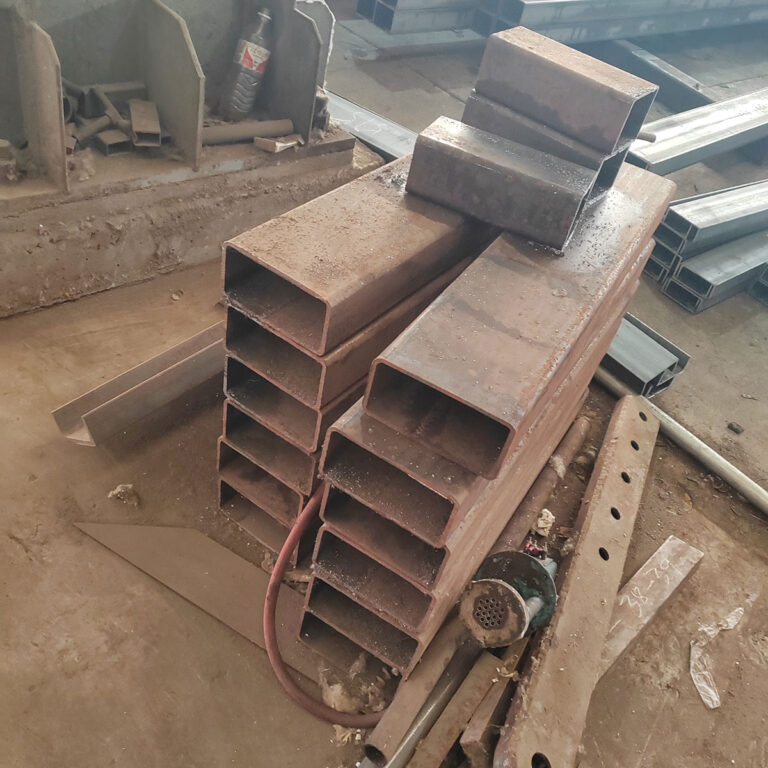
- Material: Q345B high-strength steel (Chinese GB standard) or ASTM A572 Gr.50 equivalent. Avoid Q235A — it’s mild steel and 25–30% weaker.
- Welding: Submerged-arc welded main beam, not manual stick welds. Look for two-sided symmetric welding seams.
- Beam height: 500 mm standard, 550 mm for tri-axle 60T+ payload rating.
Axles & Suspension
- Axle brand: BPW, FUWA, SAF, or local Chinese — BPW and FUWA dominate export orders.
- Axle count & rating: 2×13T tandem for 40ft standard; 3×13T or 3×16T for 40ft tri-axle or 60T+ rated use.
- Suspension: Mechanical leaf spring (cheaper, 90% of export orders) or air ride (mandatory for USA & Canadian carriers, premium for fragile cargo like lithium batteries).
- ABS: Mandatory for EU, Australia, Gulf. Optional elsewhere but worth the $400–600 upgrade.
Twist Locks & Container Compatibility
- Standard 4 twist locks (one per corner) handles 1×20, 1×40, 1×45, 1×40HC.
- 12-lock combo chassis adds 8 extra locks to handle two 20ft boxes loaded simultaneously.
- All locks should be JOST, BOST or equivalently rated for 18T per lock minimum.
King Pin, Landing Gear & Tyres
- King pin: 2″ (50 mm) JOST 2″ bolted-type, rated 16T. 3.5″ also available for USA spec.
- Landing gear: JOST or Fuwa single-speed, 28T static load. Dual-speed available for frequent uncoupled yard moves.
- Tyres: 11R22.5 or 12R22.5 tubeless, 6 tyres on tri-axle / 4 tyres on tandem. Steel or aluminium rims.
Spec Comparison Table — 4 Skeleton Variants
| Variant | Outer Length | Tare Weight | Payload | Axle Config | Typical Buyer |
|---|---|---|---|---|---|
| 20ft Single | 7,450 mm | 3,200 kg | 30 t | 2 × 13T tandem | Asia drayage fleets |
| 40ft Standard | 12,400 mm | 4,000 kg | 32–36 t | 2 × 13T or 3 × 13T | Africa / Middle East |
| 40+20ft Combo | 12,800–14,200 mm | 4,300 kg | 36–40 t | 3 × 13T tri-axle | Mixed-load fleets |
| 45ft High-Cube | 13,720 mm | 4,600 kg | 36 t | 3 × 13T tri-axle | USA / Canada / Saudi |
| Gooseneck Drop | 12,200 mm | 4,800 kg | 36 t | 3 × 13T air ride | EU intermodal |
Common practice in Asian and African markets: pair a 40ft tandem skeleton chassis (2×13T) for general freight with a separate 40ft tri-axle for ISO-tank or 30T+ heavy containers. If your operation is exclusively reefer or ISO-tank, ask the factory about thicker twist-lock reinforcement — the additional corner load of a 30T tank needs it.
Price Guide — Skeleton Semi Trailer Costs from China (2026)
Pricing for a 2026 skeleton semi trailer shipped FOB from a Shandong port typically runs in the band below. Prices are based on direct factory quotations collected in Q3 2026; assume ±5% variance depending on raw-steel index, axles brand, and order quantity.
FOB China Price Table (2026) — Skeleton Semi Trailer
| Trailer Type | Base Spec | FOB Price (USD) | Notes |
|---|---|---|---|
| 20ft Skeleton | 2×13T BPW / leaf spring | $5,400 – $6,800 | Most affordable SKU; drayage fleets |
| 40ft Skeleton (Standard) | 2×13T BPW / leaf spring | $7,200 – $9,000 | Top-volume export; ~60% of orders |
| 40ft Tri-Axle Skeleton | 3×13T BPW / leaf spring | $9,500 – $11,800 | Heavy-cargo, ISO-tank, 30T+ payload |
| 40+20ft Combo (12-lock) | 3×13T BPW / leaf spring | $11,200 – $14,500 | EU / multi-cargo fleets |
| 45ft Skeleton | 3×13T BPW / leaf spring | $12,000 – $14,800 | USA / Canada / Saudi reefer |
| Gooseneck Drop-Deck | 3×13T BPW / air ride | $13,500 – $17,000 | EU intermodal / high-cube 4.0m limit |
For full landed-cost sense, add to the FOB price:
- Sea freight (40ft chassis ro-ro or 40HQ container): $1,400 – $2,800 to West Africa, $900 – $1,800 to Southeast Asia, $2,800 – $4,200 to South America per unit (2026 CCFI-indexed rates).
- Destination import duty: 0–5% in GCC, 5–20% in EU, 10–35% across most African markets, often 0% under AGOA for eligible US-bound chassis.
- Inspection & certification: $300 – $1,200 for BV / SGS pre-shipment, plus any local homologation.
So a Nigeria-bound 40ft tandem chassis typically lands in Lagos for $9,800 – $12,500 all-in, and a Saudi-bound tri-axle lands in Jeddah for $11,500 – $14,500. Order 5+ units and freight-per-unit drops roughly 20% because the chassis ro-ro can stack three units.
What Pushes the Price Up
- BPW / SAF axles (+$1,400 vs Chinese local axles per axle)
- Air-ride suspension (+$2,200 vs mechanical leaf)
- ABS / EBS + brake chambers upgrade (+$400 – $700)
- Galvanised / zinc-rich primer + marine-grade paint (+$600 – $1,200, mandatory for humid climates)
- Drop-deck gooseneck frame work (+$1,800 – $3,000)
How to Buy a Skeleton Semi Trailer from China — 6-Step Checklist
Buying any trailer from overseas carries risk, but a container chassis is a relatively straightforward SKU to source from China — the market is mature, the engineering is standardised, and the supply chain is robust. Follow this six-step checklist.
Step 1 — Lock down your operation profile
Before you call a factory, write down: container sizes you’ll carry (20 / 40 / 45 / 40HC), max loaded weight per trip, axle weight limit on your road network, total annual container moves, and the destination country’s chassis homologation rules (EU type approval, SASO for Saudi, SONCAP for Nigeria, etc.). Skipping this step is the #1 reason buyers end up with the wrong chassis.
Step 2 — Shortlist 3 factories and request identical quotes
Send each shortlisted factory the same spec sheet (axles, suspension, twist-lock count, paint system, tyre brand, king-pin). Don’t accept “send me a quote, I’ll customize” — the comparison only works when you compare line-by-line. Reputable suppliers respond within 24 hours with itemized PDF quotations and CAD drawings.
Step 3 — Verify the factory, not the sales agent
Ask for: factory business license (verify on 国家企业信用信息公示系统), export licence, ISO 9001 certificate, and a recent factory video walkthrough. Search the supplier’s name in Canton Fair records. If the contact is a small trading company based in a residential building, you’ve probably reached a re-trader — that’s fine for small orders but expect 8–15% margin stacked on top.
Step 4 — Demand a 3rd party pre-shipment inspection (PSI)
For orders of 3+ units, book a Bureau Veritas (BV), SGS, or TUV inspection at the factory once painting is complete. Cost is $300 – $500 per inspection day and catches dimensional, paint, and component-level defects before shipping. Skipping this converts warranty claims into expensive cross-border lawsuits.
Step 5 — Negotiate Incoterms and freight
FOB Qingdao / FOB Shanghai is the standard for chassis export. CIF is fine but compare the freight mark-up against a spot quote from a freight forwarder of your own. CFR with a Letter of Credit (LC) at sight is the safest payment instrument for first-time buyers. For established relationships, 30% T/T deposit + 70% balance against BL copy is normal.
Step 6 — Plan for registration on arrival
In most African and Latin American markets, registration requires a Certificate of Conformity (COC), bill of lading, commercial invoice, packing list, and sometimes a homologation certificate. Line this up before the chassis arrives — port storage fees run $50–$150 per day and stacks up fast if paperwork is incomplete.
🚛 Get Your Skeleton Semi Trailer Quote Today
Tell us your container size, payload target and destination port. You’ll get a custom spec sheet and FOB price within 24 hours.
💬 WhatsApp: +86 15315477956
📋 Online Inquiry Form
📱 WeChat: +86 15315477956
Frequently Asked Questions
1. What’s the average price of a 40ft skeleton semi trailer from China in 2026?
For 2026 FOB Qingdao, a 40ft tandem skeleton chassis with BPW axles and mechanical leaf suspension runs $7,200 – $9,000 USD. Step up to a 40ft tri-axle configuration and the price moves into the $9,500 – $11,800 band. Add $1,400 – $2,800 per unit for sea freight to West Africa, Southeast Asia or South America.
2. Can a single chassis carry both 20ft and 40ft containers?
Yes, if it is built as a 12-lock combo chassis (also called a 20/40 combo). The frame is extended rear-ward with a sliding sub-section so the twist locks can be re-positioned to anchor either one 40ft box OR one 20ft box. Roughly 18–22% of EU intermodal chassis orders are combo type. Adding combo capability raises the chassis price by approximately $1,800 – $3,500 per unit.
3. What’s the difference between a skeleton chassis and a flatbed trailer?
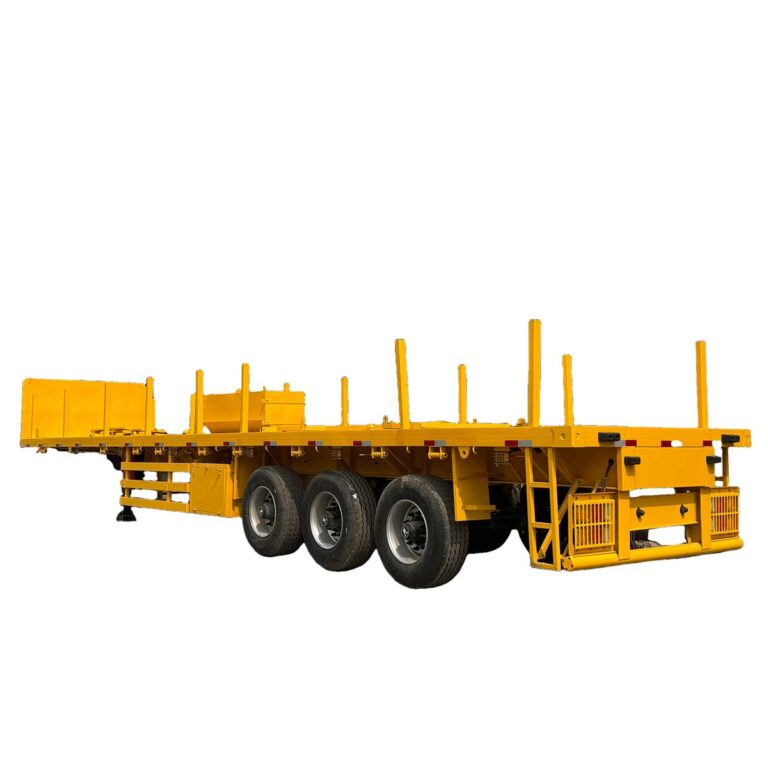
A flatbed is a continuous deck for any cargo; a skeleton chassis has no deck at all and uses ISO twist locks to fix a container directly to the frame. Skeleton chassis are 40–60% lighter (3.8 t vs 6.5 t for a comparable 40ft flatbed), which means higher legal payload for a given road weight limit. The trade-off: a skeleton chassis only carries ISO containers, while a flatbed is more versatile.
4. Do you ship skeleton semi trailers to my country?
Nanou Trailer exports to 40+ countries, including most of West Africa (Nigeria, Ghana, Senegal, Côte d’Ivoire), East Africa (Kenya, Tanzania, Mozambique), the GCC (Saudi Arabia, UAE, Qatar, Oman, Kuwait), Southeast Asia (Philippines, Indonesia, Malaysia, Vietnam), and Latin America (Chile, Peru, Bolivia, Dominican Republic). Common export documents we prepare: commercial invoice, packing list, bill of lading, certificate of origin (Form E / Form A / Form F depending on destination), and COC for SONCAP, GCC, and PVOC markets.
5. How long is the lead time for a 10-unit skeleton trailer order?
For a 10-unit order of standard 40ft tandem chassis with BPW axles and mechanical suspension, production lead time is 25–30 working days from deposit receipt, plus 5 days for final inspection + 18–35 days sea freight depending on destination. A pre-built stock order (if your spec matches in-factory inventory) can ship in 7 days, but specific options like air-ride gooseneck extend production to 35–40 working days.
6. What axles should I choose — BPW, FUWA, or Chinese local?
BPW (Germany) is the gold standard globally, with the strongest resale value in EU and US markets. FUWA (China) is the second most common brand and 30–40% cheaper; FUWA axles are sufficient for African and Asian operations. Chinese local axles (no-name brands) save another 15–25% but use lower-grade steel in the spindle and brake components — they work for lower-frequency operations, but maintenance intervals are 30–40% shorter. For 60T+ tri-axle use, BPW or SAF is strongly recommended.
7. Do I need ABS / EBS brakes to operate in my country?
ABS is mandatory in EU, Australia, Gulf (SASO / GSO), and most of Latin America (Argentina, Brazil). In African markets, SONCAP and PVOC increasingly require ABS as well. For air-ride chassis serving EU customers, EBS (electronic brake system) is required by ECE R13. Budget $400 – $700 per chassis for ABS, $1,500 – $2,200 for EBS.
Why Choose Nanou Trailer?
We’ve been building trailers in Shandong since 2008. The 32,000 m² facility runs 6 production lines, a single-shift output of 15 chassis per day, and serves 40+ export markets. Three things that distinguish us from the average trading company:
- Direct factory pricing, no middleman. You talk to our export sales team and our engineers; we don’t re-trade from a third-party factory. Most of our 2025 customers in Nigeria, Saudi Arabia and the Philippines saved 12–18% on landed cost versus working through a Guangzhou trading agent.
- Verified component brands. Every BPW, FUWA, JOST, WABCO part on our chassis is shipped in original factory packaging with serial numbers registered in our name. We don’t substitute “BPW-equivalent” unmarked parts, and we show you the component certificates before shipping.
- In-house quality gate, end-to-end. From raw steel incoming inspection to submerged-arc welding (UT-tested every batch) to dynamic axle-load testing at the staging yard, every chassis goes through 6 documented QC checkpoints. Pre-shipment BV / SGS inspections are welcome; we coordinate with the inspector at no extra cost.
- English, Spanish, French, Arabic-speaking engineers answer technical questions directly. No more “I’ll relay that to the factory” loops.
If you’re sourcing for a fleet, ask for our 2026 export catalog with FOB prices, axle options and load certification data.
🚛 Talk Directly to a Skeleton Trailer Engineer
From single-unit orders to 50-trailer fleet deals — we ship skeleton chassis to 40+ countries, including Southeast Asia, Africa, the Middle East and South America.
💬 WhatsApp: +86 15315477956
📋 Request Full Catalog
📱 WeChat: +86 15315477956
Related Articles & Resources
- Browse our full Skeleton Semi Trailer product line (10 chassis configs in stock)
- See flagship specs: Skeleton Semi Trailer (40ft tandem) and Skeleton Semi Trailer (40ft heavy-duty)
- For 20ft containers: Container Skeleton Semitrailer chassis with ISO twist locks
- Need to move containers and bulk cargo? See our Flatbed Semi Trailers
- Moving high-cube reefer or ISO tanks? Our Lowbed Semi Trailers handle the heavy-stuff category
- Full pricing reference: Semi Trailer Price Guide 2026 — Real Costs & China Supplier Breakdown
This article is maintained by Nanou Trailer’s export engineering team. Last reviewed: August 2026. Specs and prices reflect factory output in Qingdao / Liangshan industrial clusters during Q3 2026; verify with our sales team for current quotes.