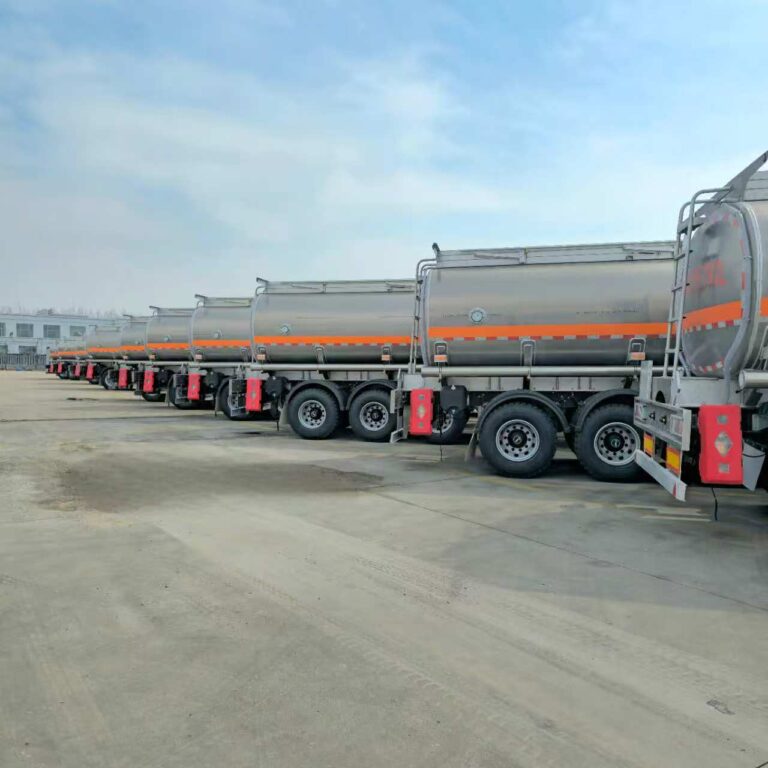


How to Choose a Tank Truck: Rigid Truck vs Tank Semi Trailer Compared (2026)
Two fuel distributors in the same city order tankers from the same factory and end up with opposite results. The first buys a 20,000-litre rigid tank truck, runs four drops a day inside a dense urban ring, and keeps the vehicle busy nine hours out of ten. The second buys the same rigid truck for inter-city diesel runs and discovers that 60% of his cost is now driver wages and fuel burned moving a heavy truck chassis that carries only 15 tonnes.
The lesson is not that one design is better. It is that tank truck configuration follows route structure, not budget. This guide works through that decision the way a fleet engineer would: mass limits first, then architecture, then the barrel itself, then price.
📋 What This Guide Covers
Most buyers start by comparing litres, which is the wrong starting point. This guide compares a rigid tank truck against a tank semi trailer on the numbers that decide profitability: legal payload after density, cost per litre of capacity, driver cost per delivery, and turning radius. You get a seven-factor comparison table, a tank-material selection table, the spec sheet to demand before signing, 2026 FOB price ranges for eight configurations, and a six-step import checklist.
What Is a Tank Truck — and Where Does “Tank Trailer” Fit?
A tank truck is any road vehicle built to carry bulk liquid, powder, or liquefied gas in a fixed vessel rather than in packages. The vessel is the expensive part, but the chassis under it decides how much of the payload you are legally allowed to keep. Three architectures exist, and export contracts mix the names constantly.
Rigid tank truck
The barrel is mounted on a truck chassis — 4×2, 6×4, or 8×4 — with cab, engine, and drive axles integrated. Capacities run from 5,000 to 25,000 litres. Because chassis, cab, and engine are paid for once per vehicle, cost per litre of capacity is high, but one driver, one registration, and one insurance policy cover it.
Tank semi trailer
The barrel sits on its own frame with a kingpin, pulled by a separate tractor. A three-axle unit commonly runs 40 to 45 m³, and the tractor is freed for other work the moment the trailer is dropped. This is the architecture behind almost every long-haul fuel and chemical movement in Africa, the Middle East, Central Asia, and Latin America.
Tank full trailer (drawbar)
A barrel on its own axles towed behind a rigid truck. Capacity is 10–20 m³ and reversing is poor — a niche option, not a fleet strategy.
When a quotation says “tank truck” for a 40 m³ unit, confirm whether it is a complete rigid vehicle or a semi trailer. The price difference is roughly double, and the shipping method is completely different.
When Do You Actually Need a Rigid Tank Truck?
Rigid units win in five specific situations. If two or more apply to you, price a rigid truck first:
- Urban and last-mile delivery. A 6×4 rigid with a 20,000-litre barrel turns in roughly 17 m; a tractor-trailer needs 21 to 23 m. In dense city centres, that four metres decides whether your driver enters the site at all.
- Volumes under 15,000 litres per day. Below that threshold the fixed cost of a tractor cannot be recovered — 12,000 litres in a 40 m³ trailer means running a 33-tonne vehicle at 30% fill.
- Mine, quarry, and plantation refuelling. Bowsers must reach equipment where no tractor can reverse. Rigid 4×4 and 6×6 tankers with PTO pumps are the standard answer.
- Water and municipal service. Dust suppression and street washing rarely justify a tractor unit, and the barrel is usually mild steel rather than stainless.
- Single-vehicle operators. One driver, one workshop, one spare-parts inventory.
Rigid vs Tank Semi Trailer: 7 Factors That Decide It
The table below compares a typical 6×4 rigid tank truck against a three-axle tank semi trailer with a 6×4 tractor, using 2026 China FOB figures.
| Factor | Rigid 6×4, 20,000 L | 3-axle tank semi trailer, 40 m³ |
|---|---|---|
| Usable payload (diesel, 0.84 kg/L) | 15.5–16.5 t | 29–32 t (subject to 6-axle GVW) |
| Capital cost, FOB China | USD 32,000–45,000 | USD 17,500–27,000 (trailer only) |
| Cost per litre of capacity | USD 1.60–2.25 | USD 0.44–0.68 |
| Driver cost per 40,000 L delivered | Two trips, two drivers or double hours | One trip, one driver |
| Turning radius | Approx. 17 m | Approx. 21–23 m |
| Fleet flexibility | Fixed — barrel cannot be detached | Tractor free for flatbed, tipper, or container work |
| Fuel burn per litre delivered | Higher — heavy chassis moved on every drop | Lower on trunk routes, higher in city centres |
One number needs explaining, because it is the specification error we correct most often: the 40,000-litre problem. Diesel at 0.84 kg/L means a full 40 m³ barrel holds 33.6 tonnes. Add an 8-tonne trailer tare and a 9-tonne 6×4 tractor and the combination is 50.6 tonnes — well above the 40-tonne gross limit applied across most of Africa, the Middle East, and Southeast Asia. Practical legal fill on a 40 m³ trailer is 26,000 to 30,000 litres. Buy the larger barrel for geometry and stability, then fill to the plate — never let a supplier quote you “40,000 litres of payload”.
Tank Body Materials: Match the Barrel to the Cargo
The shell material is where cheap quotations quietly cut corners. Ask for the grade and plate thickness in writing, then check it during inspection.
| Material | Best for | Typical shell | Notes |
|---|---|---|---|
| Q235B / Q345 carbon steel | Diesel, petrol, lubricants, water | 5–6 mm | Lowest cost; internal epoxy coating recommended for petrol and water |
| 304 stainless steel | Edible oil, potable water, mild chemicals | 4–5 mm | No coating needed; must be passivated after welding |
| 316L stainless steel | Acids, alkalis, food-grade and pharma liquids | 4–5 mm | Molybdenum content resists chloride attack; specify pickled welds |
| Aluminium 5083 | Fuel where weight matters | 6 mm | 30–35% lighter barrel than steel, roughly 40% higher cost; needs aluminium-safe fittings |
| Q370R / Q345R pressure steel | LPG, propane, ammonia, CO₂ | 10–14 mm | Design pressure 1.77 MPa, dished ends, full radiography of welds |
| Carbon steel, V or W section | Cement, fly ash, lime powder, PVC powder | 5 mm | Fluidising air pads and 0.2 MPa working pressure; a different machine from a liquid tanker |
Two material rules matter more than the price difference. Never put food-grade product in a barrel that has carried fuel — coating and weld profile make it impossible to certify. And stainless is not automatically right for chemicals: 316L resists chlorides, but concentrated acids still need a lined carbon steel or a specialised alloy. Send the cargo name, concentration, and temperature; the material follows from that, not from the budget.
Key Specifications to Check Before You Sign
A tanker quotation that lists only capacity and axle count is not a specification. These are the parameters that change what the vehicle can legally and physically do:
| المعلمة | Common fuel tanker | Chemical tanker | Why it matters |
|---|---|---|---|
| Compartments | 2–4 | 3–6 | Each compartment must match your typical drop size; a 4-compartment 40 m³ gives 10 m³ drops |
| Baffle spacing | Every 1.5–2.0 m | Every 1.5 m | Controls surge loading on the tractor and stability on curves |
| Ullage (expansion space) | 5% minimum | 5–8% | Filling to 100% risks overflow and hydraulic shock as product warms |
| Discharge system | Self-priming pump, 500–1,000 L/min, PTO driven | Pump or gravity, with drip tray | Determines unloading time per drop and driver overtime |
| Loading | Top manhole 500 mm or bottom API adaptor | Top, with vapour return | Terminals increasingly require bottom loading and vapour recovery |
| Earthing | Static reel plus grounding strap | Same, mandatory | Non-negotiable for flammable product; check it is wired, not decorative |
| Axles and brakes | 13 t or 16 t, BPW / FUWA, WABCO ABS or EBS | Same | Axle rating must cover legal load plus 20% margin |
| Test pressure | 0.2 MPa pneumatic or hydrostatic test | 0.3 MPa plus weld inspection | Ask for the signed test report, not a verbal assurance |
The most expensive mistake we see is compartment count chosen by price. A buyer orders three compartments to save USD 600, then finds his main customer takes 8,000-litre drops — every delivery strands product in a compartment and wastes the meter run. Work backwards from the delivery ticket, not from the tank.
🚛 Get Your Tank Semi Trailer Quote Today
Tell us your cargo, route, and country. You’ll get a custom spec sheet and FOB price within 24 hours.
💬 WhatsApp: +86 15315477956📋 Online Inquiry Form
📱 WeChat: +86 15315477956
Tank Truck Price Guide 2026 — FOB China Costs
The ranges below are FOB Qingdao/Tianjin for standard configurations with BPW or FUWA axles, WABCO brake valves, and a Chinese-brand discharge pump. Branded meters, imported pumps, and ADR documentation add to the top of each range.
| Configuration | Capacity | FOB price (USD) |
|---|---|---|
| Rigid 6×4 tank truck, carbon steel | 20,000 L | 32,000–45,000 |
| Rigid 6×4 tank truck, aluminium | 20,000 L | 40,000–52,000 |
| Tank semi trailer, 2 axles, carbon steel | 30 m³ | 14,500–19,000 |
| Tank semi trailer, 3 axles, carbon steel | 40 m³ | 17,500–27,000 |
| Tank semi trailer, 3 axles, aluminium | 40 m³ | 26,000–36,000 |
| Chemical tanker, 316L stainless, insulated | 30 m³ | 34,000–48,000 |
| Bulk powder tanker, V section with compressor | 40 m³ | 22,000–30,000 |
| LPG pressure tanker, 1.77 MPa | 56 m³ | 24,000–42,000 |
Add 8–12% for freight to West Africa, 5–9% to the Gulf, and expect USD 2,500–4,000 per unit for RORO booking on a 12 m trailer. A tanker is not a container-friendly cargo: most units ship by RORO or break-bulk, which is why booking six to eight weeks ahead changes the freight quote more than any negotiation with the factory.
How to Buy a Tank Truck from China — 6-Step Checklist
1. Write the route down before the specification. Cargo, density, daily litres, longest leg, largest single drop, and your national gross weight limit. One page. Every later decision flows from those six numbers, and a supplier who does not ask for them is quoting blind.
2. Confirm the certification your authority accepts. Pressure equipment may need ASME or DOT stamping; fuel transport may need ADR/UN compliance. Destination markets add their own marks — SONCAP for Nigeria, KEBS for Kenya, SASO for Saudi Arabia, EAC for East Africa. Ask which certificate the customs broker will request at the port, not which one the factory prefers to show.
3. Demand the tank drawing, not just photographs. Shell and head thickness, baffle positions, compartment volumes, valve layout, weld procedure. A manufacturer sends this in 48 hours; a trading company sends another photo.
4. Specify components by brand and model. Axle, suspension, brake valve, pump, meter, manhole cover. “Chinese good quality” is not a specification. A branded meter adds about USD 1,200 and pays for itself in avoided custody disputes.
5. Inspect and test before shipment. Hydrostatic or pneumatic test report, weld inspection record, and a meter calibration certificate. Ask for video of the discharge test with a stopwatch on screen — pump flow claims are otherwise unverifiable.
6. Fix after-sales terms in the contract. A spare-parts kit (seals, valves, lamp units), what the warranty covers, and who supplies drawings if a local workshop repairs the barrel. Tankers live 12 to 15 years; the first repair decides whether that is true for yours.
Frequently Asked Questions
Is a tank truck the same as a tank trailer?
No. A tank truck is a complete rigid vehicle with the barrel on its own chassis, cab, and engine. A tank trailer has no engine or cab and needs a separate tractor. Export quotations mix the terms constantly, so confirm which one is priced: for equal capacity a rigid vehicle costs roughly twice a semi trailer, because you are also buying the chassis and driveline.
How many litres can a 3-axle tank semi trailer legally carry?
Geometric volume is typically 40 to 45 m³, but legal payload is set by gross weight. With diesel at 0.84 kg/L and a 40-tonne limit for a six-axle combination, practical fill is 26,000 to 30,000 litres; markets allowing 44 to 48 tonnes get closer to 33,000. Never size the barrel to the figure you hope to carry, and check axle limits on the specific routes you will run.
Can one tanker carry both diesel and petrol?
Yes, if built for it: multiple compartments, baffles, and a barrel rated for both. What you cannot do is switch between incompatible cargoes without documented cleaning and certification — many authorities require a cleaning certificate before the next load. Order compartments around your real delivery mix rather than assuming flexibility later.
What is the difference between gravity discharge and pump discharge?
Gravity discharge uses a bottom valve and elevation, needs no power, and is slow — fine for terminals with a receiving pump. Pump discharge uses a PTO-driven self-priming pump at 500 to 1,000 L/min, emptying a 30,000-litre load in 30 to 60 minutes. If your customers are mines, farms, or construction sites, specify a pump; if every drop goes to a terminal, gravity saves weight and maintenance.
Do I need ADR or ASME certification?
It depends on cargo and destination. ADR applies to dangerous goods in countries that adopt the agreement; ASME or DOT stamping applies to pressure vessels such as LPG and ammonia. Many African and Middle Eastern markets accept a UN-certified vessel with a manufacturer test report plus local type approval. Confirm with your broker before ordering — retrofitting certification to a finished tanker is expensive and sometimes impossible.
How long does production and shipping take?
Standard carbon steel fuel tankers take 20 to 30 days from deposit; stainless chemical and LPG units take 35 to 50 days because of weld inspection and pressure testing. Add inland transport, 7 to 10 days of China customs clearance, and 20 to 45 days of ocean freight. Plan 10 to 14 weeks port to port, and reserve RORO space as soon as the production schedule is fixed.
Why Choose Nanou Trailer?
Barrels built to a drawing, not to a price. We manufacture in Shandong with Q345R, 304/316L stainless, and 5083 aluminium plate, and we send the tank drawing — shell thickness, baffle spacing, compartment volumes — before production starts, so you approve engineering, not a brochure.
Pressure and powder experience, not just fuel. Our line covers liquid fuel, chemical, edible oil, bulk cement and fly ash, and LPG pressure vessels to 1.77 MPa, with radiography and hydrostatic test reports supplied per unit.
Export paperwork that clears. Tankers shipped to more than 40 countries, with certificates, packing lists, and RORO or break-bulk bookings handled in-house. We tell you which certificate your port will ask for before you pay a deposit.
One engineer from quote to delivery. A named contact who answers axle ratings, compartment maths, and discharge rates directly — not a sales inbox that forwards everything.
🚛 Get Your Tank Semi Trailer Quote Today
Tell us your cargo, route, and country. You’ll get a custom spec sheet and FOB price within 24 hours.
💬 WhatsApp: +86 15315477956📋 Online Inquiry Form
📱 WeChat: +86 15315477956
Related Articles
- Tank Trailer for Sale: Types, Specs & Prices from China Manufacturer — the seven tanker types compared
- How to Choose a Fuel Oil Tanker Trailer: Complete Buyer’s Guide — barrel materials and compartment setup
- LPG Tank Trailer for Sale: Types, Specs & Prices — pressure vessel configurations
- Semi Trailer Price Guide 2026: Landed Costs & Negotiation
- How to Import a Semi Trailer from China: Complete Guide
- Ordinary Liquid Tank Truck — Product Page
- Stainless Steel & Aluminium Alloy Tanker — Product Page
- Powder Tank Car — Product Page
- Liquefied Gas Tank Truck — Product Page
- Tank Trucks & Tank Trailers — Full Category
- Dump Semi Trailers — Full Category