

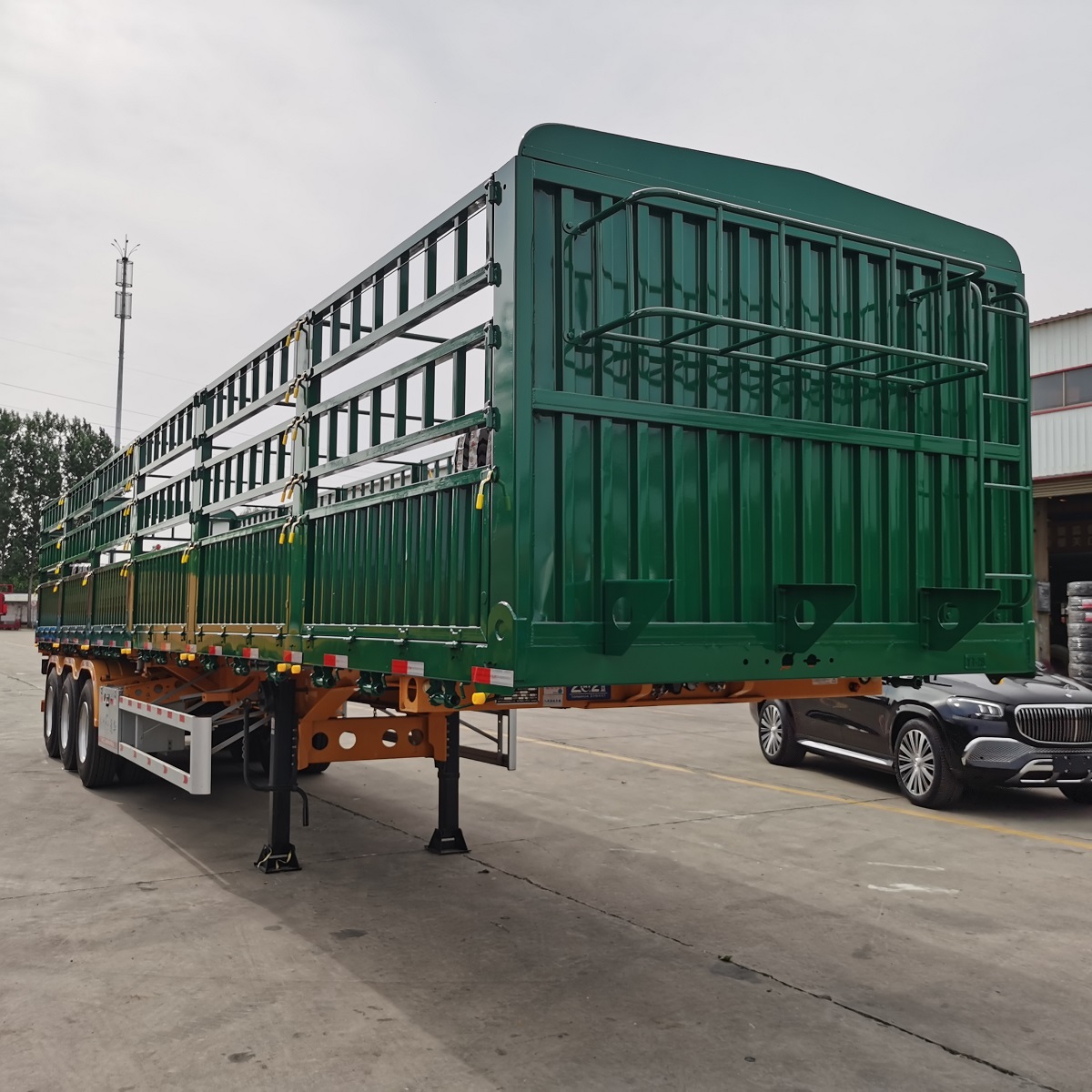
How to Choose a Livestock Semi Trailer: Complete Buyer’s Guide (2026)
📜 Summary: What This Guide Covers
Moving cattle, sheep, or goats over long distances kills profits fast when the trailer is wrong — bruised animals, dead-on-arrival losses, and fines at checkpoints all trace back to deck design, ventilation, and ramp angle. This guide walks you through the four livestock trailer configurations Chinese factories build, the floor and side-panel materials that survive African and Middle East road conditions, real 2026 FOB prices from Qingdao, and a 6-step import checklist. By the end you will know exactly which spec sheet to ask your supplier for — and which line items to push back on.
A livestock semi trailer — sometimes listed as a cattle transport semi trailer, stake livestock trailer, or two-tier animal transport trailer — is a purpose-built trailer with slatted sides, non-slip flooring, and loading ramps designed to move live animals safely over highway distances. Get the configuration wrong and you pay for it every single trip: animals lose weight from stress, arrive bruised, or die in transit. A well-specced trailer does the opposite — it loads faster, keeps animals standing, and delivers them in sellable condition.
Buyers in Nigeria, Mali, Chad, Kenya, Sudan, and Saudi Arabia ask us the same questions every month: single deck or double? Steel or bamboo flooring? How many cattle actually fit on 12.5 meters? This guide answers those questions with real numbers, then gives you the import checklist our repeat buyers follow.
What Is a Livestock Semi Trailer — and When Do You Need One?
A livestock semi trailer is built around three requirements that a standard flatbed or fence trailer does not meet: containment (animals must not slip under or jump the side walls), ventilation (heat buildup on a 1,000 km trip causes weight loss and death), and safe loading (cattle will not walk up a ramp steeper than about 20 degrees, and they panic on slippery floors).
You need a dedicated livestock trailer when:
- Long-haul cattle routes. In West Africa and East Africa, ranch-to-market trips regularly run 800–1,500 km. On those distances, an open stake bed with no flooring protection loses 5–8% of animal value to bruising and weight loss.
- Sheep and goat aggregation for export. Middle East live sheep trade (Saudi Arabia, UAE, Oman) moves animals in high-density batches — double-deck trailers roughly double animals per trip.
- Regular farm-to-feedlot shuttles. Even 200–300 km trips benefit from divided pens: mixing unfamiliar bull groups in one open space leads to injuries that show up as carcass downgrades.
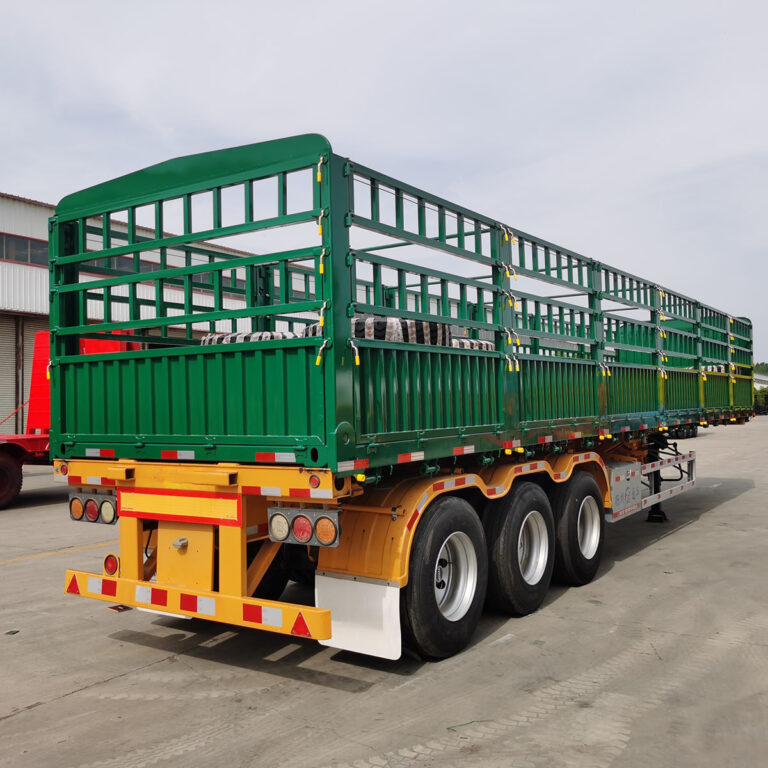
A standard fence semi trailer can move animals on short, slow trips. But it has no ramp, no upper deck option, no anti-slip floor, and side gaps that hooves catch in. If livestock is your core business, the dedicated trailer pays for itself within the first season.
Types of Livestock Trailers — Which One Fits Your Operation?
Chinese factories build livestock semi trailers in four main configurations. The right one depends on your animal mix and herd size per trip.
1. Single-Deck Stake Livestock Trailer (12–13 m, 3 axles)
The workhorse for cattle. A reinforced floor, 1.6–1.8 m high slatted side walls, internal pen dividers, and a rear hydraulic or spring-assisted ramp. A 12.5 m single-deck unit carries roughly 28–35 head of large cattle (400–550 kg each) or 90–110 sheep and goats. Simplest structure, lowest price, easiest maintenance in remote areas — this is what most African cattle haulers start with.
2. Fixed Double-Deck Livestock Trailer (two-tier, 3 axles)
A fixed upper deck creates two levels, each with about 1.6–1.8 m of headroom. Built mainly for sheep, goats, and calves: a 13 m double-deck unit carries 180–220 head of sheep or 45–55 calves per trip. For large adult cattle, the upper deck is usually omitted or kept folded — big bulls need full height. Best choice when your volume is high-density small stock.
3. Hydraulic Two-Tier Lifting Deck Trailer
The upper deck is hydraulically raised or lowered, so you can load large cattle on a full-height main deck, then split into two tiers for small stock. This flexibility matters if your fleet serves mixed demand — cattle one month, sheep the next. It adds roughly $4,000–6,000 over a fixed double-deck and one hydraulic system to maintain, but many Saudi-bound and Ethiopian-route operators consider it standard equipment.
4. Heavy-Duty Reinforced Version for Rough Routes
For unpaved ranch roads and seasonal tracks (common in Chad, Mali, southern Sudan), we build livestock trailers with raised ground clearance, 4 axles, reinforced main beams, and heavier crossmembers. Tare weight goes up about 1.5–2 tons, but frame cracks — the number one failure on rough-route trailers — drop dramatically.
Key Specifications & What to Look For
When you compare quotes, these are the line items that separate a trailer that lasts 8 years from one that needs frame repairs in year two:
| Specification | Single-Deck Stake | Fixed Double-Deck | Hydraulic Two-Tier | Heavy-Duty 4-Axle |
|---|---|---|---|---|
| Deck length | 12–12.5 m | 13 m | 13 m | 12.5–13 m |
| Axles | 3 × 13T (FUWA/BPW) | 3 × 13T | 3 × 13T | 4 × 13T |
| Tare weight | 7.5–8.5 t | 9.5–11 t | 10.5–12 t | 11–13 t |
| Cattle capacity | 28–35 head | lower deck 25–30 head | 28–35 head (full height) | 30–38 head |
| Sheep/goat capacity | 90–110 head | 180–220 head | 170–200 head | 100–120 head |
| Floor options | Checkered steel plate / bamboo-wood laminate + rubber mat / full rubber | |||
| Side walls | 1.6–1.8 m galvanized slats, rounded edges, optional padding rails | |||
| Ramp | Rear hydraulic ramp (≤18°), optional side ramps, anti-slip treads | |||
| Suspension | Mechanical leaf spring standard; air suspension optional for livestock comfort | |||
Three details worth negotiating before you sign:
- Floor material. Checkered steel is cheapest but becomes a skating rink when wet. Our recommendation for cattle routes: bamboo-wood laminate deck with 3 mm rubber matting on top — animals keep their footing, hoof wear drops, and the floor itself is replaceable in sections.
- Internal pen dividers. Insist on sliding or removable gates every 2.5–3 m. Fixed pens force you to haul partially empty when batch sizes don’t match.
- Ventilation. Open slat sides handle most climates. For closed-side versions (needed in some Gulf permits), spec roof vents and side louvers — a sealed trailer in 40°C heat is a dead-loss trip.
Price Guide — Livestock Trailer Costs from China (2026)
FOB prices from Chinese factories (Qingdao port) as of 2026, based on 3 × 13T FUWA axles and mechanical suspension unless noted. Your final number moves with axle brand, floor package, and steel prices — quote ranges, not single points:
| Configuration | FOB Price (USD) | Best For |
|---|---|---|
| 2-axle single-deck, 10 m | $8,500 – $10,500 | Short shuttles, lighter road regimes |
| 3-axle single-deck, 12.5 m | $10,500 – $13,500 | Standard cattle haulage |
| 3-axle fixed double-deck, 13 m | $15,000 – $18,500 | Sheep/goat high-density routes |
| 3-axle hydraulic two-tier, 13 m | $19,000 – $24,000 | Mixed cattle + sheep operations |
| 4-axle heavy-duty reinforced | $16,000 – $20,000 | Unpaved ranch routes, overloads tolerated |
| Aluminum double-deck | $28,000 – $35,000 | Max payload per trip, coastal corrosion |
Budget add-ons beyond FOB: sea freight to West Africa runs roughly $3,000–4,500 for a 40 ft flat rack or ro-ro slot (verify current rates — they move monthly), import duty varies by country (ECOWAS common external tariff is typically 10–20% on trailers), and BPW axles add about $600–900 over FUWA per set. Most of our livestock customers order 2–5 units per shipment; at 3+ units the per-unit freight share drops noticeably.
🚚 Get Your Livestock Trailer Quote Today
Tell us your animals (cattle or sheep), herd size per trip, and your country. You’ll get a custom spec sheet and FOB price within 24 hours.
💬 WhatsApp: +86 15315477956
📋 Online Inquiry Form
📱 WeChat: +86 15315477956
How to Buy a Livestock Trailer from China — 6-Step Checklist
This is the sequence our repeat buyers in Nigeria, Kenya, and Saudi Arabia follow. Skipping steps 2 and 4 is where first-time importers lose money.
Step 1: Define Your Animal Profile and Route
Write down: species, average animal weight, herd size per trip, paved vs unpaved share of the route, and maximum legal gross weight in your country. A trailer built for 35 cattle on tarmac is wrong for 200 sheep on laterite roads — same factory, completely different spec sheet.
Step 2: Get Spec Sheets, Not Just Prices
Ask each supplier for: floor construction (layers and materials), side wall height and slat spacing, ramp angle, pen divider design, axle and suspension brands, and tare weight. Two quotes can differ by $3,000 and the cheaper one is missing the rubber floor, the dividers, and the hydraulic ramp. Compare spec sheets line by line.
Step 3: Confirm Customization in Writing
Common customizations we handle: raised clearance for rough roads, wider side doors for mechanical loading, water tank mounts, shade roof for hot climates, and your company livery. Get drawings attached to the proforma invoice — verbal agreements about deck height cause the most disputes.
Step 4: Verify the Factory
Request a live video factory tour, ask for the production line photos of your actual order, and check business license and export history. If your order exceeds $20,000, a third-party inspection (SGS, TÜV, or a local agent) before shipment costs $300–500 and catches welding and material shortcuts while they’re still fixable.
Step 5: Agree on Payment and Delivery Terms
Standard terms: 30% deposit, 70% balance against copy of B/L. Lead time is typically 20–30 working days for livestock trailers. Decide FOB vs CIF explicitly — first-time importers often underestimate ro-ro and flat-rack freight for tall, wide units.
Step 6: Prepare Port Clearance and Roadworthiness
Before the ship sails, have your clearing agent confirm: customs HS code (8716.39 covers most livestock trailers), duty rate, and any pre-shipment inspection requirements (for example, SONCAP for Nigeria, PVoC for Kenya). Ask us for the packing list and invoice formats your agent needs — we export to 40+ countries and can match your market’s document set.
Frequently Asked Questions
How many cattle fit on a 3-axle livestock semi trailer?
On a 12.5 m single-deck trailer, plan on 28–35 head of large cattle (400–550 kg each) — roughly 0.35 m² per 100 kg of animal is the density rule most welfare guidelines use. If you carry mixed batches, sliding pen dividers let you adjust compartment sizes per trip. For sheep and goats, the same deck carries 90–110 head; a double-deck version doubles that to 180–220.
Is a double-deck livestock trailer worth the extra cost?
If your main cargo is sheep, goats, or calves — yes, almost always. Doubling animals per trip cuts your cost per head by roughly 35–45% versus running two single-deck trips, which pays back the $4,500–8,000 price premium within a few months on active routes. If your core cargo is adult cattle, a fixed double-deck rarely earns its keep because the upper deck sits empty; a hydraulic two-tier is the better premium option in that case.
Which floor and side materials survive African road conditions best?
Bamboo-wood laminate flooring with replaceable rubber matting outlasts plain checkered steel on long hauls — animals don’t slip, and you can swap worn mat sections instead of rewelding a steel deck. For sides, hot-dip galvanized or powder-coated slats with rounded edges resist the corrosion that painted carbon steel suffers within 12–18 months in humid coastal regions. On unpaved routes, also spec reinforced crossmembers — frame fatigue, not the floor, is what usually ends a cheap trailer’s life.
What documents come with the trailer for customs clearance?
Standard export set: commercial invoice, packing list, bill of lading, certificate of origin, and the trailer’s technical specifications sheet. For markets with mandatory conformity programs — SONCAP (Nigeria), PVoC (Kenya), SASO (Saudi Arabia) — we either ship with the required certificate or coordinate the pre-shipment inspection before loading. Tell us your destination port when requesting the quote and we’ll confirm the exact document list.
How long is the production lead time?
Standard-configuration livestock trailers take 20–30 working days from deposit to ex-factory. Units with hydraulic two-tier decks, custom dimensions, or special paint add 5–10 days. Sea freight from Qingdao adds 25–40 days to West African ports (Tema, Lagos, Dakar) and 18–30 days to Middle East ports (Jeddah, Jebel Ali). For fleet replacement planning, budget about 2 months door-to-port total.
Can the trailer be customized for my country’s road laws?
Yes — that’s most of what we do. Common adjustments: overall height limits (some markets cap at 4 m), kingpin height, side wall height, axle count for per-axle weight laws, lighting and reflector configurations, and license plate brackets. Send us your country’s dimension and weight limits when you inquire and we’ll build to them rather than to Chinese defaults.
Why Choose Nanou Trailer?
- 40+ export countries, livestock routes included. We ship semi trailers to Africa, the Middle East, Southeast Asia, and South America — and we know the difference between a spec for Saudi sheep trade and a spec for Sahel cattle routes.
- Factory-direct pricing with real customization. As a Shandong-based manufacturer, every livestock trailer is built to your animal profile, route, and road law — not pulled from a shelf. Typical lead time 20–30 working days.
- Component brands you can service locally. FUWA or BPW axles, JOST landing gear, WABCO orstandard valves — parts for these are stocked by dealers in Lagos, Nairobi, Dubai, and Cairo, so downtime stays measured in days, not months.
- Support after the ship sails. Spare parts kits with every order, English technical documentation, and a team that answers on WhatsApp within hours — the same number you’ll use for warranty questions a year later.
🚚 Ready to Move Cattle More Efficiently?
Send us your route, road conditions, and herd size. We’ll recommend the right deck configuration and quote FOB + CIF to your port within 24 hours.
💬 WhatsApp: +86 15315477956
📋 Online Inquiry Form
📱 WeChat: +86 15315477956
Related Articles & Products
- Livestock Semi Trailer Category Page — browse our animal transport trailer lineup
- Barn Transport Semi-Trailer — our multi-purpose livestock and cargo unit with slatted sides
- Fence Semi Trailer Category — stake-side trailers for mixed cargo and short livestock trips
- Semi Trailer Price Guide 2026: Real Costs, Specs & China Supplier Breakdown
- Tank Trailer for Sale: Types, Specs & Prices from China Manufacturer (2026)
- Skeleton Semi Trailer for Sale: Types, Specs & Prices from China Manufacturer (2026)