

How to Choose a Bulk Cement Trailer: Complete Buyer’s Guide (2026)
📌 Quick Summary: This guide walks through everything a fleet manager or procurement officer needs to know before buying a bulk cement trailer from China — including tank types (V-type vs. W-type), material options (carbon steel vs. aluminum alloy), discharge system specs, 2026 FOB price ranges ($22,000–$55,000), axle configurations, and a practical 6-step import checklist. By the end, you’ll know exactly which spec sheet to request from a factory and how to avoid common specification mistakes that cost buyers thousands in wasted cement discharge capacity.
What Is a Bulk Cement Trailer and When Do You Need One?
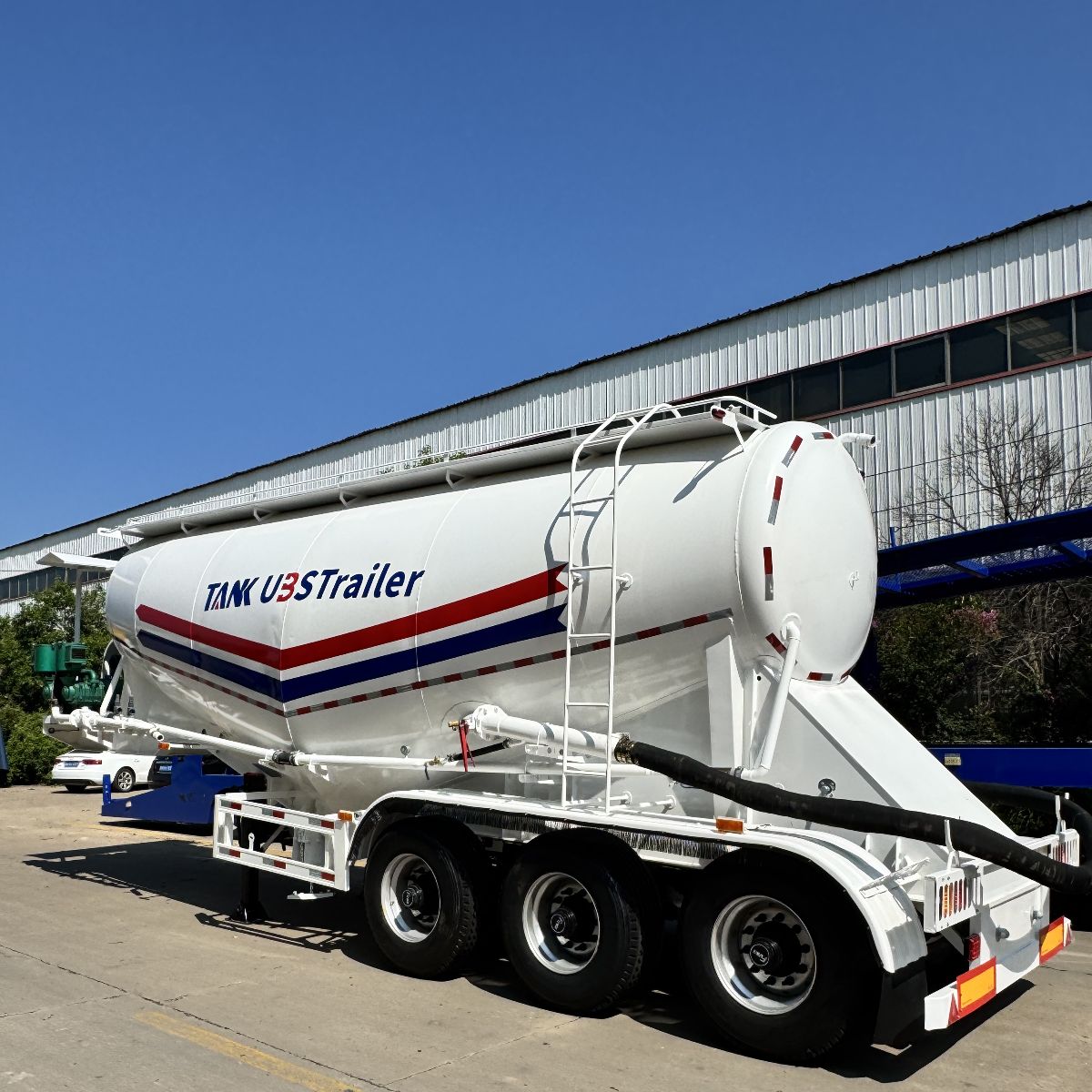
A bulk cement trailer — also called a powder tanker, cement bulker, or pneumatic dry bulk trailer — is a specialized semi-trailer designed to transport dry powder materials in sealed tanks using compressed air for both loading and discharge. Unlike liquid tankers, these trailers carry non-liquid, free-flowing powders that would otherwise require bagged transport at 5–10× the per-ton shipping cost.
If your operation involves any of these, a bulk cement trailer is the right equipment:
- Cement and concrete supply chains — transporting OPC, PPC, or slag cement from terminals to batching plants
- Construction and infrastructure projects — especially remote sites where bagged cement logistics break down
- Power plant fly ash transport — moving pulverized fly ash (PFA) from coal-fired or biomass plants to cement blending facilities
- Mining and mineral processing — carrying lime powder, talc, barite, bentonite, or mineral powder
- Flour and food-grade powder logistics — using stainless steel variants for flour, starch, or sugar
The working principle is straightforward: a diesel-powered air compressor (typically 10–12 m³/min, 0.2 MPa) pressurizes the tank, fluidizing the powder through a porous air slide at the bottom. The material then flows through discharge pipes at a rate of 1.0–1.5 tons per minute into a receiving silo — no bagging, no forklifts, no manual handling. A well-designed bulk cement trailer achieves a residual rate below 0.3%, meaning nearly all material is discharged in a single cycle.
Types of Bulk Cement Trailers — Which One Fits Your Operation?
Not all bulk cement trailers are built the same way. The tank design, material, and discharge system directly determine what you can carry, how fast you can discharge, and what you’ll pay. Here’s how to narrow it down.
1. Tank Shape: V-Type vs. W-Type (Horizontal)
V-type (single-cone) trailers have a single inclined cone inside the tank. They’re lighter and cheaper, with typical capacities of 28–40 m³. Best for operations that move a single material type on regular routes — for instance, a cement terminal supplying a fixed batching plant. The trade-off: discharge efficiency drops slightly with finer powders like fly ash.
W-type (double-cone / horizontal) trailers split the tank into two inclined sections, creating a wider fluidized bed area. This improves discharge speed and reduces residual material, making them the preferred choice for multi-stop deliveries and varied powder types. Capacities range from 40–60 m³, with the 55 m³ configuration being the most common 3-axle model on the market.
As a rule of thumb: if you haul one material on a fixed route, a V-type saves you $3,000–$5,000 on the purchase price. If you handle mixed loads or make multiple stops per trip, the W-type pays back the premium within 8–12 months through faster turnaround. You can compare both configurations on our powder tanker category page.
2. Tank Material: Carbon Steel vs. Aluminum Alloy
Carbon steel (Q345/Q235B) tanks are the workhorse of cement logistics. They handle abrasive powders like cement and fly ash without excessive wear, and replacement parts are cheap. A 3-axle, 45 m³ carbon steel trailer typically weighs 14,500–16,000 kg, leaving 24–26 tons of payload under standard regulations.
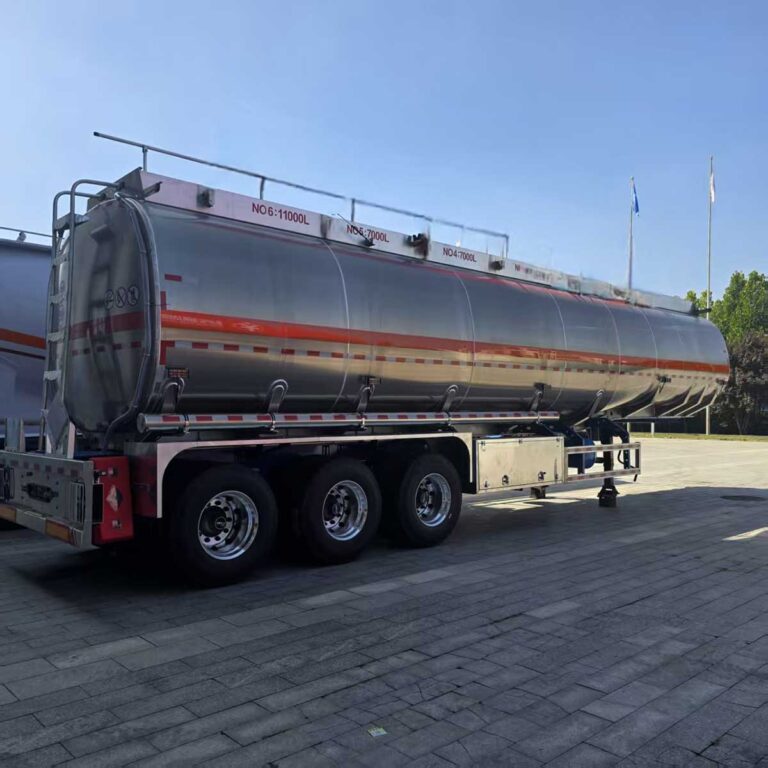
Aluminum alloy (5A06/5083) tanks reduce empty weight by 2,000–3,500 kg — that’s one to two extra tons of payload per trip. For high-volume operators running 200+ days a year, the payload gain translates to 200���600 additional tons annually. The catch: aluminum costs 40–60% more upfront and is more sensitive to impact damage during loading dock operations. You can see our aluminum alloy bulk powder tanker here for a typical 3-axle configuration.
Stainless steel (304/316L) is reserved for food-grade powders (flour, sugar, starch) or chemically reactive materials. Expect to pay 50–80% more than carbon steel.
3. Discharge System: External Compressor vs. Onboard Compressor
Most Chinese-built bulk cement trailers come with an onboard diesel compressor mounted on the trailer frame — usually a 10–12 m³/min unit running at 0.2 MPa working pressure. This makes the trailer self-contained: it can discharge anywhere with a receiving silo and a standard pipe connection, no external air supply needed.
Some lighter-weight models skip the onboard compressor to save 800–1,000 kg. These require the receiving site to supply compressed air through a fixed pipeline. If your delivery points all have fixed air systems (like established batching plants), this configuration saves both weight and maintenance. If you deliver to remote construction sites, always choose the onboard compressor.
Key Specifications & What to Look For
When requesting a quote from a Chinese manufacturer, these are the seven specification points that determine whether the trailer fits your operation. Don’t accept a quote that doesn’t address every one of them.
| Specification | Light-Duty (2-Axle) | Standard (3-Axle) | Heavy-Duty (3-Axle) |
|---|---|---|---|
| Capacity | 28–35 m³ | 40–50 m³ | 55–60 m³ |
| Tank Material | Carbon Steel Q345 | Carbon Steel / Aluminum | Aluminum 5A06 |
| Empty Weight | ~12,500 kg | 14,500–16,000 kg (CS) 12,000–13,500 kg (AL) | ~14,000 kg (AL) |
| Discharge Rate | 1.0–1.2 t/min | 1.2–1.5 t/min | 1.4–1.6 t/min |
| Residual Rate | ≤0.3% | ≤0.3% | ≤0.3% |
| Working Pressure | 0.2 MPa | 0.2 MPa | 0.2 MPa |
| Compressor | Diesel, 9 m³/min | Diesel, 10–12 m³/min | Diesel, 12 m³/min |
| Tyres | 12R22.5 × 8 | 12R22.5 / 315/80R22.5 × 12 | 315/80R22.5 × 12 |
Two details that buyers often overlook: the number of discharge pipes (2-pipe vs. 4-pipe systems — the latter allows simultaneous discharge into two silos, halving turnaround time at multi-silo terminals) and the air slide material (woven polyester vs. sintered metal — sintered lasts 3–5× longer but costs more upfront). Ask your manufacturer about both.
Price Guide — Bulk Cement Trailer Costs from China (2026)
FOB prices from Chinese manufacturers vary based on tank material, capacity, axle brand, and whether the onboard compressor is included. Below are real-world 2026 price ranges based on current Chinese factory quotes and steel market conditions (Q345 structural steel index at approximately 4,300 RMB/ton, USD/CNY at ~7.18).
| Configuration | Capacity | Axles | FOB Price (USD) |
|---|---|---|---|
| Carbon Steel V-Type | 30 m³ | 2 × FUWA 13T | $22,000–$26,000 |
| Carbon Steel W-Type | 45 m³ | 3 × FUWA 13T | $28,000–$34,000 |
| Aluminum Alloy W-Type | 45 m³ | 3 × FUWA 13T | $38,000–$46,000 |
| Aluminum Alloy W-Type | 55 m³ | 3 × BPW 13T | $45,000–$55,000 |
| Stainless Steel 304 | 40 m³ | 3 × FUWA 13T | $55,000–$65,000 |
What’s included in the FOB price: complete trailer with tank, chassis, axles, tyres, suspension system, brake system (WABCO/EBS), onboard diesel compressor, discharge pipes, safety valves, and standard lighting. What’s not included: sea freight, import duties, pre-shipment inspection (BV/SGS), and destination port charges. For a 3-axle carbon steel model shipped to Mombasa (Kenya), landed cost typically adds $3,500–$5,000 to the FOB price. For Lagos (Nigeria), add $4,000–$5,500. See our complete powder tanker category for available configurations.
🚛 Get Your Bulk Cement Trailer Quote Today
Tell us your cargo type, route, and country. You’ll get a custom spec sheet and FOB price within 24 hours.
💬 WhatsApp: +86 15315477956
📋 Online Inquiry Form
📱 WeChat: +86 15315477956
How to Buy a Bulk Cement Trailer from China — 6-Step Checklist
The buying process from a Chinese manufacturer follows a predictable path. Here’s what to do at each step — and what to watch out for.
Step 1: Define Your Material and Route Profile
Before contacting any factory, write down: (a) the exact material you’ll transport (cement grade, fly ash, lime, flour — the density and abrasiveness differ); (b) your typical route distance and road conditions; (c) the receiving site’s discharge setup (silo height, pipe diameter, whether external air is available). This prevents the factory from selling you a generic spec that doesn’t match your operation.
Step 2: Request a Detailed Spec Sheet
Ask for a written specification sheet covering tank dimensions, material grade, axle brand and capacity, tyre size, compressor specs, number of discharge pipes, and residual rate guarantee. Compare at least two factories. Don’t compare on price alone — a $3,000 saving on a trailer with a 9 m³/min compressor instead of 12 m³/min costs you 5–8 minutes per discharge cycle, which compounds across hundreds of trips.
Step 3: Verify Certifications and Standards
For markets that require homologation — EAC (Russia/CIS), GCC (Gulf), SABS (South Africa), or BV/SGS pre-shipment inspection — confirm the factory has experience producing to that standard and can provide the required documentation. Most established Chinese tanker factories hold ISO 9001 and ADR (for hazardous materials) certifications as a baseline.
Step 4: Negotiate Price and Payment Terms
Standard payment terms are 30% T/T deposit with 70% balance against bill of lading. For first-time buyers, consider adding an SGS or BV pre-shipment inspection (cost: $300–$600) to verify the trailer meets spec before final payment. Factories typically include free options like custom paint color, your company logo, and 2–4 spare tyres — ask for these rather than assuming they’re extra.
Step 5: Arrange Shipping and Insurance
For a single trailer, RoRo (roll-on/roll-off) is usually cheaper than container shipping — expect $2,500–$4,500 for Africa-bound routes and $3,000–$5,000 for South America. Bulk cement trailers are oversized (12–13.5 m length), so confirm the shipping line accepts your dimensions. All-risk marine insurance runs 0.3–0.5% of the cargo value. Your factory can handle booking, or you can use your own freight forwarder.
Step 6: Register and Commission Locally
Once the trailer arrives, you’ll need local vehicle registration, which varies by country. In most African and Middle Eastern markets, the EAC or GCC certificate from the factory satisfies registration requirements. Before the first loaded trip, test the discharge system with an empty or lightly loaded run to verify the compressor and air slide function correctly — this catches any shipping-related damage before you’re stuck at a customer’s silo with 45 tons of cement that won’t discharge.
Frequently Asked Questions
What’s the typical lifespan of a bulk cement trailer?
With regular maintenance, a carbon steel bulk cement trailer lasts 10–15 years in moderate-duty service. The main wear components are the air slide (replace every 3–5 years, $400–$800), the compressor (rebuild at 8,000–10,000 hours), and the discharge valves ($150–$300 each). Aluminum trailers can exceed 15 years but are more prone to impact damage during loading dock operations if drivers aren’t careful.
Can one trailer carry different powder materials?
Yes, but with caveats. A carbon steel trailer can carry cement, fly ash, lime, talc, and mineral powder interchangeably — just purge the tank with compressed air between loads. However, switching between abrasive cement and food-grade flour requires a dedicated stainless steel tank. Cross-contamination between non-food powders is minimal if you purge thoroughly, but some materials (like bentonite) leave residue that affects subsequent cement loads’ flow characteristics. Dedicated trailers per material type are recommended for operators running mixed fleets.
How much does sea freight cost for a bulk cement trailer?
For a standard 3-axle, 12.5-meter trailer shipped from Qingdao or Shanghai: to West Africa (Lagos/Tema) $3,500–$5,000; to East Africa (Mombasa/Dar es Salaam) $2,800–$4,200; to Middle East (Jebel Ali/Jeddah) $2,000–$3,500; to South America (Callao/Guayaquil) $4,500–$6,500. Prices fluctuate with the Drewry container and bulk freight index — always get a current quote from your freight forwarder before committing to a delivery date.
What’s the difference between FUWA and BPW axles?
FUWA is the leading Chinese axle brand — widely available, competitively priced, and sufficient for most cement transport operations. BPW (German-engineered, manufactured in China) offers longer service intervals (500,000 km vs. 300,000 km for FUWA) and smoother bearing performance under heavy continuous loads. For operators running 200+ days/year on rough roads, BPW’s lower maintenance cost justifies the $2,000–$3,000 per-trailer premium. For seasonal or moderate-duty operators, FUWA is the more cost-effective choice. Our 3-axle bulk cement powder tanker is available with either axle brand.
Do I need a special license or permit to operate a bulk cement trailer?
The trailer itself doesn’t require a special operating license beyond standard commercial vehicle registration. However, if you’re transporting hazardous powder materials (such as certain chemical powders, activated carbon, or combustible dusts), you may need ADR certification (Europe), HMR compliance (US), or equivalent hazmat permits in your jurisdiction. Ordinary cement, fly ash, and construction powders don’t trigger hazmat requirements in most countries.
What’s the discharge pipe height and how do I match it to my silo?
Standard discharge pipe height on Chinese bulk cement trailers is 4.5–5.0 meters from ground level, with a horizontal reach of 3–5 meters. Most cement receiving silos are designed with inlet ports at 5–8 meters, so the trailer’s discharge pipe connects via a flexible hose. If your silo inlet is above 8 meters, you’ll need a booster compressor at the silo base to push material upward — confirm this during the spec phase so the factory can recommend the right discharge pipe configuration. Our powder and granular material tanker offers customizable discharge pipe layouts.
Why Choose Nanou Trailer for Your Cement Transport Needs?
Nanou Trailer (Shandong Nanou Trailer Manufacturing Co., Ltd.) has been producing bulk cement trailers since 2004, with over 3,200 units delivered across 40+ countries. Here’s what sets our powder tanker lineup apart:
- Welding quality that survives rough roads: Our tanks use submerged arc welding for the main body seams (not manual MIG), with 100% X-ray inspection on critical welds. This matters because cement trailer failures almost always start at the longitudinal seam — a failure on the road means a full cement load spilled and a trailer out of service for weeks.
- Factory-direct pricing without middlemen: You deal directly with our engineering and sales team in Shandong. No trading company markup — the price you see is the factory price, and you can visit the production line at any time. Typical savings versus trading-company quotes: $3,000–$8,000 per unit.
- Custom configurations for your route and material: Every cement market is different. We build trailers to your spec — tank capacity from 28 m³ to 60 m³, 2 or 3 axles, carbon steel or aluminum, FUWA or BPW, with or without onboard compressor. Browse our powder tank car and other models for examples.
- Export documentation handled in-house: We handle EAC, GCC, BV, SGS, and SONCAP certification documentation as part of the order — no need to hire a separate compliance consultant. This shaves 2–4 weeks off your delivery timeline.
We also produce the full range of tank trailers — see our complete tank truck category for fuel tankers, LPG carriers, and chemical tankers built to the same welding and inspection standards.
🚛 Ready to Get Your Bulk Cement Trailer?
Send us your material type, preferred capacity, and destination port. We’ll prepare a custom spec sheet with FOB pricing within 24 hours.
💬 WhatsApp: +86 15315477956
📋 Online Inquiry Form
📱 WeChat: +86 15315477956