

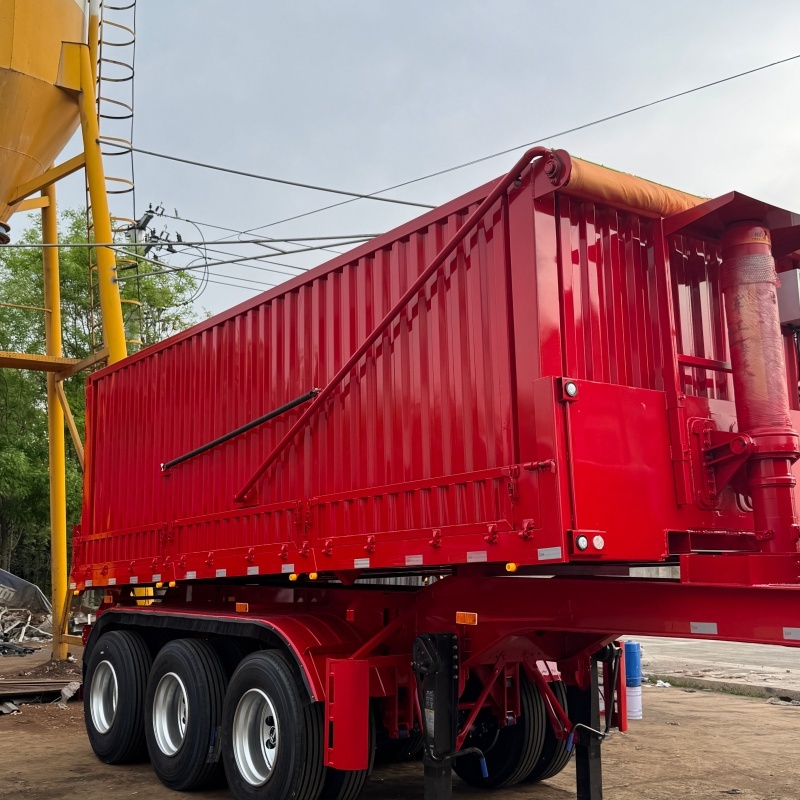
Disadvantages of Rear Flip Semi Trailers
Based on your previous concerns about the selection of rear flip semi trailers and the requirements for bulk material transportation scenarios, the core drawbacks of this type of vehicle are concentrated in three dimensions: operational limitations, maintenance costs, and compliance risks, as follows:
1、 Strict restrictions on homework scenarios
The site requirements are extremely high: when unloading, it must be parked on a completely flat and solid ground. Lifting on slopes or soft mud is prone to safety accidents such as center of gravity shifting and overturning, and lifting operations cannot be completed in narrow spaces.
There are multiple loading constraints: the goods must be evenly distributed in front, back, left, and right directions. Loading too far ahead will directly crush the hydraulic system, while loading too far back will cause the vehicle to tilt during unloading. The standardization requirements for loading operations are much higher than those for ordinary flatbed semi trailers.
High risk of lifting status: After lifting, the center of gravity of the carriage moves significantly upward. If there are people or obstacles around and they are not avoided in a timely manner, it is highly likely to cause collision, tilting and injury accidents.
2、 High maintenance cost of hydraulic system
The system failure rate is relatively high: the oil pump, oil pipe, and seals of the hydraulic lifting system are high-frequency loss components, and long-term heavy load operations are prone to failures such as weak lifting, self falling, and oil pipe bursting.
The mandatory maintenance cycle is short: the high-pressure oil pipe must be replaced every 2 years, the new car needs to replace the hydraulic oil and clean the oil tank after 300 lifts, and the oil cylinder needs to be lubricated every 120 lifts. The daily maintenance frequency is much higher than that of ordinary semi trailers.
Low operational fault tolerance: The engine speed should not exceed 1500 revolutions per minute during lifting, and the cylinder should not be exposed to humid air for more than 30 minutes after lifting. Violation of regulations can directly cause cylinder corrosion and system failure.
3、 Compliance and Limitations of Use
Capacity limitation: Due to domestic weight limit standards, the cargo compartment height of compliant rear flip semi trailers is generally low, and the loading capacity is smaller compared to side flip semi trailers, making it impossible to transport large volume goods such as light foam.
High risk of modification investigation: Many modified car models on the market that illegally increase the cargo compartment are easily identified as illegal modifications after being put on the road, and face penalties such as fines, deduction of points, and even car impoundment.
Weak driving stability: When the vehicle is lifted, it cannot be moved at all. If the cargo compartment is not fully retracted and locked during driving, it is very easy to scrape and collide with the height limit facilities, causing major traffic accidents.