

How to Choose a Flatbed Semi-Trailer: The Complete Buyer’s Guide (2026)
Nanou Trailer Technical Team · 9 min read · Updated June 2026
How to Choose a Flatbed Semi-Trailer: The Complete Buyer’s Guide (2026)
Quick Summary: Choosing the wrong flatbed semi-trailer costs you money in payload penalties, higher maintenance bills, and failed hauls. This guide covers every key decision — axle count, deck length, payload rating, material and price — so you buy exactly what your cargo needs, not what a salesperson pushes.
Whether you’re hauling construction steel in Nigeria, agricultural machinery in Brazil, or prefab modules across the Gulf, a flatbed semi-trailer is the most versatile heavy-transport tool in your fleet. But with deck lengths from 12 m to 17.5 m, axle counts from 2 to 5, and payload ratings from 30 to 80+ tonnes, one wrong spec can leave your trailer underloaded or overweight at every checkpoint.
At Nanou Trailer, we’ve manufactured and shipped flatbed, lowboy, and specialized semi-trailers to over 40 countries. This guide distills what we see buyers get right — and wrong — so you can make a confident purchasing decision.
1. What Is a Flatbed Semi-Trailer? (And When Is It the Right Choice)
A flatbed semi-trailer has an open, level loading deck with no sides or roof. This design gives it three critical advantages over other trailer types:
- Load from any direction — crane, forklift, or side-loader, no height restrictions
- Carry oversized cargo — steel coils, pipes, I-beams, generators, construction equipment
- Faster loading/unloading — no doors, no walls, no strapping inside a box
If your cargo is bagged goods, liquids, or anything that needs weather protection, a flatbed is the wrong tool — consider a tank trailer or curtainsider instead.
2. The 5 Types of Flatbed Semi-Trailers — Which Do You Need?
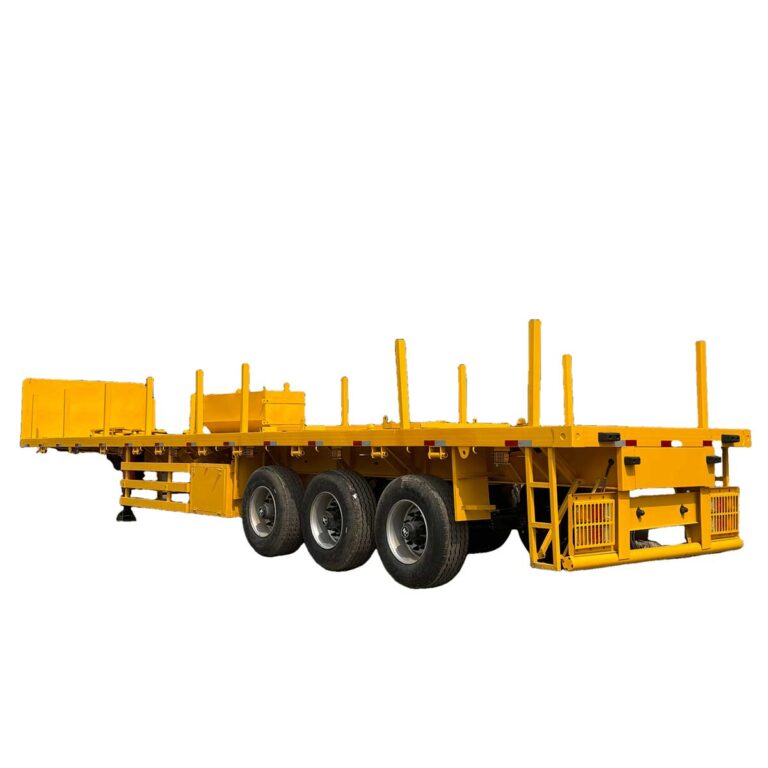
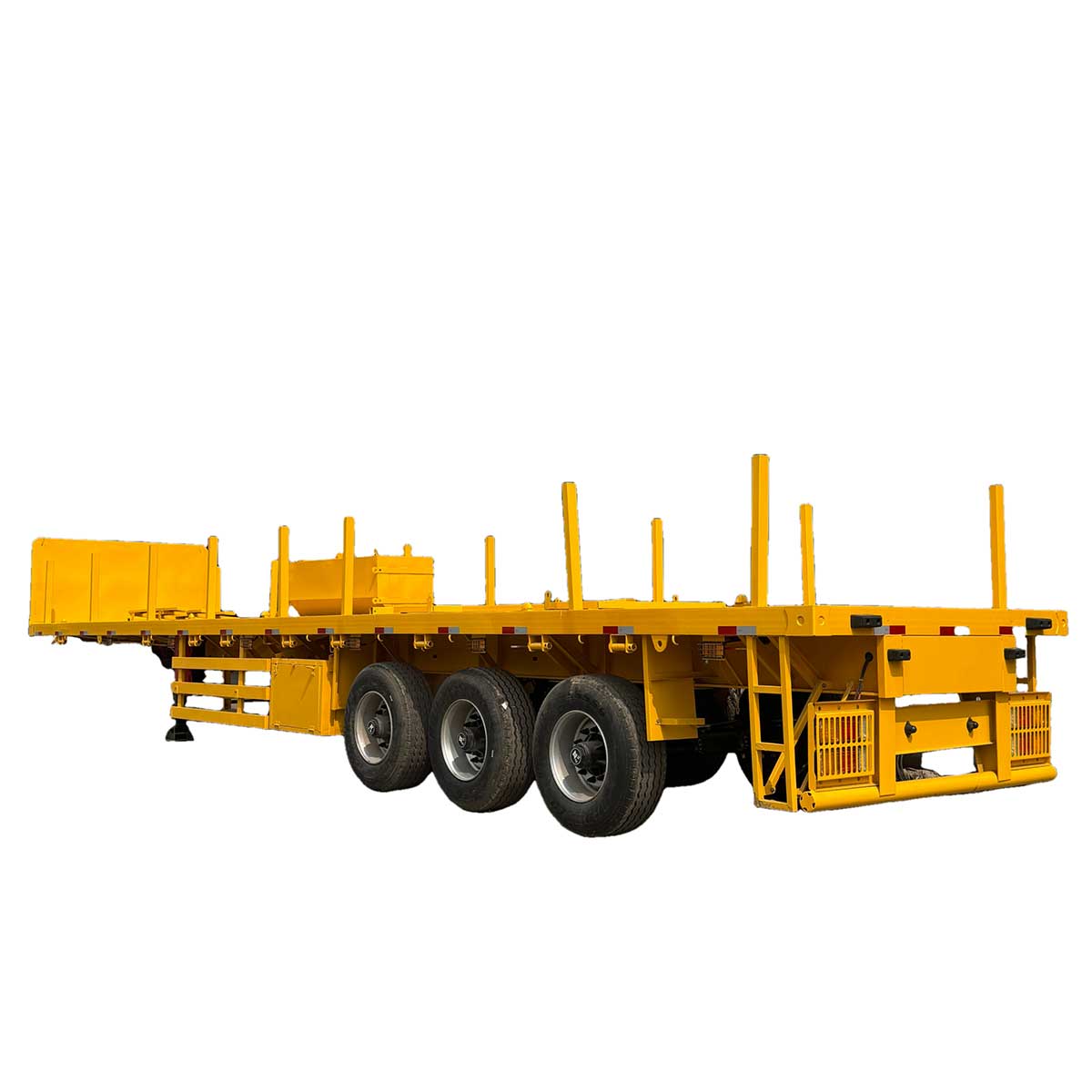
Standard Flatbed (3-Axle, 40 ft)
The workhorse of any fleet. 13-metre deck, 3-axle bogie, payload 40–50 tonnes. Best for: steel, machinery, general cargo. Most widely accepted at border crossings.
Typical price range: USD 12,000 – 18,000 ex-works China
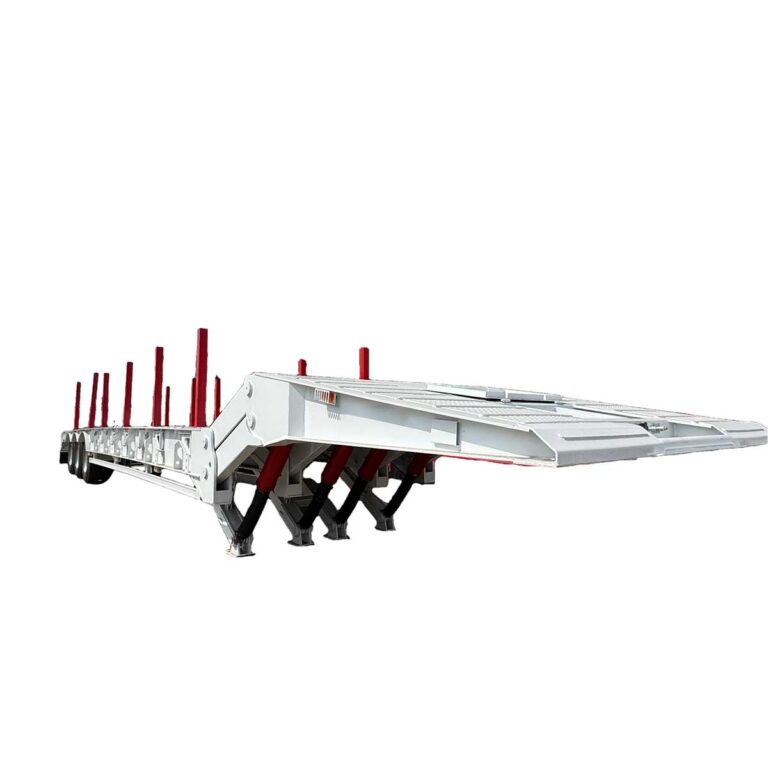
Extendable Flatbed (Telescopic)
Deck extends from 13 m to 20+ m to carry long pipes, wind turbine blades, or girders. Hydraulic or mechanical extension. Payload 35–45 tonnes (distributed).
Best for: Oil & gas pipe transport, construction steel beams, wind energy logistics
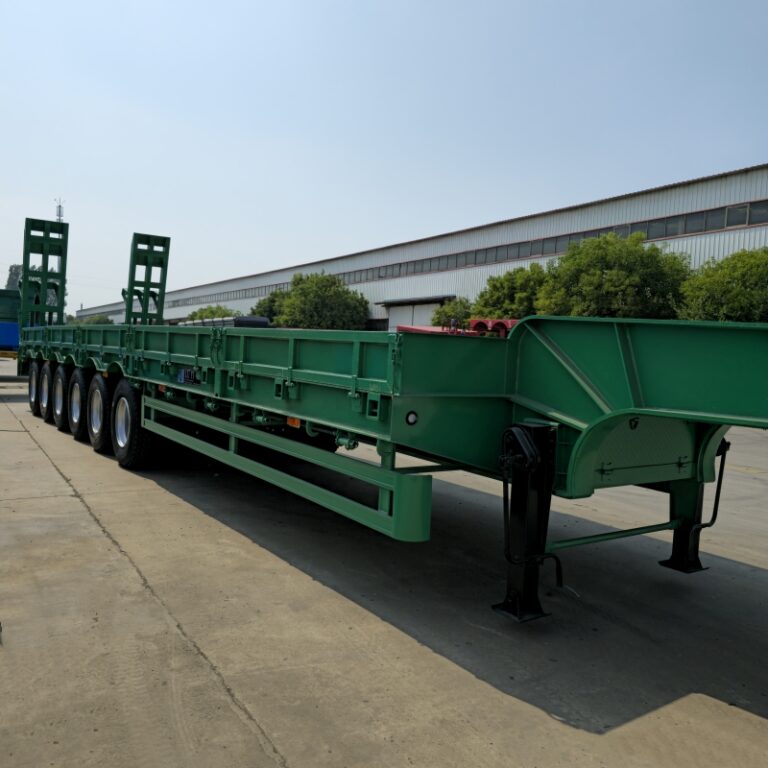
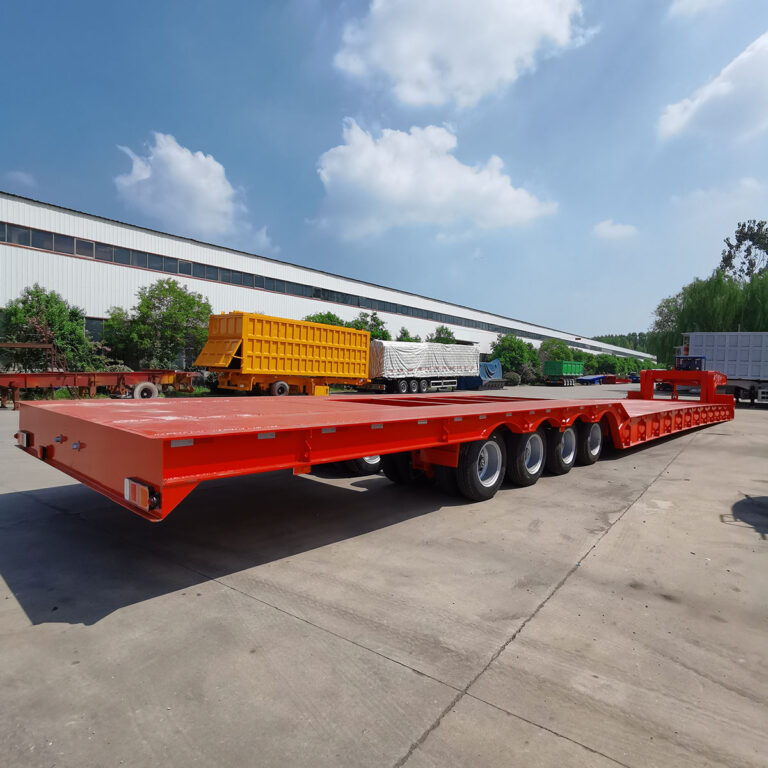
Lowbed / Step-Deck Flatbed
Dropped deck height (0.8 m vs. 1.4 m for standard) maximizes legal vertical clearance for tall cargo like excavators and transformers. 2–4 axles.
Best for: Construction equipment, mining machinery, power transformers
Skeleton / Skeletal Flatbed
Frame-only design for ISO container transport. Lighter tare weight means more payload per trip. 20 ft, 40 ft, or 45 ft container compatible.
Best for: Port logistics, container yards, intermodal freight
Multi-Axle Heavy-Haul Platform
4–6 axle configurations for payloads of 60–120 tonnes. Hydraulic steering on rear axles. Used for transformers, pressure vessels, mining haul trucks.
Best for: Mining, oil refinery projects, heavy infrastructure
3. Axle Configuration: The Most Important Decision You’ll Make
Your axle count determines payload capacity, per-axle load limits, and which roads you can legally use. This is the spec that buyers most often get wrong when ordering from overseas manufacturers.
| Axle Config | Gross Payload | Best Market | Road Requirement |
|---|---|---|---|
| 2-Axle | 25 – 30 tonnes | Short-haul, light cargo | Class B rural roads OK |
| 3-Axle | 40 – 50 tonnes | Africa, SE Asia, Middle East (most common) | Standard highway |
| 4-Axle | 55 – 65 tonnes | EU (high per-axle limits), South America | Paved highway preferred |
| 5-Axle | 70 – 90 tonnes | Heavy haul, mining, project cargo | Reinforced roads, permits required |
4. Key Specifications Checklist
When requesting a quote from any flatbed trailer manufacturer, specify all of the following. A supplier who doesn’t ask these questions before quoting is a red flag.
| Spec | Standard Range | What to Ask |
|---|---|---|
| Deck Length | 12 m – 17.5 m | What is the longest single piece you’ll haul? |
| Deck Width | 2.5 m – 3.0 m | Local road width limit? Standard is 2.5 m. |
| Deck Height (from ground) | 1.2 m – 1.55 m | Any height-sensitive bridges on your route? |
| King Pin Size | 2″ or 3.5″ | Must match your truck’s fifth wheel. |
| Main Beam Steel Grade | Q345B / Q550 | Higher grade = lighter tare weight, more payload. |
| Suspension Type | Mechanical leaf / Air bag | Air suspension for fragile cargo; leaf for rough roads. |
| Brake System | WABCO / Haldex ABS | Required for EU; recommended everywhere. |
| Tyre Size | 12R22.5 or 11R22.5 | Must match local tyre availability. |
| Twist Locks | 4 or 8 ISO positions | Required if you ever load containers. |
| Lashing Rings | 8 – 16 rings, rated 8t each | Check cargo tie-down requirements. |
5. Build Quality: What Separates a 5-Year Trailer from a 15-Year Trailer
Two trailers quoted at the same price can have dramatically different service lives. Here’s what to look for — and ask for evidence of — when evaluating Chinese flatbed trailer manufacturers:
Main Frame Steel
The most critical component. Insist on Q345B or higher grade steel for the main longitudinal beams. Some low-cost manufacturers use Q235 (ordinary mild steel), which weighs more, flexes more, and fatigues faster under heavy cyclic loading. Ask for the mill certificate.
Weld Quality
All primary welds should be continuous, not tack-welded. Request a factory video of welding operations before production. Visible porosity, undercut, or incomplete fusion are disqualifying defects.
Surface Treatment
Sand-blasting to Sa 2.5 before primer application is the standard for export trailers. Skipping this step causes paint failure within 12 months in tropical or humid climates. Ask for the coating system spec sheet.
Axle Brand
For export markets: BPW (Germany), Fuwa (China tier-1), JOST are reliable choices with global service networks. Avoid unknown-brand axles on trailers destined for remote operations where local service is unavailable.
🚛 Get a Free Technical Specification Review
Not sure which flatbed configuration fits your route and cargo? Send us your cargo details — our engineers will review and recommend the right spec within 24 hours, completely free.
6. Flatbed Semi-Trailer Price Guide (2026)
Prices vary significantly based on spec, steel grade, brand of axles/brakes, and production volume. Here is a realistic 2026 price reference for ex-works China (before shipping):
| Type | Axles | Ex-Works Price (USD) | FOB Shanghai |
|---|---|---|---|
| Standard Flatbed | 2-Axle | 9,000 – 12,000 | +800 – 1,200 |
| Standard Flatbed | 3-Axle | 12,000 – 18,000 | +1,000 – 1,500 |
| Extendable Flatbed | 3-Axle | 18,000 – 26,000 | +1,200 – 1,800 |
| Lowbed / Step Deck | 3-Axle | 22,000 – 35,000 | +1,200 – 1,800 |
| Skeletal Container | 3-Axle | 8,500 – 14,000 | +800 – 1,200 |
| Multi-Axle Heavy Platform | 4–5 Axle | 35,000 – 60,000+ | +1,800 – 3,000 |
Prices are indicative and subject to steel market fluctuation and order volume. Minimum order at Nanou Trailer is typically 1 unit for custom-spec orders or 5+ units for stock models.
7. Buying from China: 6 Things to Verify Before You Wire Money
- Factory audit or video call: See the production floor, welding shop, and paint booth. A legitimate manufacturer has nothing to hide.
- Sample photos before production: Get approval-stage photos of steel cutting, main beam assembly, and primer application.
- Production milestone photos: 30%, 60%, and 100% completion — mandatory for large orders.
- Pre-shipment inspection: Hire a third-party inspector (SGS, Bureau Veritas, or a local agent) to verify the trailer before the container is loaded.
- Bill of Lading details: Confirm HS code, declared value, and packing list accuracy before the vessel departs.
- After-sales parts availability: Ask for the axle, brake, and suspension brand, and confirm you can source parts locally within 2 weeks.
8. Frequently Asked Questions
9. Summary: Flatbed Trailer Buying Decision Tree
Use this decision guide to identify the right trailer for your application:
- Define your heaviest single haul → determines minimum payload and axle count
- Measure your longest single piece → determines deck length (standard or extendable)
- Check local per-axle weight rules → may constrain payload regardless of trailer rating
- Assess road quality on your route → dictates suspension type and main beam grade
- Confirm king pin size with your truck manufacturer before ordering
- Request factory photos, QC report, and pre-shipment inspection on every order
Ready to order or still have questions? Our sales engineers are available 7 days a week on WhatsApp (+86 15315477956) and WeChat. We typically respond within 2 hours during business hours.
📦 Get Your Custom Flatbed Trailer Quote Today
Tell us your cargo, your route, and your country. We’ll send back a detailed spec sheet, production timeline, and FOB price — usually within 24 hours.
💬 WhatsApp: +86 15315477956
📋 Online Inquiry Form
📱 WeChat: +86 15315477956 | Scan to add or message us directly
- Browse All Flatbed Trailers →
- 3-Axle Flatbed vs 4-Axle Flatbed: When to Upgrade → (coming soon)
- How to Import a Semi-Trailer from China: Complete Guide → (coming soon)
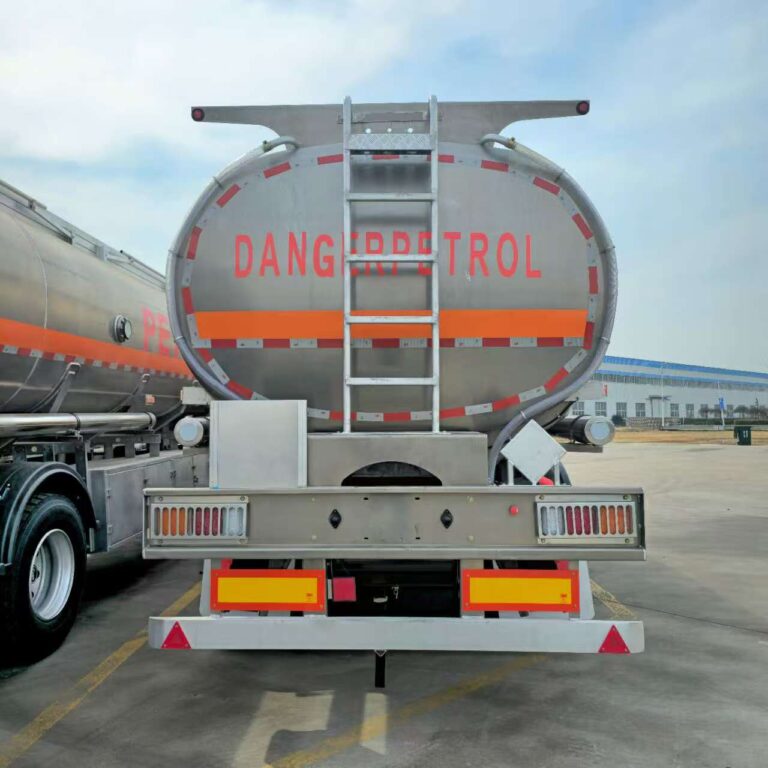
- Fuel Tank Trailers for Sale →