

Multi-Axle Lowbed Trailer Buying Guide 2026: How to Choose the Right Heavy Haul Trailer for Wind Energy, Mining, and Infrastructure Projects
The Global Heavy Haul Trailer Market Is at a Tipping Point
Something significant is happening in the heavy transport industry. According to Semi Trailer News, the global semi-trailer market is on track to reach $33 billion in 2025 and surge past $52 billion by 2035. But the headline number masks a more urgent story for procurement teams: a massive portion of the world’s active trailer fleet is between 10 and 15 years old.
In Africa, trailers routinely run 12–18 years before replacement. In the Middle East, it’s 10–14 years. Even in Europe, the average lifespan stretches to 10–12 years. What this means is that a wave of equipment replacement is now colliding with explosive demand from three sectors simultaneously: renewable energy, mining, and large-scale infrastructure.
For fleet operators, logistics managers, and engineering contractors sourcing heavy transport equipment internationally, 2026 represents both a challenge and an opportunity. The challenge? Lead times are stretching as everyone orders at once. The opportunity? Manufacturers are innovating faster than ever, and buyers who understand the technology options available will make significantly better purchasing decisions.
This guide breaks down exactly what you need to know.
Three Mega-Trends Reshaping Heavy Haul Transport Requirements
1. Wind Energy: The Transport Challenge No One Planned For
The wind farm heavy lifting and haulage market was valued at $4.45 billion in 2024 and is projected to reach $5.14 billion by 2031. But market size alone doesn’t capture the engineering challenge on the ground.
Modern onshore wind turbines now routinely exceed 100 meters in hub height. Individual blades stretch up to 60–80 meters long for the latest generation models. Tower sections weigh 80–120 tons each, while nacelles can exceed 300 tons for offshore variants. Transporting these components from port terminals or manufacturing facilities to remote wind farm sites — often across mountain passes, weak bridges, and unpaved access roads — requires purpose-built multi-axle hydraulic trailers with specialized blade adapters and tower section cradles.
This isn’t limited to Europe or North America. Wind energy capacity is expanding rapidly across the Middle East (Saudi Arabia, UAE), North Africa (Egypt, Morocco), Central Asia (Kazakhstan, Uzbekistan), and Latin America (Brazil, Chile). In many of these markets, the heavy haul transport infrastructure simply didn’t exist five years ago.
2. Mining Equipment Is Getting Heavier and Smarter
The mining sector is undergoing its own transformation. LOVOL Heavy Industry’s 2026 mining equipment showcase in Yangzhou highlighted the trend: mining operations are deploying heavier, more capable haul trucks — including electric models like the LT105E and autonomous vehicles like the methanol-powered LT130i — that require equally capable transport trailers for delivery between sites and initial deployment.
Open-pit mining scenarios demand trailers that handle 60–150 ton payloads over rough, unpaved terrain with extreme dust and temperature conditions. As our engineering team at Nanou frequently advises clients: “The trailer spec you need for a mining operation in the DRC is fundamentally different from one delivering construction equipment to a Dubai project site. Ground clearance, dust sealing, and suspension travel matter more than highway comfort.”
3. The Infrastructure Megaproject Pipeline Has Never Been Larger
From Saudi Arabia’s NEOM to India’s expressway program, from Africa’s cross-border corridors under the AfCFTA to Southeast Asia’s new industrial zones, the global infrastructure pipeline has never been larger. Every one of these projects requires moving heavy construction equipment — excavators, bulldozers, mobile cranes, piling rigs — to sites that are often far from established logistics hubs.
Multi-axle and heavy-duty trailers are seeing rising demand as operators retire older units that can’t handle heavier, irregular cargo. The economics are increasingly clear: modern trailers with stronger frames, optimized axle configurations, and hydraulic suspension systems deliver significantly lower total cost of ownership compared to maintaining aging equipment with escalating repair bills and unplanned downtime.
How to Choose the Right Axle Configuration: A Practical Comparison
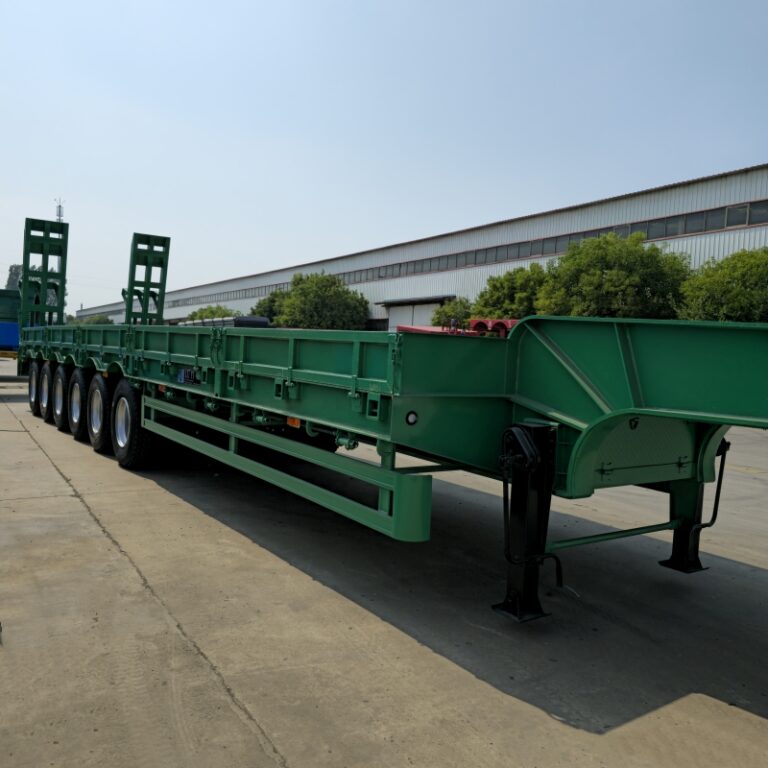
The single most important decision when specifying a heavy haul lowbed trailer is the axle configuration. This determines your legal payload capacity, road accessibility, and operational flexibility. Here’s a practical comparison:
| Configuration | Payload Range | Best For | Road Compatibility | Price (FOB China) |
|---|---|---|---|---|
| 2-Axle | 25–40 tons | Light construction equipment, compact excavators, forklifts | Most roads, standard permits | $18,000–$28,000 |
| 3-Axle | 40–60 tons | Standard excavators, wheel loaders, mobile cranes | Main highways, most developing market roads | $28,000–$42,000 |
| 4-Axle | 60–80 tons | Large excavators, piling rigs, heavy cranes | Major highways with weight restrictions | $42,000–$58,000 |
| 6-Axle | 80–100 tons | Mining equipment, large transformers, precast concrete | Requires route surveys, special permits | $58,000–$78,000 |
| 8-Axle | 100–120 tons | Wind turbine nacelles, industrial modules, heavy mining haul trucks | Specialized routes only, escort vehicles required | $78,000–$110,000 |
| 10-Axle | 120–150+ tons | Ultra-heavy mining equipment, offshore wind components | Highly restricted routes, multi-day planning | $110,000–$160,000+ |
Note: Price ranges are approximate FOB China pricing for 2026 and vary by specification, materials, and optional features. European and Japanese manufacturer pricing is typically 2–3× higher for equivalent specifications.
Key insight from industry practice: Most fleet operators in developing markets find that 3-axle and 4-axle configurations cover 70–80% of their transport needs. The higher axle configurations (6+) are typically justified only for specialized contracts — wind energy installation, mining equipment deployment, or power plant component transport — where the payload requirements exceed standard road weight limits.
If you’re new to heavy haul trailer specification, a good starting point is understanding the fundamentals of low flatbed semi-trailer design before evaluating specific axle configurations.
Front-Loading vs. Rear-Loading: Which Loading System Do You Need?
This is one of the most common questions we receive from international buyers. The answer depends entirely on what you’ll be transporting.
Front-Loading (Detachable Gooseneck)
The gooseneck detaches from the main deck, creating a ground-level ramp that allows equipment to be driven or rolled directly onto the trailer bed. This is essential for:
- Tracked vehicles (excavators, bulldozers) where ground-level approach angles matter
- Low-clearance machinery that cannot climb ramp inclines
- Wheeled equipment with low ground clearance (certain cranes, drilling rigs)
- Frequent loading/unloading at multiple sites
Trade-off: Front-loading designs are mechanically more complex and typically 15–20% more expensive than rear-loading equivalents. The detachable gooseneck also adds weight, slightly reducing payload capacity.
Rear-Loading (Hydraulic or Mechanical Ramps)
Rear ramps fold down from the trailer bed, allowing equipment to reverse onto the deck. This works well for:
- Wheeled equipment with adequate approach/departure angles (wheel loaders, dump trucks, forklifts)
- Budget-conscious operations where equipment types are consistent
- Lighter duty cycles where loading frequency is lower
Trade-off: Rear ramps limit the types of equipment you can load safely. Steep ramp angles can damage undercarriage components on low-clearance machinery, and wet or muddy conditions significantly increase slip risk during loading.
For a deeper look at how axle count interacts with loading design, our technical overview of the 10-axle low flatbed semi-trailer covers the engineering considerations for ultra-heavy configurations.
Hydraulic Suspension: When It’s Essential and When It’s Overkill
Hydraulic pendulum axle suspension is one of the most significant cost differentiators in heavy haul trailer specification. Here’s how to evaluate whether you need it:
You Need Hydraulic Suspension When:
- Transporting loads that exceed standard road width or height dimensions
- Operating on routes with significant road camber changes or uneven surfaces
- Carrying fragile or precision equipment (transformers, turbine nacelles, industrial modules)
- Regulatory requirements mandate load-leveling for oversize permits
- Route includes bridges with strict axle-load distribution requirements
Standard Leaf Spring or Air Suspension Is Sufficient When:
- Transporting standard construction equipment within normal road dimensions
- Operating primarily on paved highways in good condition
- Payload weights are well within the trailer’s rated capacity
- Budget constraints are a primary concern
Hydraulic suspension adds approximately 20–30% to the trailer’s base cost, but for operators handling oversize loads, the investment typically pays back within 12–18 months through reduced cargo damage claims, fewer permit violations, and expanded route options.
Regional Road Weight Regulations: What Buyers Often Overlook
One of the most costly mistakes international buyers make is specifying a trailer that doesn’t comply with destination market weight regulations. Here’s a summary of key limits by region:
| Region | Max Gross Vehicle Weight | Max Axle Load (Single) | Key Regulation |
|---|---|---|---|
| EU/EEC | 40–44 tons (standard) | 10 tons (single), 18 tons (tandem) | Directive 96/53/EC |
| GCC (Saudi, UAE) | 49–56 tons (varies by state) | 10–13 tons | GCC Standardization Org. |
| South Africa/SADC | 56 tons (standard) | 9–10 tons | National Road Traffic Act |
| East Africa (Kenya, Tanzania) | 56 tons (standard) | 8–10 tons | EAC Vehicle Load Control Act |
| West Africa (Nigeria, Ghana) | 56 tons (standard) | 10 tons | ECOWAS Directive |
| India | 49–56 tons (varies by state) | 9–10 tons | Motor Vehicles Act, CMVR |
| Southeast Asia | 40–49 tons (varies significantly) | 8–10 tons | ASEAN MRA (harmonizing) |
| Latin America (Brazil, Chile) | 45–57 tons | 10–13 tons | Varies by country |
Critical note: These are standard limits. Oversize and overweight loads — which is exactly what heavy haul trailers are designed for — require special permits in virtually every jurisdiction. The permit process, costs, and approval timelines vary enormously. In some African markets, permits can be obtained in days; in the EU, complex oversize load permits may take weeks and require detailed route surveys.
Always confirm destination market requirements with your local transport authority or a specialized heavy haul logistics consultant before finalizing your trailer specification.
Frame Material and Construction: The Hidden Quality Indicator
The frame is the backbone of any heavy haul trailer, and this is where the biggest quality differences exist between manufacturers.
Steel grades: High-strength structural steel (Q460, Q690, or equivalent) is standard for quality heavy haul trailers. Lower-grade steel (Q235, Q345) is cheaper but significantly heavier for equivalent strength — meaning less payload capacity within legal weight limits.
Design methodology: Manufacturers using finite element analysis (FEA) in frame design can optimize cross-member placement and wall thickness to eliminate stress concentrations while minimizing weight. This isn’t just marketing language — a well-designed frame can be 15–20% lighter than a conventional design at the same load rating, directly increasing your revenue per trip.
Welding quality: For heavy haul trailers carrying 80+ ton loads, weld quality is a safety-critical factor. Look for manufacturers with ISO 3834 welding quality certification, automated submerged arc welding (SAW) processes, and post-weld heat treatment for critical joints.
Surface treatment: Shot blasting followed by polyurethane paint systems provide the best corrosion resistance. In tropical and coastal environments (common in Southeast Asian and African deployments), this makes a meaningful difference in service life.
Nanou’s lowbed semi-trailer range uses Q460/Q690 high-strength steel with FEA-optimized frames and full SAW welding across critical joints. Configurations span 2-axle through 10-axle, including front-loading, rear-loading, and specialized wind energy transport variants.
Frequently Asked Questions
What is the difference between a lowbed trailer and a lowboy trailer?
The terms “lowbed” and “lowboy” refer to the same type of trailer — a semi-trailer with a deck height significantly lower than a standard flatbed, designed to transport tall or heavy equipment. “Lowboy” is more commonly used in North America, while “lowbed” is the preferred term in Europe, Africa, the Middle East, and Asia. The key distinguishing feature is the dropped deck section between the gooseneck and rear axles, which keeps the center of gravity low and allows transport of equipment that would exceed height limits on a standard flatbed.
How much does a multi-axle lowbed trailer cost from China?
FOB China pricing for multi-axle lowbed trailers in 2026 typically ranges from $28,000 for a basic 3-axle rear-loading model to $160,000+ for a custom 10-axle hydraulic modular configuration. The price depends on axle count, suspension type (leaf spring vs. hydraulic), loading system (rear ramp vs. detachable gooseneck), steel grade, and optional features. European-manufactured equivalents typically cost 2–3× more for similar specifications. Shipping costs (RoRo or bulk carrier) add $3,000–$12,000 depending on destination.
Can a lowbed trailer transport wind turbine blades?
Standard lowbed trailers cannot transport modern wind turbine blades (50–80 meters long) without modification. Purpose-built wind energy transport trailers use extendable deck sections, specialized blade adapters, and bolster supports to accommodate extreme lengths. For tower sections and nacelles, multi-axle hydraulic lowbed trailers in 4-axle to 8-axle configurations are standard, with hydraulic suspension maintaining load stability across uneven terrain.
What certifications do I need to import a semi-trailer from China?
Certification requirements depend on your destination market: DOT certification for North America, ECE/EEC type approval for Europe, GCC conformity for Gulf states, and SABS approval for South Africa. Reputable Chinese manufacturers can supply trailers with CCC (China Compulsory Certification), ISO 9001 quality management, and destination-specific certifications. Always request SGS or Bureau Veritas pre-shipment inspection for orders above $50,000.
How do I choose between leaf spring and hydraulic suspension for a lowbed trailer?
Choose نظام التعليق الزنبركي الورقي if you’re transporting standard construction equipment within normal road dimensions on paved highways — it’s simpler, cheaper to maintain, and adequate for most general heavy haul work. Choose hydraulic suspension if you’re handling oversize loads that exceed standard dimensions, operating on routes with poor road conditions, or carrying fragile/precision equipment where load leveling is critical. Hydraulic suspension costs 20–30% more but offers independent axle adjustment, significantly better stability, and often qualifies you for oversize load permits that leaf spring trailers cannot obtain.
What is the typical delivery time for a custom heavy haul trailer from China?
Standard models (3-axle, 4-axle with common specifications) typically ship within 25–35 working days from order confirmation. Custom-engineered heavy haul trailers (6+ axles, hydraulic suspension, specialized loading systems) require 45–60 working days due to engineering design, component sourcing, and additional testing. Shipping to most international destinations adds 3–6 weeks depending on route and method (RoRo, bulk carrier, or container where dimensions allow).
Related Reading
- Understanding Low Flatbed Semi-Trailers — fundamentals of lowbed trailer design and construction
- Understanding the 10 Axle Low Flatbed Semi-Trailer — deep dive into ultra-heavy haul configurations
- How to Choose a Suitable Dump Semi-Trailer — if your operation also involves bulk material hauling
About Shandong Nanou Automobile Co., Ltd.
Based in Liangshan, Shandong — China’s trailer manufacturing capital — شركة شاندونغ نانو للسيارات المحدودة. operates one of the region’s largest production facilities with over 230 semi-trailer models. For heavy haul and special transport applications, Nanou offers custom engineering across the full axle range (2–10 axles), with options including detachable gooseneck front-loading, hydraulic rear ramps, pendulum axle hydraulic suspension, and specialized wind energy transport configurations.
All trailers are manufactured under ISO 9001 quality management with CCC, DOT, ECE/EEC, and GCC certifications available. Pre-shipment inspection by SGS or Bureau Veritas is standard practice.
Request a customized quotation:
- Website: www.nanou-trailer.com
- البريد الإلكتروني: nanou-automobile@nanou-trailer.com
- WhatsApp: +86 159 7063 7777
- الهاتف: +86 153 1547 7956 / +86 159 7063 7777
- العنوان: Jiezhuang Village Industrial Park, Liangshan County, Shandong Province, China