

Bulk Cement Trailer for Sale: Types, Specs & Prices from China Manufacturer (2026)
A bulk cement trailer is the most efficient way to move fly ash, cement powder, lime powder, and other fine dry bulk materials over long distances. If you run a cement distribution fleet, supply concrete batching plants, or haul industrial powders for mining and construction projects, the right powder tank trailer cuts your unloading time from hours down to 30-45 minutes per load.
In this guide, we compare the main bulk cement trailer designs, list the specifications that actually affect performance, give 2026 FOB price ranges from China, and walk through a six-step buying checklist so you do not overpay on options you do not need.
Summary: This article explains what a bulk cement trailer is, compares V-type, W-type, aluminum alloy, and carbon steel powder tank trailers, lists key specs like tank volume, axle load, and discharge rate, and gives 2026 FOB price ranges from China. You will also get a 6-step buying checklist and answers to the most common questions buyers ask before placing an order.
What Is a Bulk Cement Trailer?
A bulk cement trailer, also called a powder tank trailer or cement tanker, is a pneumatic semi-trailer built to transport dry, free-flowing powders. The trailer uses an air compressor and fluidization system to push cargo out through discharge pipes, so the material never has to be bagged or handled manually.
Typical applications include:
- Portland cement and fly ash for ready-mix concrete plants
- Lime powder for steel plants and water treatment
- Alumina powder and mineral fillers for industrial processing
- Flour, starch, and food-grade powders (with stainless steel or aluminum tanks)
Unlike a dump trailer or flatbed, a powder tank trailer is a sealed system. That means no dust loss during transport, no weather damage, and faster turnaround at both the loading silo and the unloading point.
Types of Powder Tank Trailers — Which One Fits Your Business?
Not every bulk cement trailer is built the same. The internal tank shape, material, and axle layout determine what you can haul, how fast you unload, and how much weight you can legally carry.
V-Type / Single-Cone Bulk Cement Tanker
The V-type tank has one steep cone at the bottom. It is the simplest and cheapest design, usually built in carbon steel. These trailers work well for standard Portland cement and fly ash, but the residual material left after discharge is higher than W-type designs. If your routes are short and your material flows easily, a V-type is a cost-effective choice.
W-Type / Double-Cone Powder Tank Trailer
The W-type uses two lower cones, which improves fluidization and reduces leftover material to under 1% by volume. This is the design most buyers choose for cement, lime, and finer industrial powders. Nanou builds W-type 3-axle powder and granular material tank trucks with fluidized bed systems for faster, cleaner unloading.
Aluminum Alloy Cement Tank Trailer
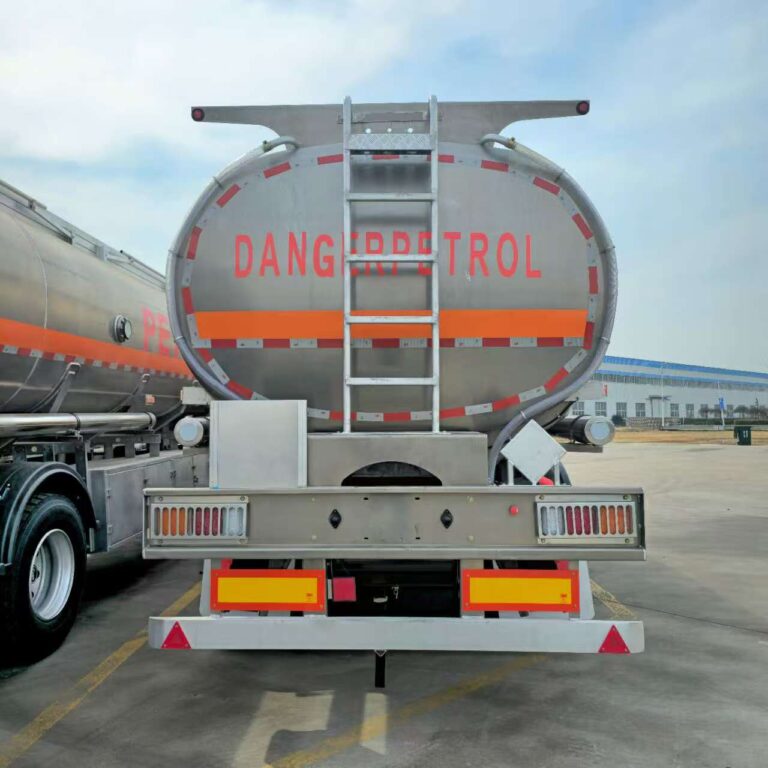
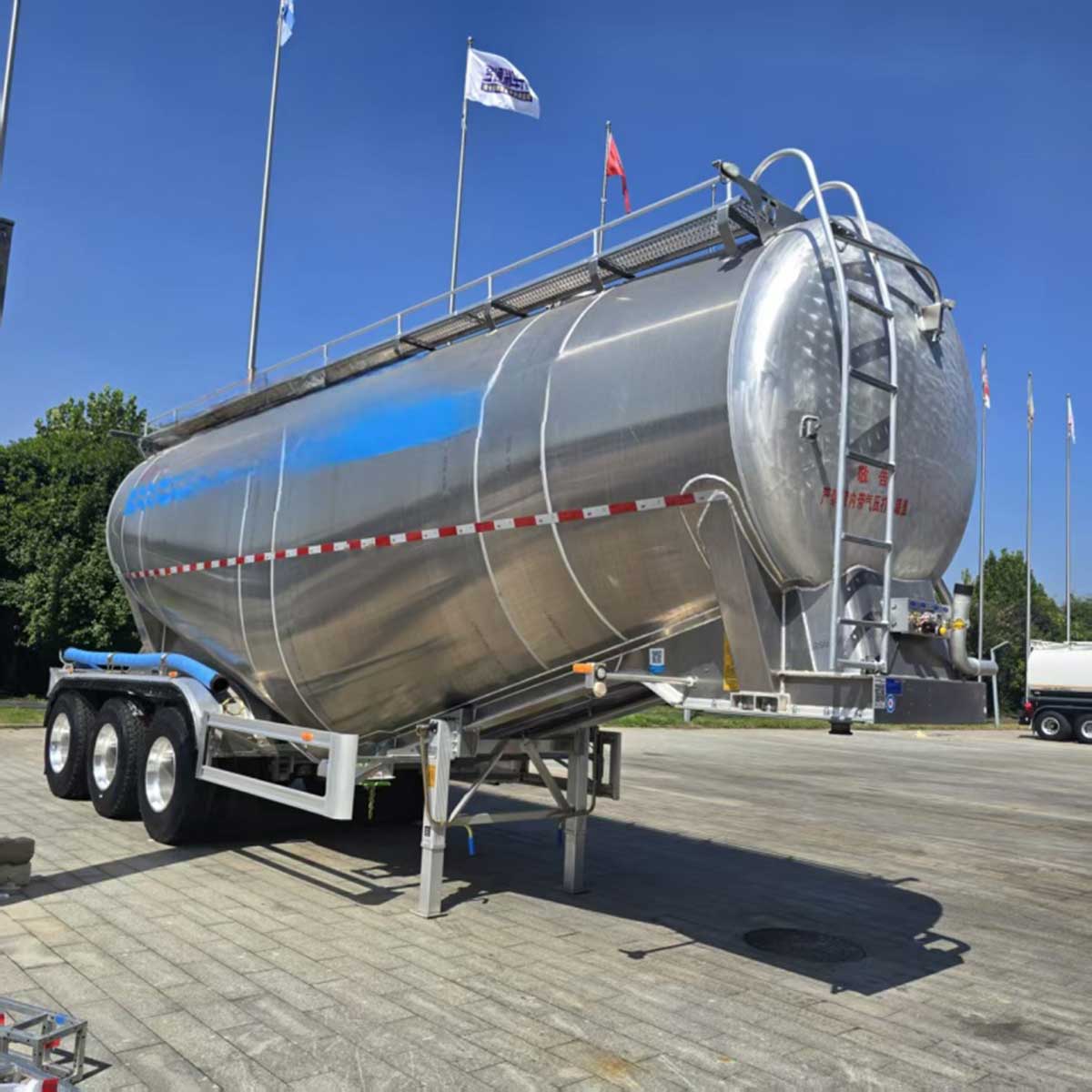
Aluminum alloy 5083 tanks are 30-40% lighter than carbon steel. That extra payload capacity directly increases revenue per trip, especially in markets with strict axle weight laws. Aluminum also resists corrosion from moisture in cement and fly ash. Our 3-axis bulk bituminous coal powder aluminum tanker is a popular export model for buyers in Africa and the Middle East.
Carbon Steel Cement Tank Trailer
Carbon steel Q345 tanks are heavier and lower cost. They are the standard choice for buyers who want the lowest upfront price and operate on paved roads with moderate corrosion exposure. With proper internal coating and regular cleaning, a carbon steel powder tank trailer can last 8-10 years.
Stainless Steel Food-Grade Tanker
For flour, starch, or chemical powders that require clean transport, stainless steel 304 or 316L tanks are used. These trailers cost more but meet food safety and chemical resistance standards.
Key Specifications & What to Look For
When you compare quotes, look past the paint job. These are the numbers that determine whether the trailer earns money or sits in the yard.
| Specification | Typical Range | Why It Matters |
|---|---|---|
| Tank Volume | 30 – 60 m³ | Larger volume raises payload per trip, but may exceed local weight limits. |
| Axle Configuration | 2 / 3 / 4 axles | 3 axles is the global standard; 4 axles adds capacity for heavy haul markets. |
| Payload | 30 – 60 tons | Match this to your tractor head GCWR and local road regulations. |
| Tank Material | Q345 steel / 5083 aluminum / 304 stainless | Aluminum saves weight; stainless resists corrosion for food or chemicals. |
| Tank Thickness | 4 – 6 mm shell, 5 – 8 mm heads | Thicker heads handle pressure and impacts from loading arms. |
| Discharge Rate | 1.2 – 1.8 tons/minute | Faster discharge means less downtime and more loads per day. |
| Working Pressure | 0.2 MPa typical | Pressure must match your compressor and silo inlet rating. |
| Suspension | Mechanical / air / bogie | Air suspension protects the tank and improves stability on rough roads. |
Price Guide — Bulk Cement Trailer Costs from China (2026)
Prices depend on tank volume, material, axle brand, and optional equipment like air compressors, discharge hoses, and aluminum rims. The table below shows realistic 2026 FOB China ranges from Nanou.
| Configuration | Volume | 2026 FOB Price (USD) |
|---|---|---|
| 2-axle carbon steel V-type | 30 m³ | $16,000 – $20,000 |
| 3-axle carbon steel W-type | 42 – 45 m³ | $20,000 – $26,000 |
| 3-axle aluminum alloy W-type | 45 – 50 m³ | $28,000 – $36,000 |
| 4-axle heavy-duty carbon steel | 55 – 60 m³ | $32,000 – $40,000 |
| Stainless steel food-grade | 40 – 45 m³ | $38,000 – $48,000 |
These are FOB prices from major Chinese ports such as Qingdao and Shanghai. Sea freight, import duties, and local registration are extra. For an exact quote on a 3-axis bulk cement powder material tanker truck, send us your destination port and required specs.
How to Buy a Bulk Cement Trailer from China — 6-Step Checklist
- Define your cargo and volume. Cement, fly ash, and lime have different bulk densities. A 45 m³ tank holds roughly 50-55 tons of cement but only 35-40 tons of lighter fly ash.
- Check local weight and dimension laws. Many countries limit single-axle loads to 10-13 tons. Make sure the axle layout and payload match your permits.
- Choose the tank material. Carbon steel for lowest cost, aluminum for payload, stainless steel for food or corrosive powders.
- Request detailed specs and photos. Ask for tank thickness, compressor brand, discharge pipe diameter, and fluidization bed design.
- Confirm packaging and shipping. Bulk cement trailers are usually shipped by RORO or container flat rack. Ask whether the price includes wax coating and tire protection.
- Get spare parts and warranty terms. Air compressors, relief valves, and manhole seals are wear parts. A one-year warranty and spare parts kit save money later.
🚛 Get Your Bulk Cement Trailer Quote Today
Tell us your cargo, route, and country. You’ll get a custom spec sheet and FOB price within 24 hours.
💬 WhatsApp: +86 15315477956
📋 Online Inquiry Form
📱 WeChat: +86 15315477956
Frequently Asked Questions
What is the difference between a bulk cement trailer and a powder tank trailer?
There is no real difference. “Bulk cement trailer” is the common term in construction and cement distribution, while “powder tank trailer” is the broader name for any dry powder transport, including lime, fly ash, flour, and industrial fillers. The tank design and fluidization system are the same.
How long does it take to unload a bulk cement trailer?
A well-designed W-type trailer with a matching air compressor unloads 40-50 tons of cement in 30-45 minutes. The actual time depends on the silo inlet pressure, material flowability, and how clean the tank fluidization bed is.
Can a powder tank trailer carry multiple materials?
Yes, but you need to clean the tank thoroughly between different materials to avoid contamination. Food-grade powders require stainless steel tanks and certified cleaning. For cement and fly ash only, carbon steel or aluminum tanks are sufficient.
Are Chinese bulk cement trailers reliable for export?
Chinese manufacturers now supply the majority of bulk cement trailers in Africa, the Middle East, Southeast Asia, and Latin America. Quality varies by factory, so check welding standards, steel certificates, and compressor brands. Nanou trailers are welded by certified operators and use named-brand axles and compressors on request.
What documents do I need to import a bulk cement trailer?
You typically need a commercial invoice, packing list, bill of lading, certificate of origin, and sometimes a VIN or homologation certificate for registration. Nanou prepares full shipping documents and can arrange CCS or BV inspection if your country requires it.
How many years does a cement tank trailer last?
With normal maintenance, a carbon steel bulk cement trailer lasts 8-10 years, an aluminum alloy model 12-15 years, and a stainless steel model 15-20 years. Regular cleaning after unloading and annual valve inspections are the main factors that extend life.
Why Choose Nanou Trailer?
- Factory-direct pricing: We manufacture in Shandong, China, with no trading company markup. You deal directly with the engineering and production team.
- Export experience: Nanou trailers operate in over 40 countries, including Nigeria, Kenya, Tanzania, Saudi Arabia, the UAE, Chile, and Peru.
- Custom specs: We adjust tank volume, axle brand, suspension type, and discharge layout to match your cargo and local regulations.
- Document support: We provide full export paperwork and can arrange third-party inspection, shipping, and insurance.
🚛 Ready to Move More Powder Per Load?
Speak with our sales engineer on WhatsApp or WeChat and get a tailored quote for your market.
💬 WhatsApp: +86 15315477956
📋 Online Inquiry Form
📱 WeChat: +86 15315477956