

Heavy Equipment Transport Trailer for Sale: Types, Specs & Prices from China Manufacturer (2026)
A heavy equipment transport trailer is the only safe way to move excavators, bulldozers, cranes, and wind-turbine components over public roads. If your fleet handles loads above 40 tonnes, the wrong trailer choice turns every haul into a compliance risk and a profit leak. This guide breaks down the five trailer types used for heavy haulage, lists real 2026 FOB prices from Shandong manufacturers, and gives you a 6-step buying checklist.
Summary
In this guide you will learn: (1) which trailer type fits which cargo class, (2) axle, deck-height and ramp specs that matter, (3) 2026 FOB price ranges from $18,500 to $85,000, (4) a 6-step import checklist for China buyers, and (5) answers to the most common questions about permits, GVW limits and shipping.
What Is a Heavy Equipment Transport Trailer?
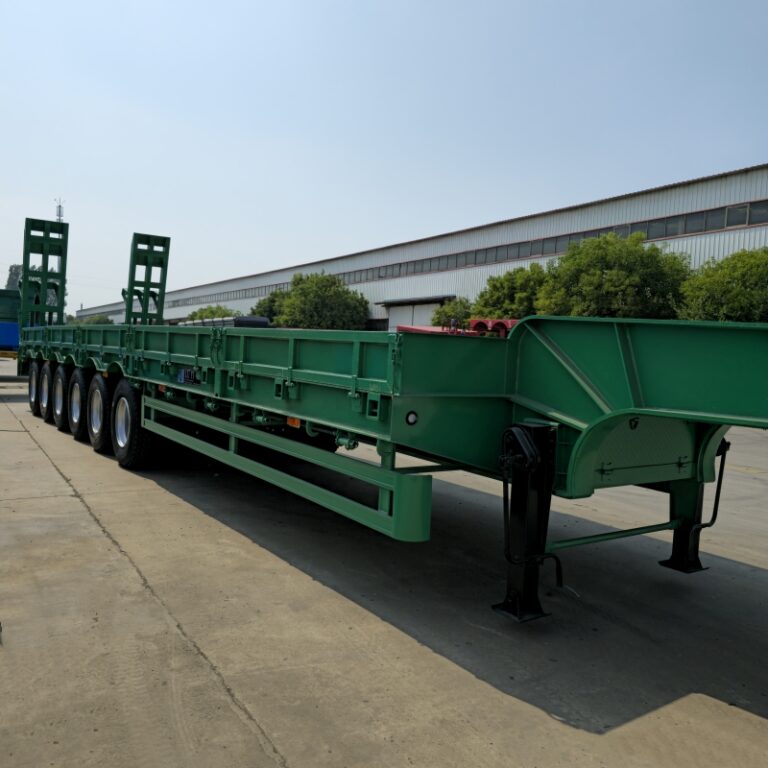
A heavy equipment transport trailer is any semi-trailer designed to carry oversized or overweight machinery that cannot be driven on public roads. In most countries, “heavy haulage” starts at gross vehicle weights above 40 tonnes, with single cargo pieces exceeding 30 tonnes. These trailers differ from standard flatbeds in four ways:
- Lower deck height — usually 800 mm to 1,200 mm to keep the center of gravity down.
- Higher axle counts — 3 to 9 axles, often with hydraulic or air suspension for load sharing.
- Removable or hydraulic ramps — self-loading capability without external cranes.
- Reinforced frames — main beams in HG60 or HG70 high-tensile steel, rated for 60–120 tonne cargo.
Nanou Trailer builds these units in Liangshan, Shandong — China’s largest semi-trailer manufacturing cluster. Our lowbed semi-trailer line and special transporter range cover every heavy-haul segment from 40-tonne excavators to 90-tonne transformer modules.
Types of Heavy Equipment Transport Trailers
Not every oversized load needs the same trailer. Below are the five designs used in 90 % of heavy haulage jobs.
1. Fixed Gooseneck Lowbed (FGL)
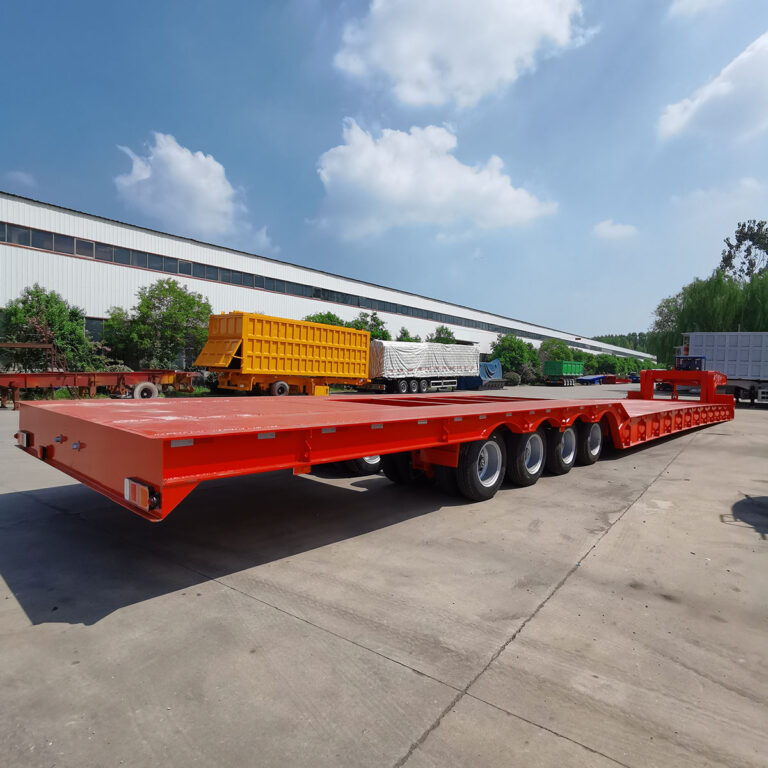
The fixed gooseneck lowbed is the most common entry-level heavy hauler. The gooseneck is welded to the main deck, giving a rigid structure with a deck height of 1,000–1,200 mm. It is ideal for:
- Standard excavators (20–40 tonnes)
- Bulldozers and motor graders
- Rigid dump trucks up to 45 tonnes GVW
A 3-axle FGL with 60-tonne capacity typically runs on FUWA or BPW axles with mechanical suspension. Deck lengths range from 9 m to 13 m. Our 16 m export low flat semi-trailer is a popular FGL configuration for Russian and Central Asian buyers who need extra deck length for combined loads.
2. Hydraulic Detachable Gooseneck (HDG)
When cargo cannot be driven over a rear ramp — for example, a non-running excavator or a tracked crusher — the hydraulic detachable gooseneck becomes essential. The front neck detaches and lowers to ground level via hydraulic cylinders. The cargo is driven or winched onto the deck, then the neck is reattached.
HDG trailers cost 25–35 % more than fixed gooseneck models, but they eliminate crane rental at both ends of the haul. Our 6-axis hydraulic goose head ladder truck and axis hydraulic folding goose head flatbed semi-trailer both use HDG architecture for 60–80 tonne loads.
3. Step-Deck / Drop-Deck Lowboy
The step-deck design has two deck levels: a higher front deck over the gooseneck and a lower rear well. This keeps overall height within 4.0 m legal limits while providing extra vertical clearance for tall cargo. Step-decks are common for:
- Agricultural combines and harvesters
- Industrial presses and CNC machines
- Tall containers or tank sections
Well lengths range from 6 m to 9 m, with deck widths of 2.5 m to 3.0 m. If you need a custom well length, we cut the frame to your specification during production.
4. Multi-Axle Modular Trailer (Hydraulic Platform)
For loads above 80 tonnes — transformers, offshore platform sections, refinery vessels — a single lowbed is no longer enough. Modular trailers use 2 to 12 axle lines, each with independent hydraulic suspension. The lines can be coupled side-by-side (side-by-side mode) or end-to-end (longitudinal mode) to match cargo footprint.
Each axle line carries 12–18 tonnes, so a 6-line modular set handles 72–108 tonnes. Steering is either manual rod steering or electronic self-steering. These trailers are often classified as “special transport” equipment and require pilot vehicles and route permits in most jurisdictions.
5. Pull-Type / Tow-Bar Lowbed
The pull-type lowbed is towed by a drawbar instead of riding on a fifth wheel. It is used when the prime mover must stay on hardstand while the trailer enters soft terrain — for example, mining sites or agricultural fields. Our pull type low flatbed truck uses a heavy-duty tow bar rated for 40-tonne drawbar pull, with off-road tires and reinforced side girders for rough-ground operation.
Key Specifications & What to Look For
Buyers from Africa, the Middle East and Southeast Asia often receive quotes that look similar on paper but differ massively in real-world performance. Use this table to compare apples to apples.
| Spec | Light Duty (40–60 t) | Medium Duty (60–80 t) | Heavy Duty (80–120 t) |
|---|---|---|---|
| Axle config | 3 axles (FUWA/BPW 13 t) | 4–5 axles (16 t each) | 6–9 axles (modular) |
| Main beam steel | Q345B / HG60 | HG60 / HG70 | HG70 + reinforced sub-frame |
| Deck height | 1,000–1,200 mm | 900–1,100 mm | 800–1,000 mm |
| Deck length | 9–13 m | 12–16 m | Custom (modular) |
| Suspension | Mechanical or air | Air or hydraulic | Hydraulic (line-control) |
| Ramps | Spring/manual | Hydraulic folding | Detachable gooseneck |
| Braking | Double-circuit air | ABS + air | ABS + EBS + air |
| Tire spec | 11.00R20 (12 units) | 11.00R20 or 12R22.5 | 385/65R22.5 super-single |
One detail that separates budget trailers from road-ready units: the main beam height. A 3-axle 60-tonne lowbed should have a main beam height of at least 500 mm (web height). Quotes with 450 mm or less will sag under load and crack at the gooseneck joint within two years.
Price Guide — Heavy Equipment Transport Trailer Costs from China (2026)
Prices below are FOB Qingdao/Tianjin in US dollars, based on Q3 2026 steel index and axle pricing. They assume standard specs; hydraulic gooseneck, ABS, aluminum ramps and custom paint add 5–15 %.
| Trailer Type | Axles | Capacity | FOB Price (USD) |
|---|---|---|---|
| Fixed gooseneck lowbed | 3 | 40–50 t | $18,500 – $24,000 |
| Fixed gooseneck lowbed | 4 | 50–65 t | $26,000 – $32,000 |
| Hydraulic detachable gooseneck | 3 | 50–60 t | $28,000 – $35,000 |
| Hydraulic detachable gooseneck | 4–5 | 60–80 t | $38,000 – $52,000 |
| Step-deck lowboy | 3 | 40–55 t | $22,000 – $29,000 |
| Multi-axle modular (per line) | 2-line | 24–36 t | $18,000 – $24,000/line |
| Multi-axle modular (6-line set) | 6-line | 72–108 t | $85,000 – $110,000 |
| Pull-type lowbed | 2–3 | 30–50 t | $16,000 – $23,000 |
What moves the price needle in 2026?
- Steel: Hot-rolled coil in China is trading around 3,650 CNY/tonne (≈$507/tonne). Every $50/tonne swing changes trailer cost by roughly $800–$1,200.
- Axles: BPW axles carry a $300–$500 per-axle premium over FUWA. For a 5-axle trailer, that is $1,500–$2,500 extra.
- USD/CNY: At 7.15, Chinese trailers are 8–10 % cheaper in dollar terms than at 6.50. If you are buying in USD, now is a favorable window.
- Freight: A 40 ft container to Mombasa or Lagos runs $3,200–$4,500; Ro-Ro to Jebel Ali is $2,800–$3,800 per unit.
For a full breakdown of landed costs by destination, see our Semi Trailer Price Guide 2026.
Get Your Heavy Equipment Transport Trailer Quote Today
Tell us your cargo weight, dimensions, and destination port. We will spec the right axle count, deck height, and ramp type — and send an FOB quote within 24 hours.
WhatsApp: +86 15315477956
Online Inquiry Form
WeChat: +86 15315477956
How to Buy a Heavy Equipment Transport Trailer from China — 6-Step Checklist
Step 1: Define Cargo & Route
List the heaviest and tallest machines you will haul. Measure track width, ground clearance, and total weight. Note the steepest grade and worst road surface on your regular routes — this determines whether you need mechanical or hydraulic suspension.
Step 2: Choose Trailer Type & Axle Count
Use the spec table above to match capacity to axle configuration. If you move more than one machine class, a hydraulic gooseneck lowbed gives the most flexibility. If you only haul standard 30-tonne excavators, a 3-axle fixed gooseneck is the cost-optimal choice.
Step 3: Request Engineering Drawings
Any supplier who refuses to share frame drawings before payment is a red flag. Ask for:
- Main beam cross-section (height x flange width x web thickness)
- Gooseneck weld detail and gusset plate thickness
- Axle spacing and kingpin position
- Full load stress simulation report (optional but recommended for 80 t+ units)
Step 4: Verify Certifications
Different markets require different paperwork:
- Africa (most countries): COC/CIV certificate, ISO 9001 factory audit
- Middle East (GCC): SASO or G-Mark, often with third-party inspection (SGS/BV/Intertek)
- South America: Mercosur or local homologation (Brazil DENATRAN, etc.)
- CIS / Russia: EAC/TR CU 018/2011 certificate
Nanou Trailer provides COC, SASO, and EAC documentation on request. Lead time for certification paperwork is 7–10 days.
Step 5: Inspect Before Shipping
For orders above $40,000, we recommend a third-party pre-shipment inspection (PSI). SGS or CCIC charges $400–$700 per container. They check weld quality, paint thickness, axle alignment, brake testing, and dimensional accuracy. A PSI report is also required by many African banks for LC release.
Step 6: Arrange Logistics
Heavy equipment trailers are usually shipped by:
- Container (FLC): Only possible if the trailer can be knocked down or is under 12 m. Small lowbeds fit in 40 ft HQ containers.
- Ro-Ro: The trailer is driven onto the vessel. Best for complete, ready-to-use units. Slightly more expensive but zero reassembly at destination.
- Break-bulk: For oversized modular trailers that exceed container or Ro-Ro dimensions. Most expensive, but necessary for 6+ axle lines.
For a deeper dive on import procedures, read our Import Guide: How to Buy a Semi Trailer from China.
Frequently Asked Questions
What is the difference between a lowbed and a lowboy trailer?
Functionally they are the same — both have a deck lower than a standard flatbed. “Lowboy” is the North American term; “lowbed” or “low loader” is used in Europe, Africa, and Asia. In China manufacturing catalogs, “lowbed semi trailer” is the standard export term. If you are buying for the US or Canadian market, specify “lowboy” in your inquiry and we will adjust kingpin height and DOT lighting to match.
How many axles do I need for a 50-tonne excavator?
A 50-tonne excavator plus the trailer’s own tare weight (≈12 tonnes) gives a gross combination weight of 62 tonnes. Most countries limit axle loads to 10–13 tonnes per axle. Therefore, you need at least 5 axles (5 x 13 t = 65 t capacity) to stay legal. A 4-axle trailer rated at 16 tonnes per axle (64 t total) can also work in jurisdictions that allow higher axle loads. Our four-axis hook machine version is built exactly for this weight class.
Can I move a heavy equipment trailer without a special permit?
That depends on your local regulations. In most countries, permits are required when:
- Gross weight exceeds 40–48 tonnes (varies by country)
- Overall width exceeds 2.5–2.6 m
- Overall height exceeds 4.0–4.2 m
- Overall length exceeds 18–20 m
If your route includes bridges or tunnels, check load ratings and clearance heights before dispatch. We can provide dimensional drawings for permit applications.
What is the lead time for a custom heavy haul trailer from China?
Standard configurations: 20–25 days production + 7 days port handling. Custom modular trailers with hydraulic steering: 35–45 days. Add 7–10 days for third-party certification if required. Sea freight adds 15–35 days depending on destination. Total door-to-port timeline: 45–75 days.
Is a hydraulic gooseneck worth the extra cost?
If you load non-running machines more than twice per month, yes. A hydraulic gooseneck eliminates crane rental ($200–$500 per lift) and reduces loading time from 2 hours to 20 minutes. The payback period is typically 8–12 months for active fleets. If you only haul self-propelled equipment that can drive onto a rear ramp, a fixed gooseneck saves $8,000–$15,000 upfront.
What is the maximum weight a single semi-trailer can carry?
Legally, most countries cap semi-trailer GVW at 40–50 tonnes. For heavier loads, you need a multi-axle modular system or a road train configuration. In mining and private-road applications, single trailers have moved 200+ tonnes, but these require specialized prime movers and are not street-legal. Our heaviest standard configuration is a 9-axle modular set rated at 120 tonnes.
Why Choose Nanou Trailer?
We are not a trading company — we manufacture in Liangshan, Shandong, with direct control over welding, shot-blasting, painting, and axle assembly. Here is what that means for heavy haul buyers:
- Custom engineering: We design frames around your cargo, not the other way around. Need a 17 m deck with 600 mm height for a transformer? We cut and weld it to spec.
- Axle flexibility: FUWA, BPW, or SAF axles; mechanical, air, or full-hydraulic suspension. You choose the brand and configuration.
- Export experience: We have shipped heavy haul trailers to Nigeria, Kenya, Tanzania, Saudi Arabia, UAE, Kazakhstan, and Chile. We know which ports accept Ro-Ro, which require break-bulk, and what paperwork each customs office expects.
- After-sales parts: Brake chambers, suspension bushings, kingpins, and landing gears are stocked in our warehouse. We ship spares by air freight within 48 hours of order confirmation.
Ready to Move Your Heavy Fleet?
Send us your machine specs and destination. We will recommend the right trailer type, axle count, and suspension — with a firm FOB quote in 24 hours.
WhatsApp: +86 15315477956
Online Inquiry Form
WeChat: +86 15315477956
Related Articles
- Lowbed Semi Trailer Product Range — Browse our full low-loader catalog with 40 t to 120 t capacity options.
- Special Transporter Semi Trailers — Hydraulic gooseneck, modular, and pull-type designs for oversized cargo.
- Special Transport Trailer Buying Guide — Deep dive into hydraulic gooseneck and modular configurations.
- Bridge Beam Transporter Guide — Multi-axle trailers for infrastructure and construction projects.
- Semi Trailer Price Guide 2026 — FOB prices, landed costs, and payment terms for every trailer type.
- How to Import a Semi Trailer from China — Step-by-step import checklist with certification and logistics advice.