

Energy Storage Container Transport: The Complete Buyer’s Guide to BESS Shipping & Semi-Trailer Selection (2026)
The global battery energy storage system (BESS) market is entering an unprecedented growth phase. Valued at USD 13.87 billion in 2025, the container energy storage sector is projected to reach USD 35.82 billion by the end of the decade, growing at a compound annual rate of approximately 20.9%. For procurement managers, logistics coordinators, and EPC contractors involved in renewable energy projects, one challenge looms large: how do you safely and cost-effectively transport these 40–45 ton energy storage containers from factory to project site?
This guide breaks down everything you need to know about energy storage container transport in 2026 — from trailer selection and weight compliance to route planning and total cost of ownership.
Why BESS Container Transport Is the Logistics Challenge of the Decade
The scale of BESS deployment is staggering. China alone integrated 81 GWh of energy storage in 2024, with domestic bidding surging to 190 GWh by late 2025 — a 138% year-over-year jump. In the United States, installations are approaching 80 GWh, driven largely by AI data center demand that could consume over 20% of total U.S. power capacity by 2030. Meanwhile, Germany targets 24 GW of storage by 2037 as Europe races toward a continental goal of 200 GW before 2030.
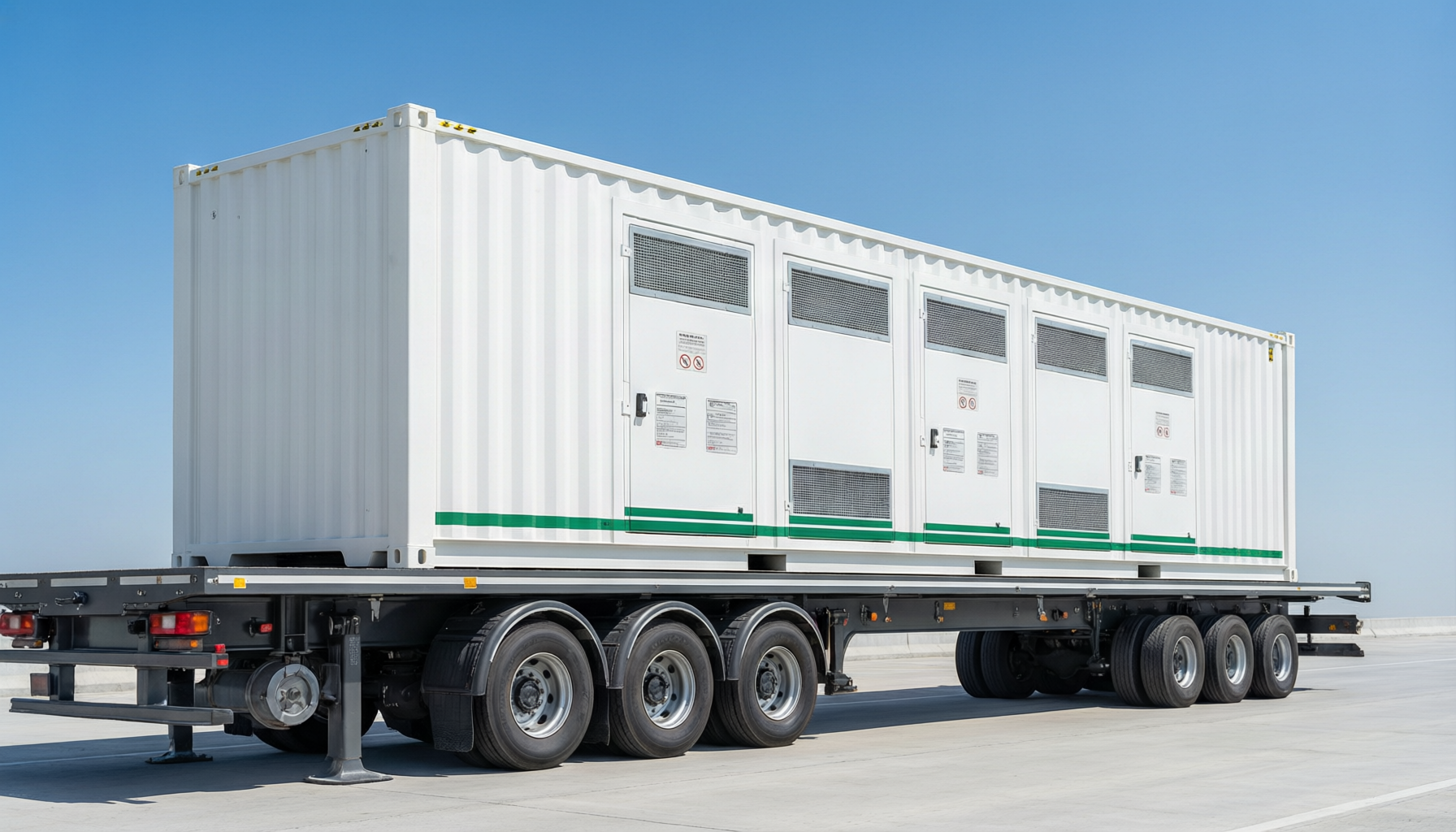
This explosive growth creates a massive downstream demand for specialized transport equipment. Each 5–7 MWh BESS container weighs between 40 and 45 metric tons — far exceeding the payload of standard container chassis. The batteries inside are classified as dangerous goods (UN3481), adding layers of regulatory complexity to every shipment.
According to a recent logistics industry analysis, successful BESS deployment in 2026 hinges on three critical factors: crane safety planning, thorough route surveys, and plug-and-play commissioning protocols — all of which start with choosing the right semi-trailer.
BESS Container Specifications: What Buyers Must Know
Before selecting transport equipment, understanding the physical parameters of modern BESS containers is essential.
| Parameter | 20ft BESS Container (3–5 MWh) | 40ft BESS Container (5–7 MWh) |
|---|---|---|
| External Dimensions | 6,058 × 2,438 × 2,896 mm | 12,192 × 2,438 × 2,896 mm |
| Gross Weight | 28–35 tons | 40–45 tons |
| Battery Chemistry | LFP (90%+ market share) | LFP / Sodium-ion (emerging) |
| Cooling System | Liquid cooling (mandatory for dense configs) | Liquid cooling |
| Hazard Classification | UN3481, Class 9 | UN3481, Class 9 |
| Cell Format | 314 Ah standard | 314 Ah / 628 Ah |
| System Cost Benchmark | Below USD 115/kWh (2026) | Below USD 115/kWh (2026) |
Nanou Engineering Team Advisory: “When specifying trailers for BESS transport, always design for the worst-case weight scenario. A 40ft unit at 45 tons requires a chassis rated for at least 50 tons GVM with reinforced twist locks and a low center of gravity to prevent rollover on uneven project-site terrain.”
Choosing the Right Semi-Trailer for BESS Container Transport
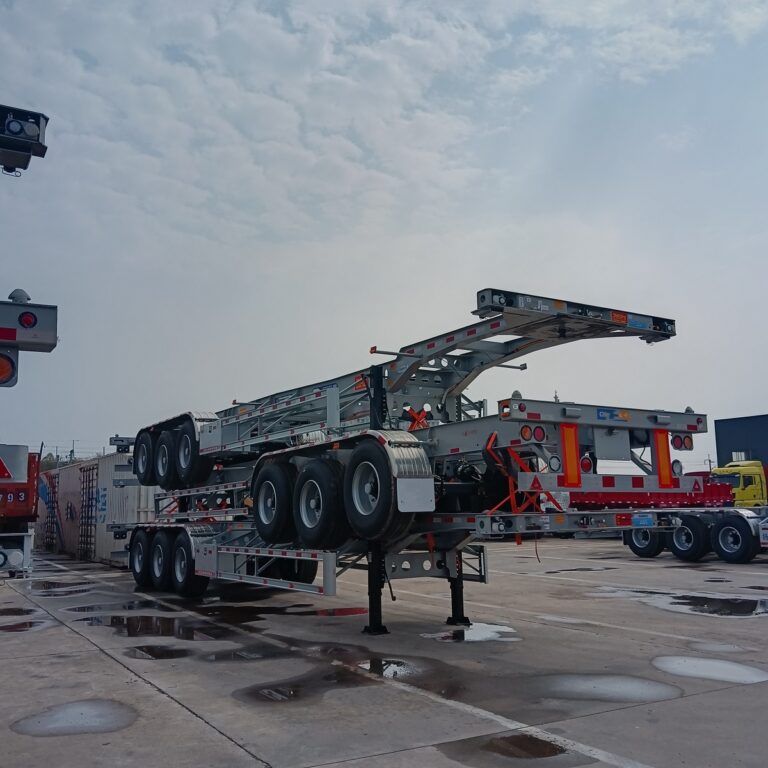
Option 1: Heavy-Duty Container Skeleton Trailer
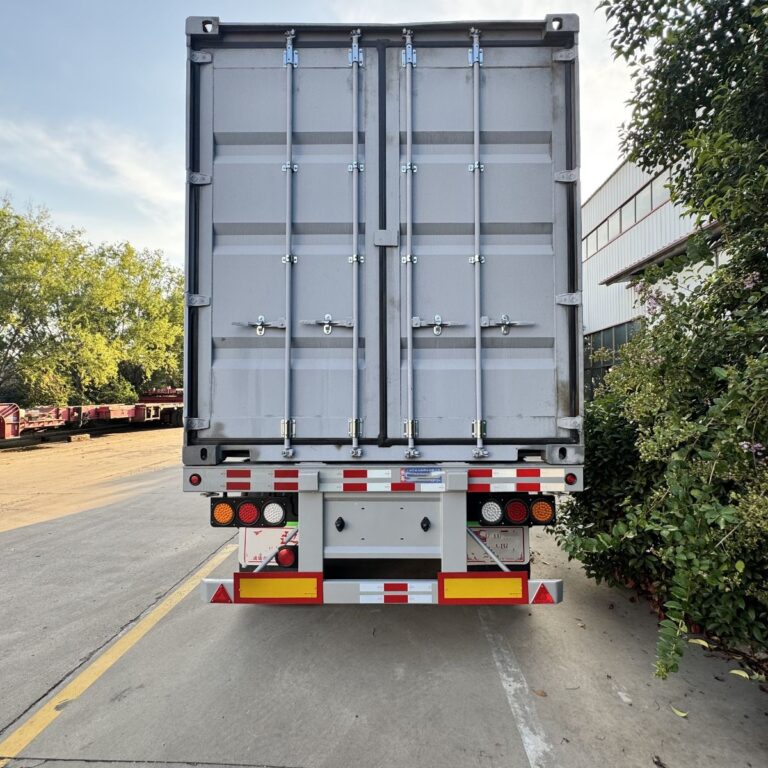
For standard 20ft and 40ft BESS containers, a reinforced container skeleton trailer is the most common choice. Key specifications to look for include:
- Axle configuration: 3-axle (for 20ft units up to 35 tons) or 4-axle (for 40ft units up to 45+ tons)
- Twist lock system: ISO-standard 4-point or 8-point locking with reinforced mounting plates
- Suspension: Mechanical leaf spring for cost efficiency, or air suspension for sensitive battery cargo on rough roads
- Frame material: High-strength low-alloy (HSLA) steel with anti-corrosion treatment for coastal/humid project sites
Nanou Automobile offers heavy-duty container skeleton semi-trailers engineered for BESS transport, with customizable axle configurations from 2 to 4 axles and payload ratings up to 60 tons.
Option 2: Low Flatbed Semi-Trailer for Oversized Units
When BESS containers exceed standard ISO dimensions — common with pre-assembled 7+ MWh systems — a multi-axle lowbed trailer becomes necessary. These trailers offer:
- Deck heights as low as 650mm for overhead clearance under bridges and power lines
- Hydraulic steering for tight-radius turns at project sites
- Extendable decks to accommodate custom container lengths
- Payload capacity from 40 to 120 tons across 3–10 axle configurations
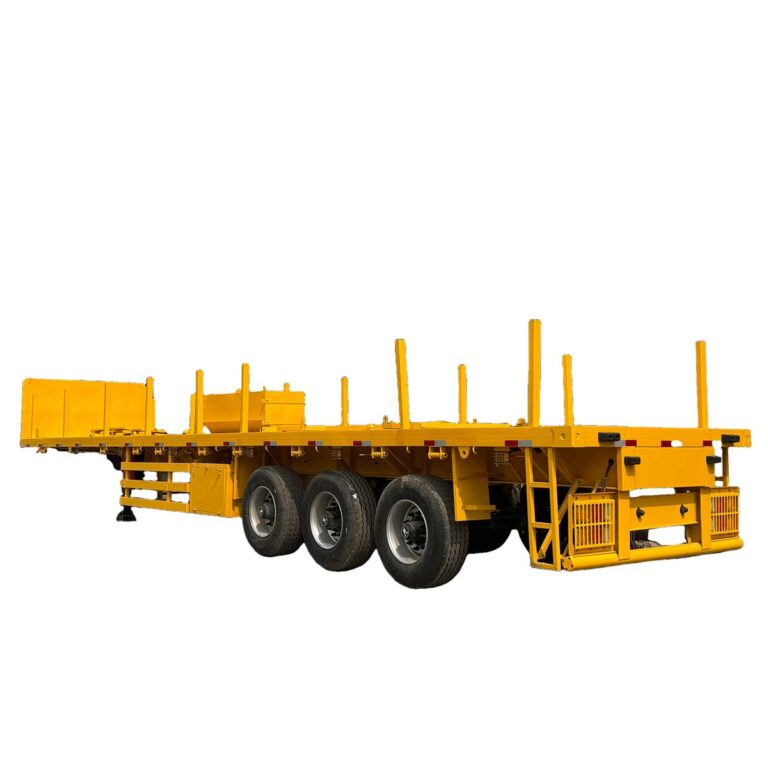
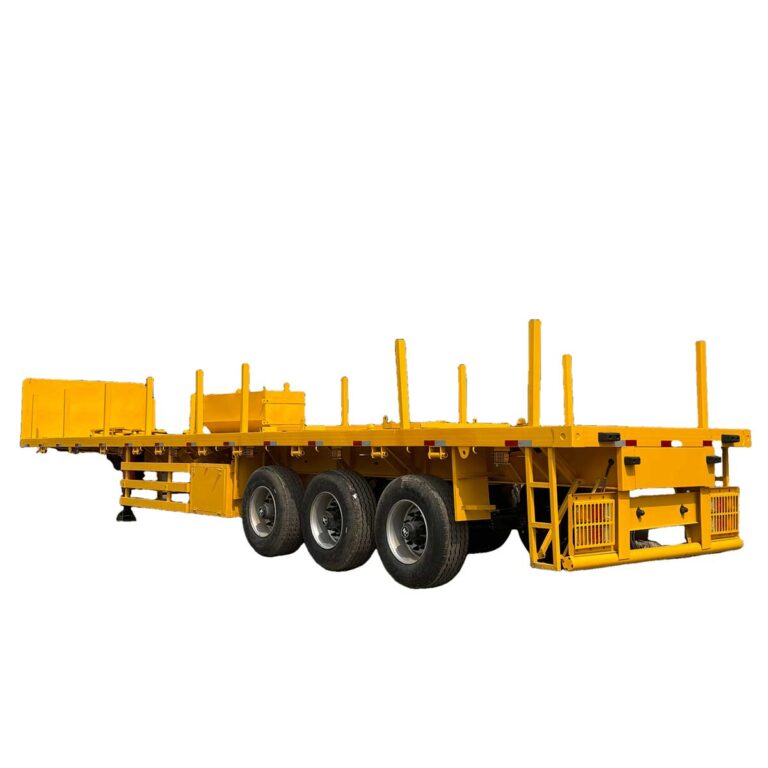
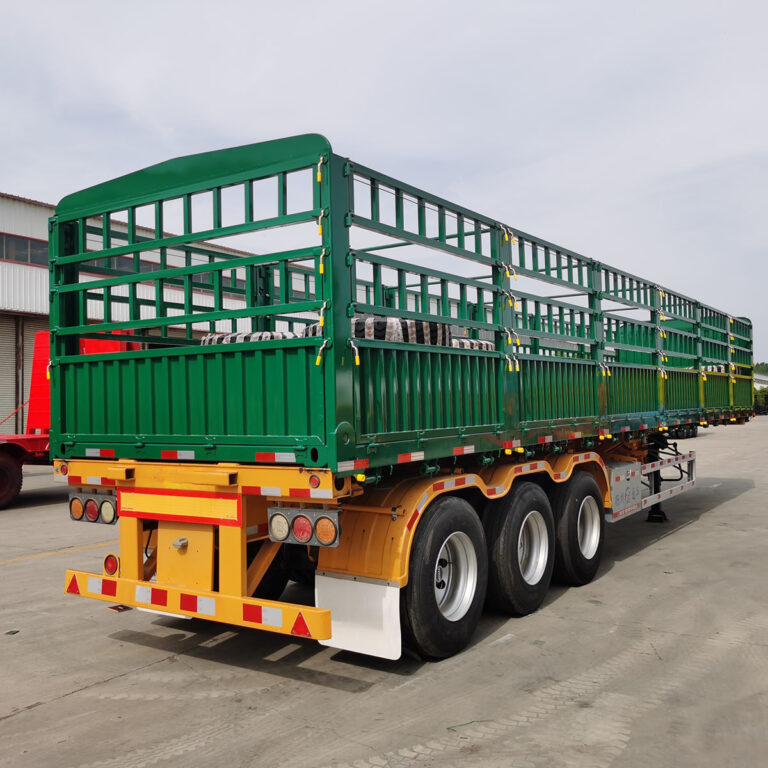
Option 3: Flatbed Semi-Trailer for Multi-Container Loads
For utility-scale projects requiring multiple smaller BESS units per trip, a heavy-duty flatbed semi-trailer with a reinforced deck can carry 2–3 units simultaneously, reducing per-unit transport costs by up to 40%.
Comparison Table: Semi-Trailer Options for BESS Transport
| Feature | Skeleton Trailer | Lowbed Trailer | Flatbed Trailer |
|---|---|---|---|
| Best For | Standard 20ft/40ft BESS | Oversized/pre-assembled BESS | Multi-unit small BESS |
| Payload Range | 30–60 tons | 40–120 tons | 30–80 tons |
| Axle Options | 2–4 axles | 2–10 axles | 2–4 axles |
| Deck Height | Standard (1,200mm) | Low (650–900mm) | Standard (1,100–1,400mm) |
| Twist Locks | Built-in ISO standard | Optional add-on | Optional add-on |
| Route Flexibility | High (standard roads) | Moderate (route survey needed) | High (standard roads) |
| Approx. FOB Price Range | USD 12,000–28,000 | USD 18,000–65,000 | USD 10,000–25,000 |
| Lead Time (2026) | 25–35 days | 30–45 days | 20–30 days |
Key Regulatory & Safety Considerations for 2026
Transporting BESS containers isn’t like moving standard freight. Buyers must navigate a complex web of regulations:
Dangerous Goods Compliance: Lithium-ion batteries fall under UN3481 (Class 9 — Miscellaneous Dangerous Goods). Shippers need proper IMDG/IATA declarations, and trailers must display Class 9 hazard placards. Cross-border shipments require compliance declarations at every transit point.
Weight Distribution: The concentrated weight of battery cells creates a low, dense center of gravity that differs from standard containerized cargo. Trailer manufacturers must reinforce the chassis cross-members and position axles to handle this unique weight profile.
Route Surveys: According to industry logistics specialists, every BESS delivery route should undergo a professional survey covering bridge weight limits, overhead clearance, road gradient, and turning radii. This is especially critical for project sites in emerging markets across Africa, the Middle East, and Southeast Asia, where road infrastructure may not support 45-ton payloads.
Fire Safety: BESS containers carry inherent thermal runaway risk. Trailers should be equipped with fire-resistant deck coatings and adequate ventilation clearances. Some jurisdictions now require onboard fire suppression systems for road transport of large battery systems.
Emerging Market Demand: Where BESS Transport Is Growing Fastest
The 2026 market outlook highlights several high-growth corridors for BESS deployment:
Middle East & North Africa: Solar-plus-storage megaprojects in Saudi Arabia, UAE, and Egypt are driving demand for containerized BESS. The region’s extreme heat (50°C+) requires trailers with heat-resistant hydraulic systems and UV-stable wiring.
Southeast Asia: Grid stabilization projects in the Philippines, Vietnam, and Indonesia are accelerating. Island geography means BESS containers often require intermodal transport — ship to port, then trailer to site — making container skeleton trailers the default choice.
Sub-Saharan Africa: Off-grid and mini-grid BESS deployments are expanding rapidly. The challenging road conditions in countries like DRC, Tanzania, and Mozambique demand trailers with robust suspension systems and high ground clearance options.
Procurement Tip: When ordering trailers for BESS projects in tropical or desert climates, specify tropicalized electrical systems, sand/dust filtration for brake components, and marine-grade anti-corrosion coating. Nanou’s engineering team can customize any trailer model for extreme-environment operation.
Cost Optimization: Total Cost of Ownership (TCO) for BESS Transport
Smart buyers look beyond the purchase price. Here’s a TCO framework for evaluating semi-trailer investments for BESS logistics:
| Cost Factor | Budget Consideration |
|---|---|
| Purchase Price | 40–50% of 5-year TCO |
| Maintenance (axles, brakes, suspension) | 15–20% of TCO; higher for air suspension |
| Fuel Efficiency Impact | Heavier trailers = 5–8% higher fuel consumption |
| Tire Replacement | 4–6 sets per year for high-mileage routes |
| Compliance & Certification | USD 500–2,000 per trailer annually |
| Downtime Cost | USD 500–2,000/day when trailer is off-road |
| Resale Value (Year 5) | 30–45% of original price for quality brands |
For fleet operators handling multiple BESS projects, investing in standardized trailer configurations reduces spare parts inventory and mechanic training costs — a frequently overlooked savings opportunity.
Frequently Asked Questions (FAQ)
1. What type of semi-trailer is best for transporting a 5 MWh BESS container?
A 3-axle or 4-axle container skeleton trailer with reinforced twist locks is the standard choice for a 20ft 5 MWh BESS container weighing approximately 35–40 tons. For 40ft units at 5–7 MWh (40–45 tons), a 4-axle configuration with air suspension is recommended for added stability and weight distribution compliance.
2. Are BESS containers classified as dangerous goods for transport?
Yes. BESS containers containing lithium-ion batteries are classified under UN3481 (Class 9 — Miscellaneous Dangerous Goods). Transport requires proper IMDG declarations for sea freight, ADR compliance for European road transport, and Class 9 hazard placarding on the trailer. Always verify destination-country-specific requirements before shipping.
3. How much does a semi-trailer for BESS transport cost in 2026?
Prices vary by configuration. A standard 3-axle container skeleton trailer starts around USD 12,000–18,000 FOB China. Heavy-duty 4-axle models with air suspension and reinforced frames for 45-ton BESS containers typically range from USD 20,000–28,000. Lowbed trailers for oversized units can cost USD 18,000–65,000 depending on axle count and customization.
4. Can standard container chassis handle BESS container weight?
Most standard 3-axle container chassis are rated for 30–35 ton payloads — sufficient for smaller 20ft BESS units but inadequate for 40ft containers at 40–45 tons. Using an under-rated chassis risks structural failure, regulatory penalties, and insurance voidance. Always specify a chassis rated at least 15% above your maximum expected payload.
5. What is the lead time for ordering a BESS transport trailer from China?
Standard container skeleton trailers typically ship within 25–35 days of order confirmation. Custom heavy-duty lowbed or multi-axle configurations may require 30–45 days. Note that premium battery cells currently carry 6–9 month lead times in the BESS supply chain, so trailer procurement should be aligned early in the project timeline to avoid bottlenecks.
6. Do I need special insurance for transporting BESS containers?
Yes. Standard cargo insurance typically excludes lithium battery-related incidents. You’ll need specialized BESS transport insurance covering thermal runaway, environmental contamination, and third-party liability. Insurance providers will often require proof that the trailer meets specific safety standards before issuing coverage.
Related Reading
- Skeleton Semi Trailer for Sale: Container Chassis Types, Specs & Prices (2026) — A comprehensive overview of container chassis options for intermodal transport.
- Multi-Axle Lowbed Trailer Buying Guide 2026 — How to choose heavy haul trailers for wind energy, mining, and infrastructure projects.
- How to Choose a Flatbed Semi-Trailer: The Complete Buyer’s Guide (2026) — Selection criteria for flatbed trailers across payload types.
About Shandong Nanou Automobile Co., Ltd.
Shandong Nanou Automobile is a leading semi-trailer manufacturer based in Liangshan County, Shandong Province — China’s commercial vehicle production hub. With a product range covering 230+ semi-trailer models across 10 major categories, Nanou serves export customers in over 60 countries with reliable, customizable transport solutions for BESS containers, heavy equipment, bulk materials, and general freight.
Contact Us for a Custom BESS Transport Trailer Quote:
- Email: nanou-automobile@nanou-trailer.com
- WhatsApp: +86 159 7063 7777
- Phone: +86 153 1547 7956 / +86 159 7063 7777
- Dirección: Jiezhuang Village Industrial Park, Liangshan County, Shandong Province, China