

Why Export Buyers Choose Chinese Car Carrier Trailers: Pros, Cons & 2026 Costs
Summary: This guide is written for dealers, logistics operators and fleet owners in Africa, the Gulf, Central Asia and Latin America who move imported vehicles from port to city. It explains what a car carrier trailer must do on a 900–1,200 km inland run, which of the four common Chinese deck configurations fits which trade, the nine specifications that decide whether the trailer survives five years of overloaded roads, and what FOB and CIF prices look like in 2026. You also get the honest downsides — documentation, paint, spares — and the six steps that separate a clean import from an expensive lesson.
Reading time: 9 minutes. Written by the export engineering team at Shandong Nanou Trailer, 40+ destination countries.
A car carrier trailer is judged by one number: cars delivered per trip without a single insurance claim. Everything else — paint, badge, brochure — is decoration. In the export markets where Chinese car carriers sell hardest, the trailer does a job European equipment was never designed for: 40°C asphalt, 1,000 km of broken shoulder, ramp angles set by a nine-year-old sedan with 130 mm of ground clearance, and a loading crew that has forty minutes before the port gate closes.
That is why the same 13.5 m unit that costs €42,000 in Germany sells for USD 9,800–13,500 FOB Qingdao — and why roughly one in three first-time importers still loses money on the purchase. The gap is rarely the steel. It is the specification sheet.
What a Car Carrier Trailer Does in an Import Market
In Europe the job is a fixed shuttle between factory and dealer network: paved, flat, predictable. In Lagos, Mombasa, Jebel Ali or Tashkent, the same trailer collects 6–9 units from a port yard — vehicles parked for weeks with flat batteries and locked steering — and delivers them along a corridor that may end in 200 km of unsealed road. Three requirements follow:
- Loading angle, not deck length. A flatbed with bolt-on ramps sits at 1.45–1.55 m; a sedan climbs that at 14–18°. A purpose-built carrier sits at 0.95–1.15 m and reaches the deck at 6–8°. Below 8° you stop scraping front lips.
- Vertical clearance that adjusts. An imported fleet is never uniform. A fixed upper deck either wastes 400 mm on sedans or cannot take the SUV at all.
- Lashing points at wheel level. Four 5 t straps per car on a rail — not a welded ring on a 4 mm plate. Over 1,000 km of potholes, that is the difference between a car arriving straight and a car arriving two centimetres off its mounts.
The arithmetic explains the category. A flatbed carries two cars; a 3-axle hydraulic double deck carries seven. Same driver, same tolls, same permit, fuel within 15% — 3.5× the revenue.
Types of Car Carrier Trailer Chinese Exporters Build
Four configurations cover nearly all export demand. The USD 9,800 to USD 31,000 spread between them is engineering, not markup.
1. Single-Deck Open Carrier — 4 to 6 Cars
13.0–13.5 m deck, fixed or hydraulic rear ramp, tare 6.5–8 t, two or three axles. The entry unit for port shuttles under 150 km, and the easiest to resell. Its limit is obvious: one deck, so 4–6 cars.
2. Double-Deck Fixed Carrier — 6 to 7 Cars
Upper deck welded at a fixed 1.85–2.0 m, 11.5–12.5 m usable on top, tare 9.5–11 t. Best value per car when the vehicle mix is predictable. Check the per-position rating: a 2.6 t SUV on a deck rated 2.0 t is a fatigue failure waiting to happen.
3. Double-Deck Hydraulic-Lift Carrier — 7 to 9 Cars
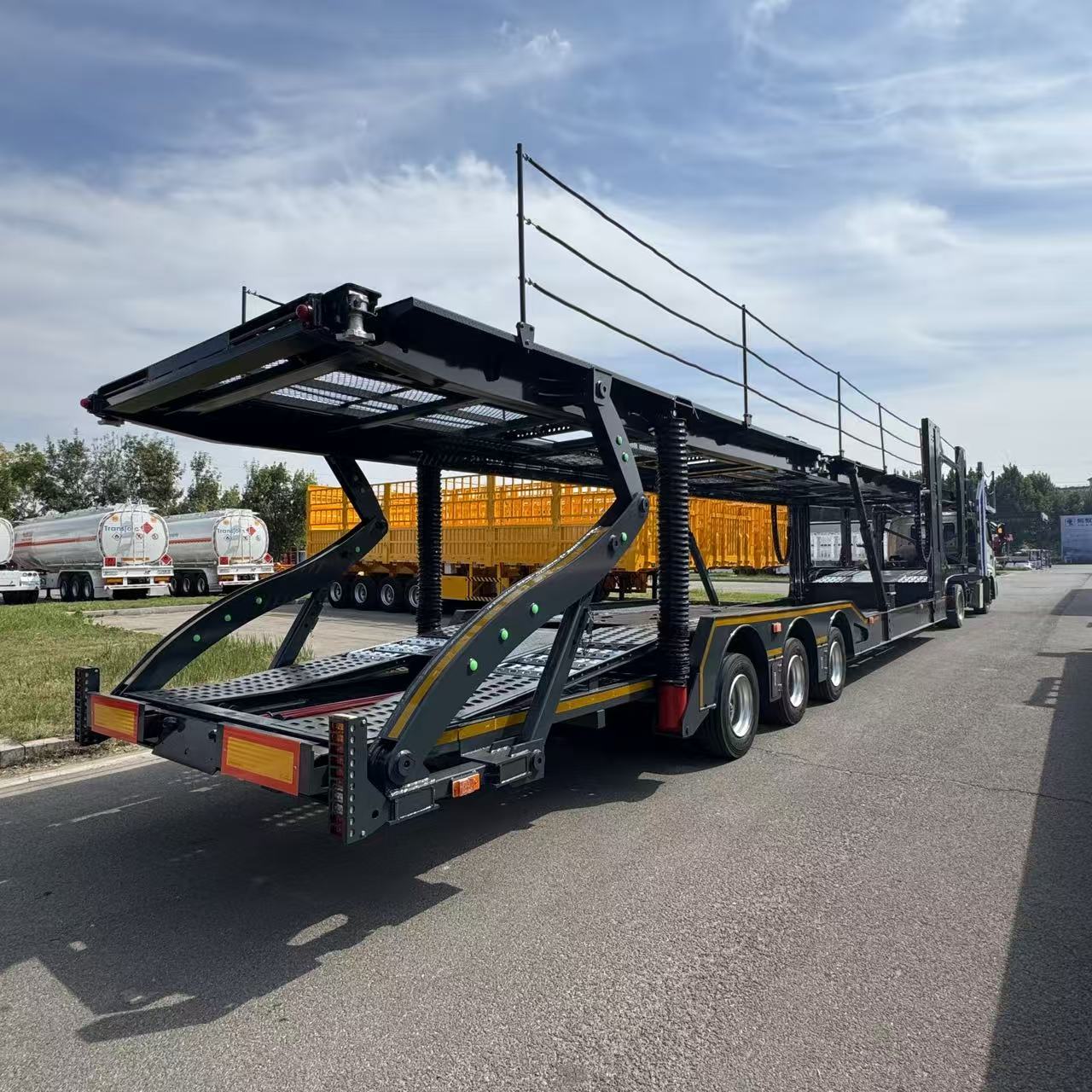
The workhorse. Two to four cylinders raise the upper deck from about 1.15 m to 2.6 m, so the same trailer takes a low sedan below and a 1.9 m SUV above. Tare climbs to 11–13 t, and so does maintenance: hoses, seals, cylinder rods, and a hand pump that must work with the engine off.
4. Multi-Axle Pickup & SUV Carrier — 5 to 8 Units
A wider single deck on three or four axles, 20–30 t payload, 8.25R20 or 12R22.5 tyres. Built for the West and East African upcountry trade, where the cargo is double-cab pickups and the last 200 km is graded laterite. Heavier, slower, far more forgiving of overload.
Current models and photos are listed on our car carrier trailer category page, including the 3-axle multifunctional sedan carrier, the 6-seat car carrier semi-trailer and the car transport semi-trailer used on longer corridors.
Pros and Cons of Buying a Car Carrier Trailer from China
Any supplier who lists only advantages is selling, not advising. Here is the honest ledger, based on what actually goes wrong in the first two years.
| Pros | Cons — and how to neutralise them |
|---|---|
| FOB price 30–45% below European builds; a 3-axle hydraulic double deck lands at USD 18,500–24,500. | Paint fails first in coastal humidity. Specify Sa2.5 blasting, epoxy primer plus polyurethane topcoat at 100–120 µm DFT, and ask for readings on the finished frame. |
| Build time 25–35 days versus 4–6 months in Europe, and deck heights change without new tooling. | Component quality varies inside one factory. Naming axle, cylinder and tyre brands in the contract beats any warranty clause. |
| Parts are commodity items: FUWA-pattern 13 t axles, 12R22.5 tyres, standard brake chambers. A workshop in Kano can service it. | No local dealer means claims are settled with parts shipped from China. Budget USD 400–700 for a startup spares kit. |
| Hydraulic lift is standard at this price point, not an option. | Hydraulic hoses are the top field failure. Ask for two spares, a seal kit and the cylinder rod diameter in writing. |
| Shipping is flexible: break-bulk, flat rack or ro-ro depending on route and budget. | A 13.7 m trailer does not fit a 40HQ (12.03 m internal). Anyone quoting a container rate for a complete double deck has not checked. |
| Chinese exporters handle SONCAP, PVoC and SASO paperwork routinely. | Certification is the buyer’s legal responsibility. Confirm with your clearing agent before the deposit; retrofitting after arrival is expensive. |
Every disadvantage above is a specification or paperwork problem, and both are fixable before payment. What is not fixable is discovering them at the port.
Key Specifications — What to Verify Before You Sign
These nine lines decide whether the trailer lasts five years or eighteen months. Get each one in writing, with the component brand named.
| Parameter | Normal range (export build) | What to check |
|---|---|---|
| Overall length | 13.5 m single deck; 22–30 m double deck | Usable deck length, not frame length — ramps and gooseneck eat 2–3 m. |
| Lower deck height | 0.95–1.15 m | Above 1.20 m you exceed 10° on a 3 m ramp. |
| Upper deck travel | 1.15–2.60 m hydraulic | Minimum 1.85 m clear for a full-size SUV; confirm per-position rating. |
| Ramp length / angle | 2.8–3.6 m, 6–8° | Measured with the trailer at kerb weight, not stripped of hydraulics. |
| Tare weight | 8.5–13 t | Every extra tonne of tare is a tonne of payload you cannot sell. |
| Axles | 3 × 13 t (FUWA pattern, BPW optional) | “13T rated” is a beam rating; ask for bearing and brake shoe size. |
| Main beam | Q345B, 500×200×8×12 mm | No butt weld in the mid-span; continuous fillet, no visible undercut. |
| Tyres | 12R22.5, load index 152/148 | Chinese brand is fine; unbranded bias-look radials are not. |
| Lashing system | 4 straps per car, 5 t rated, rail-mounted | Rail, not welded rings; 50 mm strap width, ratchet type. |
Price Guide — Car Carrier Trailer Costs from China (2026)
2026 FOB ranges from Shandong and Hebei production, 30% deposit, standard paint and Chinese-brand axles. CIF figures assume one unit shipped break-bulk or on a flat rack; freight moves, so treat them as budgeting tools, not quotes.
| Configuration | Capacity | FOB (USD) | Est. CIF Lagos | Est. CIF Jebel Ali |
|---|---|---|---|---|
| 2-axle single deck, 13.0 m | 4–5 cars | 8,900–11,500 | +4,200 | +3,600 |
| 3-axle single deck, 13.5 m | 5–6 cars | 9,800–13,500 | +4,800 | +4,100 |
| 3-axle double deck, fixed | 6–7 cars | 14,500–19,500 | +5,900 | +5,000 |
| 3-axle double deck, hydraulic | 7–8 cars | 18,500–24,500 | +6,400 | +5,500 |
| 4-axle double deck, hydraulic | 8–9 cars | 24,000–31,000 | +7,500 | +6,300 |
| Multi-axle pickup / SUV carrier | 5–8 units | 16,000–22,000 | +6,100 | +5,200 |
Payback, worked honestly. A 3-axle hydraulic double deck at USD 22,000 FOB is roughly USD 30,000 landed in Lagos. If the corridor pays USD 55 per car and you move seven, gross is USD 385 per trip; three round trips a week is USD 4,620 a month. Strip out fuel (about 38 L/100 km loaded on a 1,000 km round trip) plus driver and maintenance — call it 45% of gross — and you clear near USD 2,500 a month. Payback lands around 12 months. Anyone promising six is quoting revenue, not profit.
🚛 Get Your Car Carrier Trailer Quote Today
Tell us your cargo, route, and country. You’ll get a custom spec sheet and FOB price within 24 hours.
💬 WhatsApp: +86 15315477956
📋 Online Inquiry Form
📱 WeChat: +86 15315477956
How to Buy a Car Carrier Trailer from China — 6-Step Checklist
1. Define the route before the trailer. Write down the heaviest vehicle, the longest vehicle, the worst gradient, the tightest yard gate and the local axle-load limit. A 4-axle unit is wasted money if the corridor caps axle load at 10 t; a 2-axle unit is a problem if you must swing a 13.5 m deck through a narrow gate.
2. Demand a named-component spec sheet. Axle brand and model, beam dimensions and steel grade, cylinder bore and stroke, tyre load index, paint system and DFT. If the sheet says “high quality” anywhere, the sheet is worthless.
3. Watch a video of an identical finished unit. Not a stock clip of something similar — the serial number on the frame should match, filmed before the decks are painted, with the welds visible.
4. Inspect before shipment, not after arrival. Third-party pre-shipment inspection (SGS, BV or TÜV) costs USD 300–600 and checks dimensions, welds, hydraulic function under load and paint thickness. On a USD 25,000 unit it is the cheapest insurance in the deal.
5. Get the destination documents right. Nigeria requires SONCAP; Kenya, Tanzania and Uganda require PVoC; Saudi Arabia requires SASO/SABER; most destinations need a certificate of origin. Confirm with your clearing agent before the deposit and make documents a contract line item.
6. Buy the spares kit with the trailer. Brake chambers, slack adjusters, a full set of hydraulic hoses, cylinder seal kits, wheel studs, spare straps. It ships on the same pallet for a fraction of air freight later — and it keeps the trailer from sitting three weeks over a USD 40 hose.
For customs, payment and shipping in more detail, see our step-by-step import guide and the 2026 price guide with regional landed costs and payment terms.
Frequently Asked Questions
How many cars can a car carrier trailer carry?
Four to five on a 2-axle single deck, five to six on a 3-axle single deck, six to seven on a fixed double deck, seven to nine on a hydraulic double deck, and five to eight pickups on a multi-axle single deck. The real limit is not deck area but the per-position rating: if the upper deck is rated 2.0 t, a 2.6 t SUV cannot go there however much space is left.
Can a car carrier trailer be shipped in a 40-foot container?
Not as a complete unit. A 40HQ has about 12.03 m of internal length and a 13.5 m trailer will not fit; double-deck units are further out of range. Realistic options are a 40-foot flat rack with ramps removed, break-bulk on a general cargo vessel, or ro-ro where the port handles it. Ask for shipping dimensions and centre of gravity in writing — forwarders price on those figures.
What loading angle is safe for low-clearance sedans?
Keep it at or below 8°, and aim for 6° if you regularly move sedans with 120–140 mm of clearance. On a trailer with a 1.10 m deck that means a ramp of at least 3.2 m. A 2.5 m ramp on a 1.20 m deck gives over 12°, and you will be repairing front bumpers within a month.
Do Chinese car carrier trailers meet local road regulations?
The trailer itself is usually straightforward — compliance is dimensional and axle-load based rather than type-approval in most African and CIS markets. Confirm locally: maximum articulated length, maximum axle load (10 t is common on African corridors, 13 t in the GCC), lighting and reflective marking rules, and whether a pre-shipment conformity certificate is required. Get the dimensional drawing stamped and sent to your clearing agent before production.
What warranty comes with a Chinese car carrier trailer?
Typical export terms are 12 months on structure and 6 months on hydraulic components, with parts shipped from China and labour covered locally. That is workable — but only if the contract names components. A warranty on “the hydraulic system” is unenforceable; one naming the cylinder brand, bore and seal kit part number is not.
How long does delivery take?
Production runs 25–35 days for standard configurations and 40–50 days for custom deck layouts. Sea transit is about 30–40 days to Lagos or Mombasa, 18–25 to Jebel Ali, 12–18 to Karachi. Add 5–10 working days for documents and clearing. Plan 10–12 weeks deposit to arrival, and do not promise your own customers anything shorter.
Why Choose Nanou Trailer?
We build the deck around the cargo, not the catalogue. Deck height, ramp length, upper-deck travel and rail spacing are set from the vehicles you actually carry. Send the five heaviest and longest units in your fleet and we return a drawing with the loading angle calculated for each.
Named components, on the contract. Axle model, beam steel grade and dimensions, cylinder bore, tyre load index, paint system and target DFT all appear on the spec sheet you sign. No substitutions after the deposit.
Export experience across 40+ countries. Nigeria, Kenya, Tanzania, Ghana, Saudi Arabia, the UAE, Kazakhstan, Uzbekistan, Peru, the Philippines — we know which documents each destination’s clearing agents ask for, which is why our paperwork tends to clear first time.
Verified before it leaves. Every unit gets a pre-shipment video with the frame serial visible, a hydraulic test under load and a coating thickness reading. Third-party inspection is welcome. Browse the range on the car carrier trailer page, or compare deck options against a flatbed semi trailer if your cargo mix is heavier than passenger cars.
🚛 Ready to Move More Cars Per Load?
Send us your heaviest vehicle, your narrowest ramp and your worst road. We will size the deck around it and send drawings before you pay a deposit.
💬 WhatsApp: +86 15315477956
📋 Online Inquiry Form
📱 WeChat: +86 15315477956
Related Articles
- Car Carrier Trailer for Sale: Types, Specs & Prices from China (2026) — the configuration-by-configuration reference.
- Semi Trailer Price Guide 2026: Costs by Trailer Type, Region & Payment Terms — what freight, duty and terms add to FOB.
- Import Guide: How to Buy a Semi Trailer from China (2026) — contracts, inspection, shipping and clearing in sequence.
- How to Choose a Skeleton Semi Trailer: Complete Buyer’s Guide — if your volume is containers rather than cars.
- Car Carrier Trailers — Full Product Range — current models, photos and specifications.