

Wind Turbine Blade Trailer for Sale: Types, Specs & Prices from China Manufacturer (2026)
Wind Turbine Blade Trailer for Sale: Types, Specs & Prices from China Manufacturer (2026)
Summary: This guide covers everything you need to know before buying a wind turbine blade trailer. You will learn how extendable, liftable, and mountain-grade blade transporters work, what axle and steering configurations matter, how much they cost in China, and how to import one without compliance issues.
Moving a single wind turbine blade is not like moving standard cargo. A modern onshore blade measures 40 m to 80 m, and offshore blades can exceed 100 m. The trailer must carry that load through winding roads, under power lines, across uneven terrain, and around tight corners. That is why wind energy contractors, transport companies, and wind farm developers need a purpose-built wind turbine blade trailer rather than a generic flatbed or lowbed.
China is now one of the largest sources of these specialized trailers. Manufacturers in Shandong, Jiangsu, and Hebei build extendable blade trailers, hydraulic lift blade trailers, and modular mountain transporters for export to Africa, the Middle East, Latin America, and Southeast Asia. This guide explains the designs, specs, and 2026 price levels so you can choose the right unit for your route.
What Is a Wind Turbine Blade Trailer?
A wind turbine blade trailer is a heavy-haul semi-trailer engineered to transport long, aerodynamic wind blades from port or factory to wind farm sites. Unlike standard flatbeds, it has an extendable deck, pivoting cradle, hydraulic lifting system, or turntable that lets the blade tilt, rotate, or extend during transport.
The goal is to reduce the swept radius of the blade-and-trailer combination. A 60 m blade mounted rigidly on a flatbed would sweep a circle wider than most rural roads allow. By lifting the blade tip, rotating the blade 360°, or telescoping the bed, the operator can navigate corners that would otherwise be impossible.
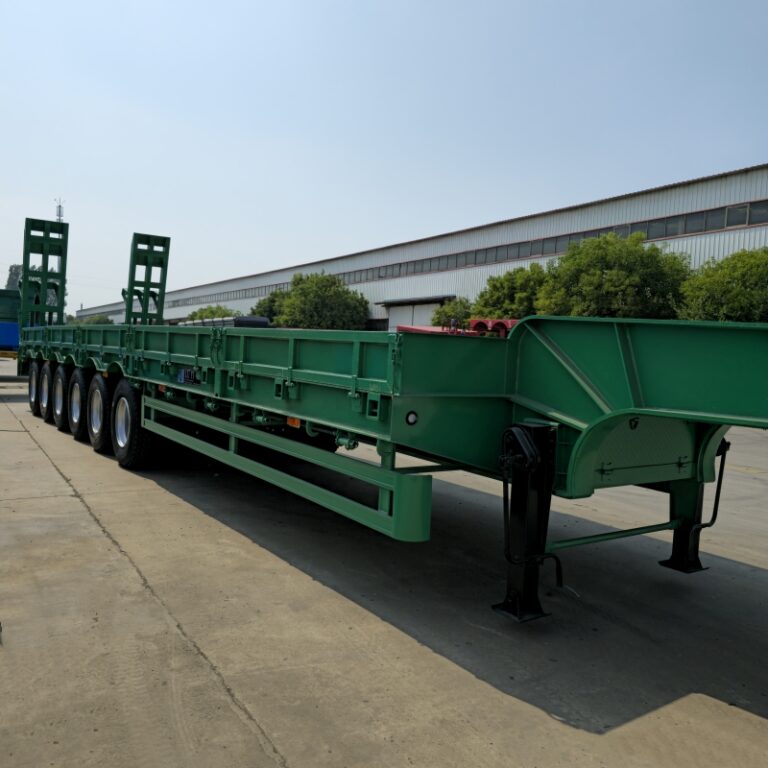
Blade trailers are usually built on a lowbed semi-trailer chassis to keep the center of gravity low. Many units share design DNA with wind mill transporter platforms, which are used for tower sections, nacelles, and hubs in addition to blades.
Types of Wind Turbine Blade Trailers — Which One Fits Your Route?
Not every wind farm is the same. Flat desert sites need different trailers than mountainous ridges or narrow village roads. Here are the four main categories.
1. Extendable Blade Trailer
The deck slides out like a telescope. A 20 m base bed can extend to 60 m or more. The blade rests on supports along the length. This is the simplest and most common design for onshore wind farms with reasonable road access.
Typical use: Blades up to 70 m on paved or graded roads.
Advantage: Lower cost, simple operation, easy to ship in a compact form.
Limit: Cannot lift or rotate the blade, so tight corners and overhead obstacles remain a problem.
2. Liftable / Rotatable Blade Trailer
This design adds a hydraulic lifting cradle near the gooseneck. The cradle can raise the blade root, lower the tip, or rotate the blade around its longitudinal axis. By changing the angle, the operator can pass under power lines or around buildings.
Typical use: Blades 50 m to 75 m in mixed terrain.
Advantage: Better obstacle clearance without changing the road path.
Limit: Heavier and more expensive than a basic extendable trailer.
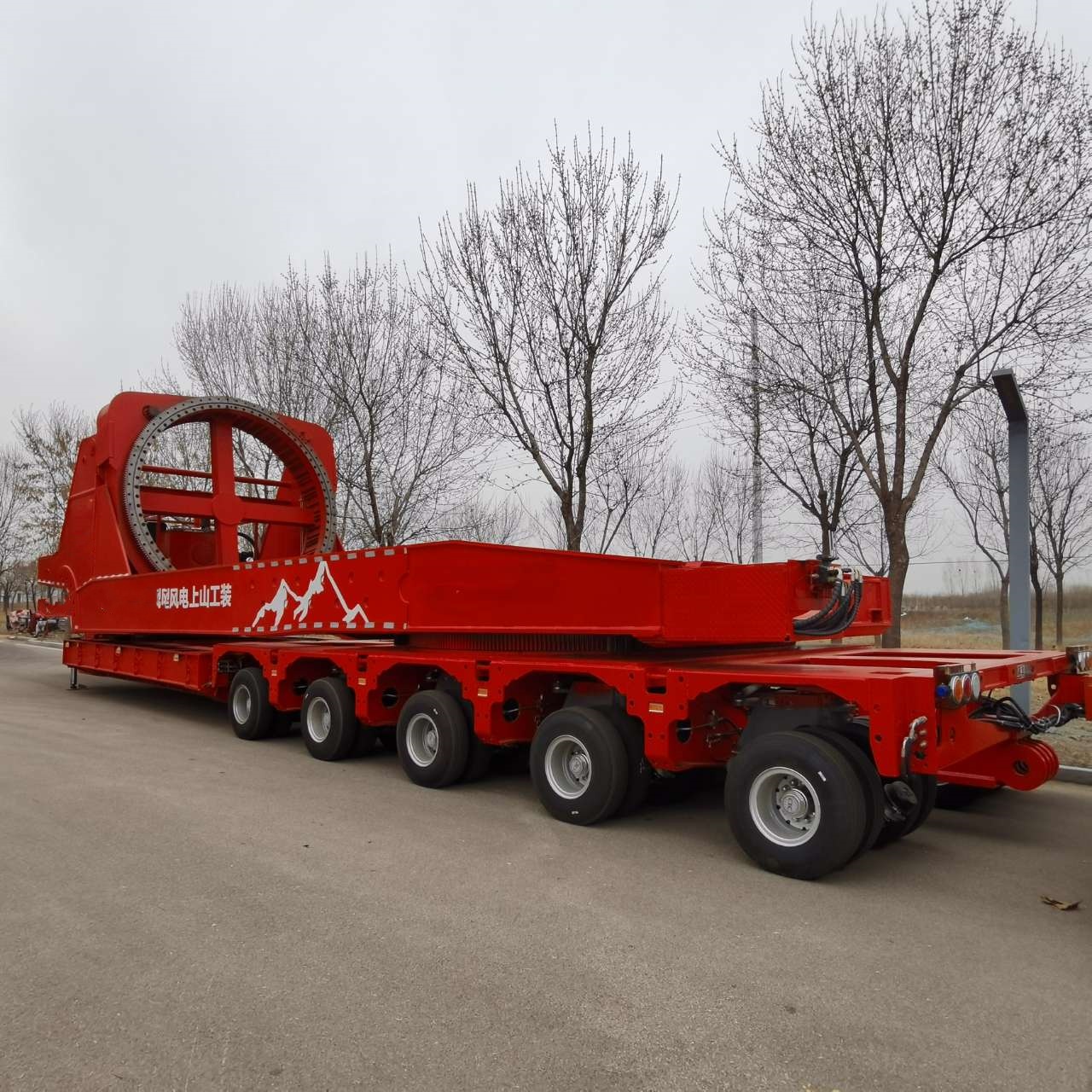
3. Mountain-Grade Wind Blade Transporter
Mountain wind farms in China, Turkey, Brazil, and South Africa often require climbing narrow, steep roads. A mountain-grade transporter uses a low, narrow chassis, multiple driven axles, hydraulic suspension, and sometimes a steering rear dolly. The blade can rotate 360° and tilt up to 60° to clear trees and rocks.
Typical use: Remote or steep sites, blades 40 m to 65 m.
Advantage: Can reach sites that conventional trailers cannot.
Limit: Higher tare weight, slower travel speed, longer transport time.
4. Modular Hydraulic Blade Trailer (Adapter)
Used for the largest offshore and onshore blades, this system combines a modular platform trailer with a blade adapter. The adapter grips the blade root and allows full 360° rotation and tip height adjustment. The platform underneath provides multiple axle lines and hydraulic steering.
Typical use: Blades over 70 m, especially offshore projects.
Advantage: Highest payload and maneuverability.
Limit: Most expensive option and requires skilled operators.
Key Specifications & What to Look For
Before you request a quote, confirm these parameters. They determine whether the trailer can legally and safely carry your blades.
| Spec | Light-Duty Extendable | Liftable / Rotatable | Mountain-Grade |
|---|---|---|---|
| Extendable Length | 20–58 m | 25–62 m | 18–50 m |
| Axles | 2–4 axles | 3–5 axles | 4–6 axles + dolly |
| Payload | 20–35 t | 25–45 t | 30–60 t |
| Tire Size | 385/65R22.5 | 385/65R22.5 | 425/65R22.5 or 385/65R22.5 |
| Steering | Mechanical / None | Hydraulic steering | Hydraulic + remote control |
| Blade Rotation | Fixed cradle | ±180° to 360° | 360° continuous |
| Main Beam | Q345B / Q690 high-strength steel | Q690 steel | Q690 + reinforced gooseneck |
Axle brand matters for maintenance. BPW and Fuwa are the most common in China. BPW axles cost 10–15% more but are widely supported in Europe and Africa. Fuwa axles are cheaper and spare parts are easy to find across Asia and the Middle East.
Braking should be WABCO or equivalent air brake with ABS. For long descents, ask about an exhaust brake or retarder option. Suspension should be mechanical, airbag, or hydraulic depending on road quality.
Price Guide — Wind Turbine Blade Trailer Costs from China (2026)
Prices depend on length, axle count, steel grade, hydraulic complexity, and the destination port. The table below shows realistic FOB China ranges based on current Shandong manufacturer quotes.
| Blade Trailer Type | Length Range | 2026 FOB Price (USD) |
|---|---|---|
| Standard extendable blade trailer | 20–45 m | $22,000–$38,000 |
| Long extendable blade trailer | 45–62 m | $35,000–$55,000 |
| Liftable / rotatable blade trailer | 25–60 m | $48,000–$78,000 |
| Mountain-grade wind blade transporter | 18–50 m | $65,000–$115,000 |
| Modular hydraulic blade adapter system | Custom per blade | $120,000–$200,000+ |
These are base unit prices. Extras such as ABS-EBS, GPS tracker, custom paint, spare tire carriers, toolboxes, and reinforced lashing points add 2–8%. Ocean freight to West Africa, the Middle East, or South America typically adds $3,000–$8,000 per unit depending on deck space.
How to Buy a Wind Turbine Blade Trailer from China — 6-Step Checklist
Buying specialized transport equipment from overseas is straightforward if you follow a checklist. Missing one step can lead to customs delays, port storage fees, or a trailer that does not match local road permits.
Step 1: Define your blade and route
Measure the blade length, weight, and root diameter. Map the worst corners, lowest overhead lines, bridge weight limits, and maximum gradients on your haul route. This determines whether you need a basic extendable trailer or a full mountain-grade system.
Step 2: Choose the right trailer type
Match the route constraints to the trailer capability. Flat, open sites suit extendable trailers. Mountainous or forested sites need liftable or rotatable systems. Long offshore blades usually need modular adapters.
Step 3: Confirm technical specs in writing
Ask for a spec sheet that lists main beam steel grade, axle brand and load rating, tire size, extendable length range, hydraulic pressure, rotation angle, and kingpin height. Do not rely on photos alone.
Step 4: Verify certifications
Request the manufacturer’s COC (Certificate of Conformity), welding procedure records, and axle brand certificates. If your country requires ADR, ECE, or local homologation, ask whether the factory can prepare the documentation before shipment.
Step 5: Agree on packaging and shipping
Long trailers are often shipped partially disassembled or telescoped to fit inside a 40HQ frame or on a flat-rack container. Confirm who pays for blocking, bracing, and port handling. Clarify Incoterms — FOB Qingdao is common.
Step 6: Inspect before balance payment
Request photos and a short video of the hydraulic system in operation. For large orders, hire a third-party inspector at the factory. Only release the balance payment after confirming the unit matches the signed spec sheet.
🚛 Get Your Wind Turbine Blade Trailer Quote Today
Tell us your blade length, route, and destination country. You’ll get a custom spec sheet and FOB price within 24 hours.
💬 WhatsApp: +86 15315477956
📋 Online Inquiry Form
📱 WeChat: +86 15315477956
Frequently Asked Questions
How long of a blade can a wind turbine blade trailer carry?
A standard extendable trailer can transport blades up to 60 m. With a multi-stage telescoping design and a blade adapter, some trailers can handle blades up to 80 m. For offshore blades exceeding 90 m, a modular platform with a hydraulic adapter is normally required.
What is the difference between a wind blade trailer and a lowbed trailer?
A lowbed trailer carries heavy, compact loads such as excavators and bulldozers. A wind turbine blade trailer is built around an extendable or rotatable deck that supports a long, slender blade. The chassis is lower and longer, and it includes hydraulic or steering systems that a normal lowbed does not need.
Can one trailer carry blades of different lengths?
Yes, if it is extendable. The deck can be adjusted to match the blade length. However, the cradle or adapter must fit the blade root diameter. Some operators keep multiple cradles for different blade models and swap them on the same trailer chassis.
Which axle brand is better for wind blade trailers — BPW or Fuwa?
Both are reliable. BPW is preferred in markets where European spare parts are easy to source. Fuwa is more common in Asia, Africa, and the Middle East because of lower cost and faster parts availability. Choose based on your local maintenance network.
Do Chinese wind blade trailers meet international standards?
Reputable manufacturers build to GB/T, ISO, and EN standards for welding and braking. Many can also supply ADR or ECE documentation on request. Always ask for the COC and axle certificates before placing an order, and confirm whether your import country requires additional homologation.
How are wind turbine blade trailers shipped?
They are usually telescoped to the shortest length, loaded on a flat-rack container or Ro-Ro vessel, and secured with welded lugs and chains. Ocean freight from Qingdao to West Africa takes 25–35 days, and to the Middle East takes 18–25 days. Disassembly and reassembly at the destination are usually the buyer’s responsibility.
Why Choose Nanou Trailer?
Nanou Trailer is a Shandong-based manufacturer exporting semi-trailers to more than 40 countries. Our wind mill transporter range includes extendable, liftable, and mountain-grade models for onshore and offshore wind projects.
- Custom engineering: We match axle count, deck length, cradle type, and hydraulic options to your blade and route.
- Document support: We provide COC, welding records, axle certificates, and homologation assistance for most African, Middle Eastern, and Latin American markets.
- Competitive pricing: Factory-direct pricing from Shandong means no middleman markup. Typical blade trailers ship at 15–25% below European equivalents.
- After-sales parts: We keep spare parts for Fuwa and BPW axles, hydraulic cylinders, and common wear components in stock for export.
🚛 Get Your Wind Turbine Blade Trailer Quote Today
Send us your blade specs and destination. We will recommend the right wind turbine blade trailer and send an FOB quote within 24 hours.
💬 WhatsApp: +86 15315477956
📋 Online Inquiry Form
📱 WeChat: +86 15315477956
Related Articles
- Wind Mill Transporter Product Range — Browse extendable, liftable, and mountain-grade models from Nanou.
- Lowbed Semi Trailer Catalog — Heavy-haul lowbeds for construction, mining, and wind energy equipment.
- Special Transporter Semi Trailer — Custom trailers for oversized and abnormal loads.
- Wind Power Mountain Utility Car — A mountain-grade transport solution for wind farm access roads.