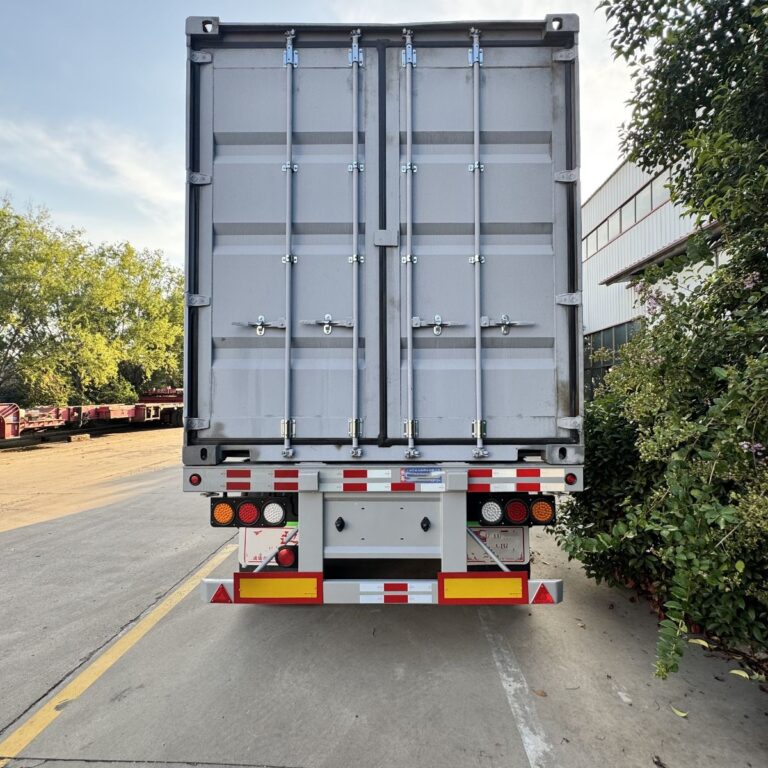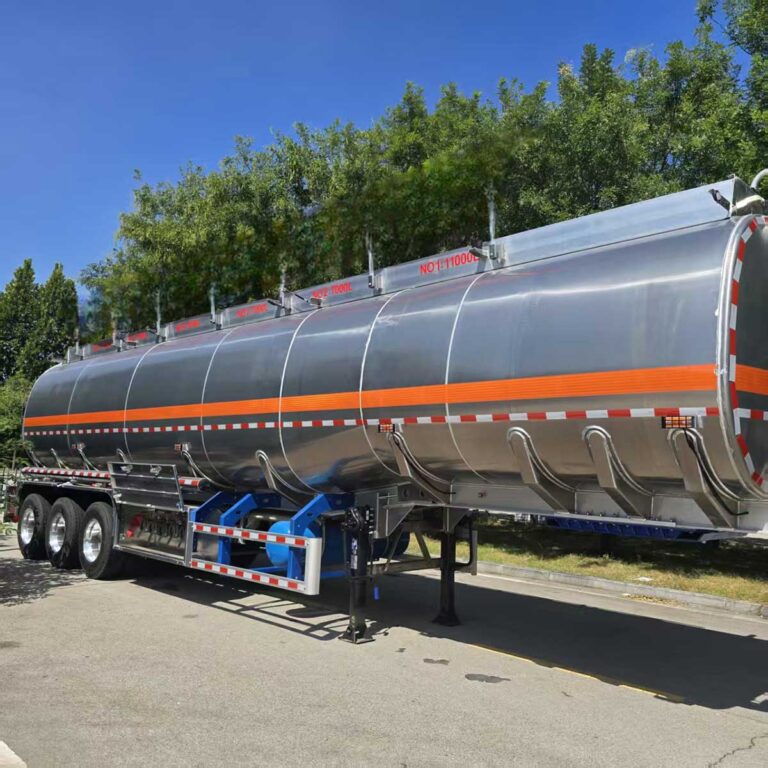


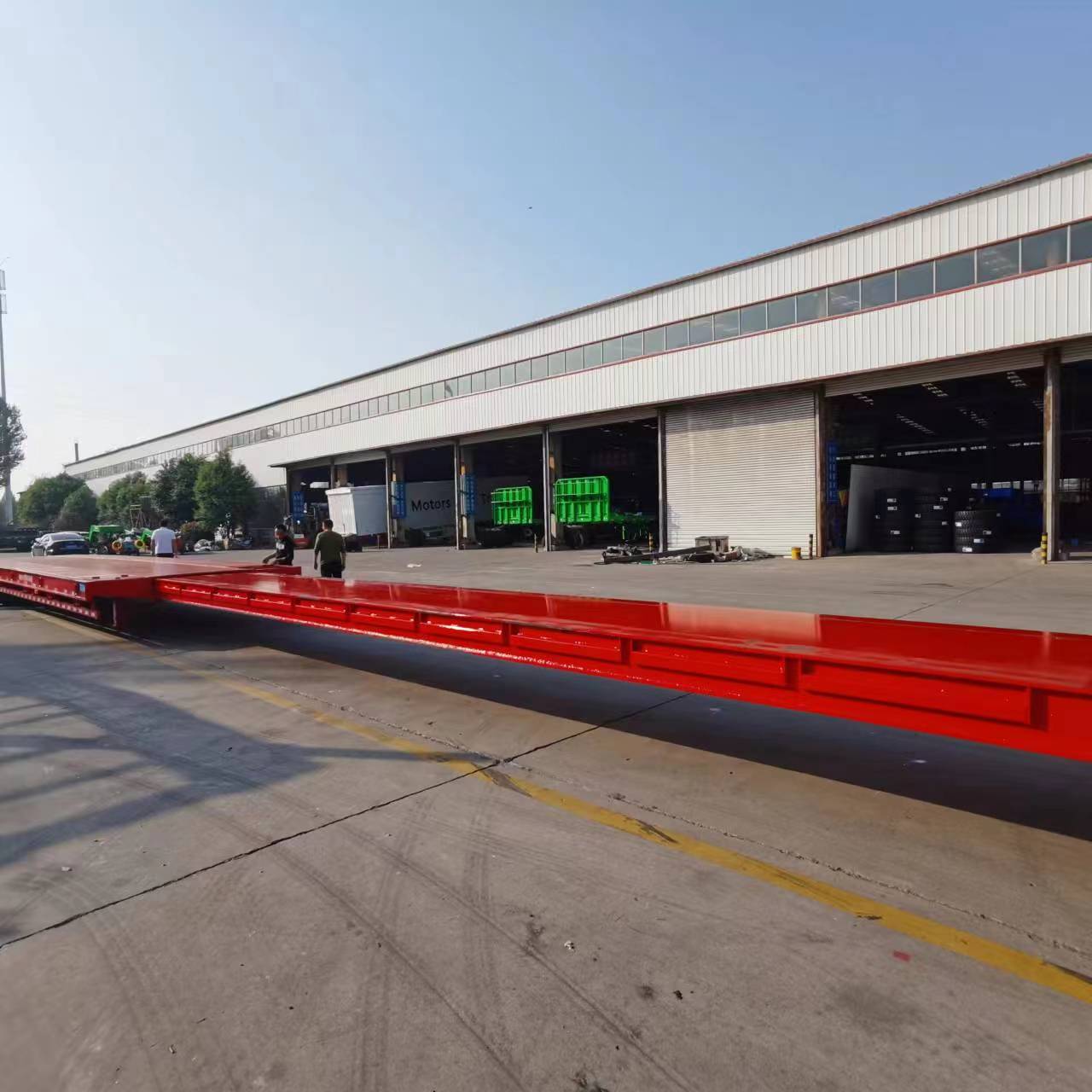
Special Transport Trailer for Sale: Types, Specs & Prices from China Manufacturer (2026)
Special Transport Trailer for Sale: Types, Specs & Prices from China Manufacturer (2026)
Summary: A special transport trailer is built for cargo that breaks standard dimension or weight limits — wind turbine blades, bridge girders, mining shovels, or bundled timber. This guide breaks down the four main types of heavy-haul trailers (hydraulic gooseneck, pull-type lowbed, multi-axle modular, and timber carriers), their axle layouts, load ratings, and 2026 FOB prices from Shandong manufacturers. You will also get a 6-step import checklist and answers to the most common questions about permits, escort rules, and hydraulic systems.
When a crawler crane weighs 120 tonnes or a wind blade stretches past 60 metres, a standard flatbed or lowbed trailer will not cut it. You need a special transport trailer — a heavy-haul platform engineered with hydraulic necks, extra axles, and reinforced frames to move cargo that exceeds legal road limits.
Shandong province, home to Nanou Trailer, produces roughly 40 % of China’s heavy-haul trailer output. Local shops ship special transporters to mines in Chile, wind farms in South Africa, and highway projects in the Middle East. In this article we explain what makes these trailers different, which type matches your cargo profile, and what you should budget in 2026.
What Is a Special Transport Trailer and When Do You Need One?
A special transport trailer is any semi-trailer designed to carry oversize or overweight cargo that cannot be broken into smaller loads. Unlike a standard 40-tonne lowbed, these units often feature:
- Hydraulic folding or detachable goosenecks that let the trailer deck drop to ground level for self-loading
- 3 to 6 axle lines (and more with dollies) to spread axle loads below 10–12 tonnes per axle
- Concentrated load beams rated for 80–150 tonnes at the centre
- Modular design so sections bolt together for longer or wider payloads
You need one when your cargo exceeds standard trailer ratings. A 45-tonne excavator on a three-axle lowbed will overload the frame and tyres. A 55-metre wind blade on a standard extendable trailer will overhang dangerously. In both cases, a special transport trailer is the only safe, legal option.
Types of Special Transport Trailers — Which One Fits Your Load?
1. Hydraulic Gooseneck (Folding-Neck) Trailers
The gooseneck houses a hydraulic cylinder that raises and lowers the front of the deck. For loading, the neck folds down until the deck touches the ground — a tracked machine simply drives on. No ramps, no cranes. Typical capacities run from 60 to 120 tonnes. Deck widths are 2.5 m to 3.0 m, with extendable side brackets for wider cargo. The 6-axis hydraulic goose head ladder truck in our range uses a 25 MPa hydraulic system and BPW axles rated at 9 tonnes per line.
2. Pull-Type Lowbed Trailers
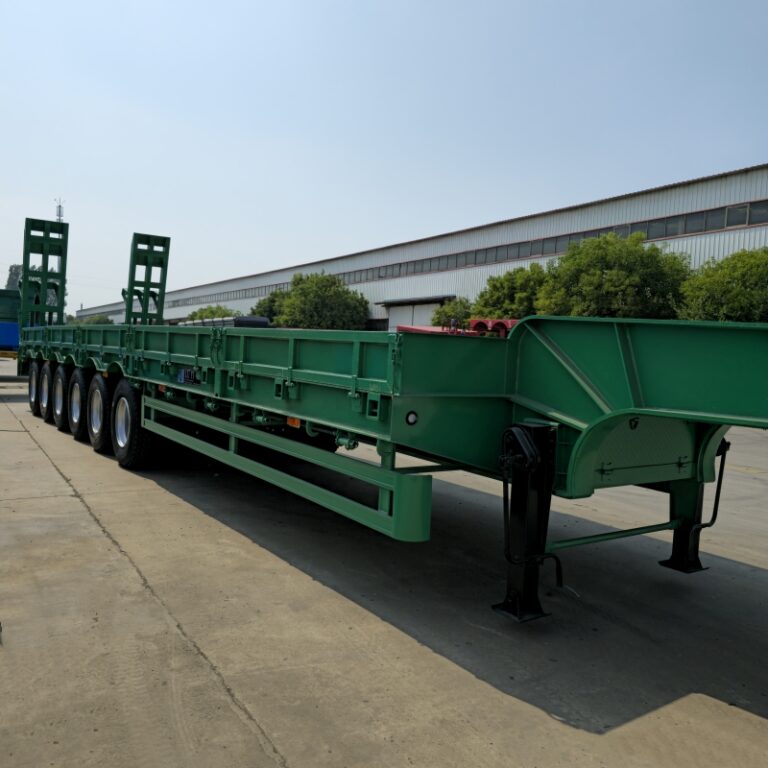
These are towed by a heavy tractor through a drawbar or turntable coupling instead of a fifth-wheel kingpin. The layout is popular in rough-terrain mines and forestry roads where articulation matters more than highway speed. Pull-type units often run on 385/65R22.5 super-single tyres and can be fitted with hydraulic suspension for self-levelling on uneven ground. Our pull type low flatbed truck is specced for 80-tonne concentrated loads with four steerable axle lines.
3. Multi-Axle Modular Trailers
For the heaviest jobs — 200-tonne transformers or bridge beams — modular trailers link end-to-end and side-by-side. Each module carries 2 or 3 axle lines and connects via hydraulic hard lines so all axles steer and raise in unison. A typical 6-module train with 18 axle lines can haul 300+ tonnes at 5 km/h. The large special transport semi-trailer in our catalogue uses a bolt-together modular frame and optional self-propelled power pack (SPMT-style) for yard moves without a tractor.
4. Timber & Heavy Haul Transporters
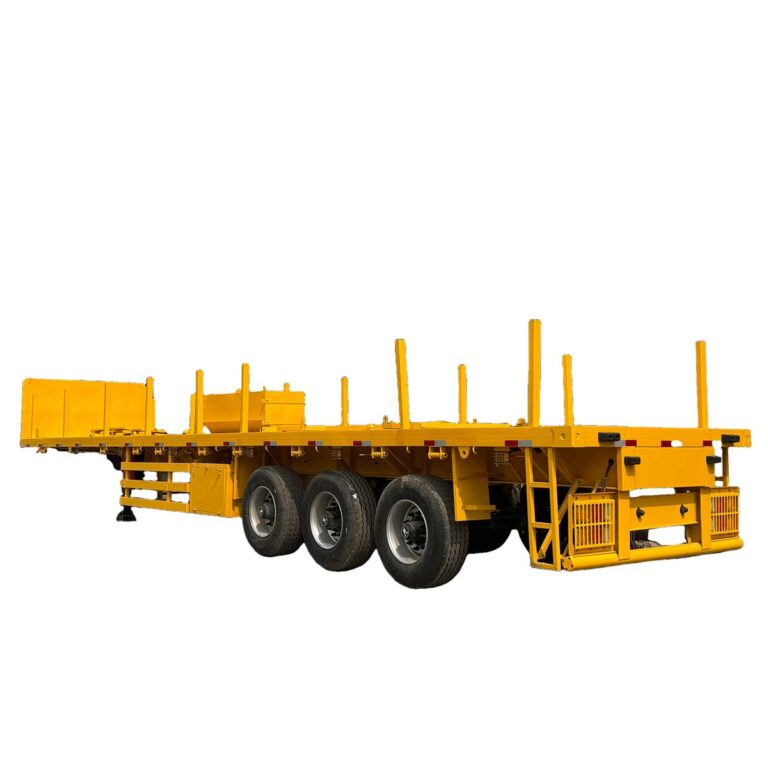
Timber carriers combine a reinforced frame with stake pockets and grapple anchors. They are not always “oversize,” but the concentrated load of hardwood logs demands the same frame engineering as a heavy-haul deck. Our timber carrier uses a Q690 high-strength steel main beam and three rows of stake pockets spaced at 800 mm centres.
Key Specifications & What to Look For
Below is a side-by-side comparison of the four main variants. Use it to match trailer specs to your cargo envelope and route restrictions.
| Spec | Hydraulic Gooseneck | Pull-Type Lowbed | Multi-Axle Modular | Timber Carrier |
|---|---|---|---|---|
| Axle lines | 3–6 | 4–6 | 6–18+ | 2–4 |
| Max payload | 60–120 t | 80–150 t | 200–400 t | 40–70 t |
| Deck height (loaded) | 800–1,000 mm | 700–950 mm | 1,200–1,500 mm | 1,100–1,300 mm |
| Loading method | Hydraulic ground-level drop | Ramps or crane | Crane / SPMT roll-on | Loader / grapple |
| Main beam steel | Q690 / HG60 | Q690 / HG70 | Q890 / Weldox 700 | Q690 |
| Tyre size | 385/65R22.5 | 385/65R22.5 | 215/75R17.5 (module) | 11.00R20 / 12R22.5 |
| Axle brand | BPW / FUWA | BPW / FUWA | Hydraulic axle (self-steer) | FUWA / BPW |
| Гидравлическая система | 16–25 MPa | Optional 20 MPa | 25–35 MPa (central pump) | None |
Key buying tip: Ask for the concentrated load rating at the centre of the deck, not just the overall payload. A trailer rated for 100 tonnes “evenly distributed” may only handle 60 tonnes at the centre beam — and that is where your excavator’s tracks will sit.
Price Guide — Special Transport Trailer Costs from China (2026)
Prices below are FOB Qingdao / Lianyungang in US dollars. They assume standard Q690 frame steel, BPW or FUWA axles, and hydraulic gooseneck where listed. Landing costs (sea freight, import duty, and inspection) add 18–35 % depending on destination.
| Trailer Type | Axle Count | Payload Range | FOB Price (USD) |
|---|---|---|---|
| 3-axle hydraulic gooseneck lowbed | 3 | 60 t | $22,000 – $28,000 |
| 4-axle hydraulic gooseneck | 4 | 80 t | $28,000 – $36,000 |
| 5-axle folding-neck heavy haul | 5 | 100 t | $35,000 – $45,000 |
| 6-axle hydraulic gooseneck (extendable) | 6 | 120 t | $42,000 – $55,000 |
| Pull-type lowbed (4-axle, steerable) | 4 | 80 t | $30,000 – $40,000 |
| Multi-axle modular (per 3-axle module) | 3 | 60 t / module | $38,000 – $50,000 |
| Timber carrier (3-axle, high-strength frame) | 3 | 50 t | $18,000 – $24,000 |
What moves the price needle? Axle brand (BPW adds ~8 % over FUWA), hydraulic valve blocks (Rexroth vs. domestic), extendable deck length (+$3,000–$6,000), and central-inflation tyre systems (+$1,200 per axle line). If your route includes narrow mountain passes, specify hydraulic all-wheel steering — it adds cost but saves you from hiring a second trailer for cornering.
🚛 Get Your Special Transport Trailer Quote Today
Tell us your cargo weight, dimensions, and destination country. We will spec the right axle count, neck type, and deck length — and send an FOB quote within 24 hours.
💬 WhatsApp: +86 15315477956
📋 Online Inquiry Form
📱 WeChat: +86 15315477956
How to Buy a Special Transport Trailer from China — 6-Step Checklist
- Measure your heaviest and widest piece of cargo. Record weight, length, width, height, and centre-of-gravity position. A 45-tonne excavator and a 45-tonne transformer need different decks because the excavator’s load is spread over tracks while the transformer sits on four narrow footpads.
- Map your worst route. Note bridge weight limits, tunnel heights, and minimum turning radius. In South Africa, the N3 corridor allows 56 tonnes gross; in Chile’s Andes passes, you may be limited to 8 tonnes per axle.
- Choose the neck and axle layout. For self-loading tracked machines, pick a hydraulic folding neck. For static heavy lifts, a fixed-neck multi-axle modular train is cheaper and stronger.
- Request a concentrated-load engineering sheet. Reputable builders will run FEA on the main beam and send you a signed load chart. Do not accept a generic “100-tonne” claim without the beam cross-section and weld specification.
- Confirm hydraulic component brands. Ask for the hydraulic pump, valve block, and cylinder manufacturer. Rexroth, Parker, and Husco are proven in sub-zero and desert heat. Cheap domestic copies fail under cyclic loading.
- Lock in Incoterms and payment terms. Most Shandong manufacturers quote FOB Qingdao with 30 % T/T deposit and 70 % against BL copy. For orders above $80,000, negotiate an L/C at sight to protect both parties.
Frequently Asked Questions
What is the difference between a special transport trailer and a standard lowbed trailer?
A standard lowbed trailer is designed for general cargo up to about 60 tonnes with even weight distribution. A special transport trailer uses thicker main beams (Q690 or Q890 steel), extra axle lines, and often a hydraulic gooseneck to handle concentrated loads above 80 tonnes or cargo that exceeds standard width and height limits. Special trailers also include engineering documentation and load charts that standard trailers do not.
Do I need a permit to move an oversize load on a special transport trailer?
Yes, in virtually every country. Permits are issued by the national or state road authority and specify route, travel times, escort vehicle requirements, and maximum dimensions. In the United States, anything over 2.6 m wide or 4.11 m high triggers a wide-load permit. In the EU, abnormal load permits can take 5–10 working days. Your trailer supplier cannot obtain these for you, but they can provide the exact dimensions and axle-load data you need for the application.
How many axles do I need for a 100-tonne excavator?
At 100 tonnes payload plus 20 tonnes trailer tare, you have 120 tonnes gross. Divided by a 10-tonne-per-axle limit, you need 12 axle lines. A common layout is a 6-axle trailer plus a 3-axle jeep dolly and 3-axle booster at the rear. If your destination allows 12 tonnes per axle (some mining roads do), a 5-axle trailer with 2+2 dollies may suffice. Always design for the strictest axle limit on your route, not the average.
Can a hydraulic gooseneck trailer be used without a ramp?
Yes, that is the main point of the design. The hydraulic cylinder lowers the gooseneck until the deck angle is near zero — typically within 3–5 degrees. Tracked equipment simply drives onto the deck. The neck then hydraulically raises back to towing position and locks with mechanical pins. The entire process takes 3–5 minutes and requires no external crane or ramp.
What maintenance does a special transport trailer need?
Beyond standard greasing and brake-pad checks, inspect the hydraulic cylinder seals every 250 operating hours for leaks. Check main-beam weld joints annually with dye-penetrant testing — stress cracks usually start at the neck-deck junction. Replace super-single tyres in sets (not individually) to keep axle loads balanced. If your trailer has hydraulic steering, flush the steering fluid every 12 months. These steps sound expensive, but a single cracked main beam on a remote job site will cost far more in downtime.
How long does it take to manufacture a custom special transport trailer?
Standard configurations with 3–4 axles ship in 25–30 days from order confirmation. Custom modular trains or extendable decks with hydraulic steering need 45–60 days because the beam welding and hydraulic pipe routing are done by hand. Sea freight to West Africa or South America adds another 35–50 days. Plan your procurement cycle so the trailer arrives two weeks before the cargo is ready to move.
Why Choose Nanou Trailer?
- Heavy-haul engineering team: Our designers have built trailers for 150-tonne mining trucks and 65-metre wind blades. Every frame is FEA-checked before the first weld.
- Proven export logistics: We have shipped special transporters to 40+ countries, including Chile, Peru, Nigeria, Saudi Arabia, and Kazakhstan. We know which ports accept oversize RORO and which require flat-rack loading.
- Modular customisation: Need a 9-metre deck instead of 12? Want BPW axles with central tyre inflation? We build to order, not from a fixed catalogue.
- Post-sale support: We ship spare hydraulic seal kits, brake calipers, and tyre assemblies with every trailer, and we keep your BOM on file for rapid re-ordering.
🚛 Ready to Move Your Heaviest Cargo?
Send us your cargo specs and route details. We will recommend the right special transport trailer configuration and deliver a firm FOB quote within one business day.
💬 WhatsApp: +86 15315477956
📋 Online Inquiry Form
📱 WeChat: +86 15315477956
Related Articles
- Browse all Special Transporter Semi Trailers — see live specs and request individual quotes.
- U-Shape Dump Semi Trailer for Sale: Types, Specs & Prices (2026) — if your haul also includes loose aggregate.
- Skeleton Semi Trailer for Sale: Types, Specs & Prices (2026) — for container chassis options.
- Semi Trailer Price Guide 2026 — cross-type pricing and landed-cost estimates.