

How to Choose a Container Transport Trailer: Complete Buyer’s Guide (2026)
Choosing the right container transport trailer can cut your per-container hauling cost by 15–25% and extend chassis life past 15 years. The wrong spec, however, leads to overweight fines, damaged corners, and delivery delays that cost far more than the trailer itself.
This guide breaks down every container trailer type sold by Chinese manufacturers in 2026, the payload and dimension limits that matter for 20 ft, 40 ft and 45 ft boxes, and real FOB prices you can use to benchmark quotes. Whether you run a port drayage fleet, a cross-border logistics line, or a construction site receiving ISO containers, you will know exactly which chassis to order after reading this.
Summary: What You Will Learn
- The 5 container transport trailer chassis types and which ISO sizes each handles
- Payload ratings, axle configurations, and kingpin heights that determine compatibility with your tractor fleet
- 2026 China FOB price ranges from $12,500 to $38,000 depending on spec
- A 6-step procurement checklist to avoid specification mismatches and import paperwork delays
- Answers to the 6 most common buyer questions about container carriers
What Is a Container Transport Trailer?
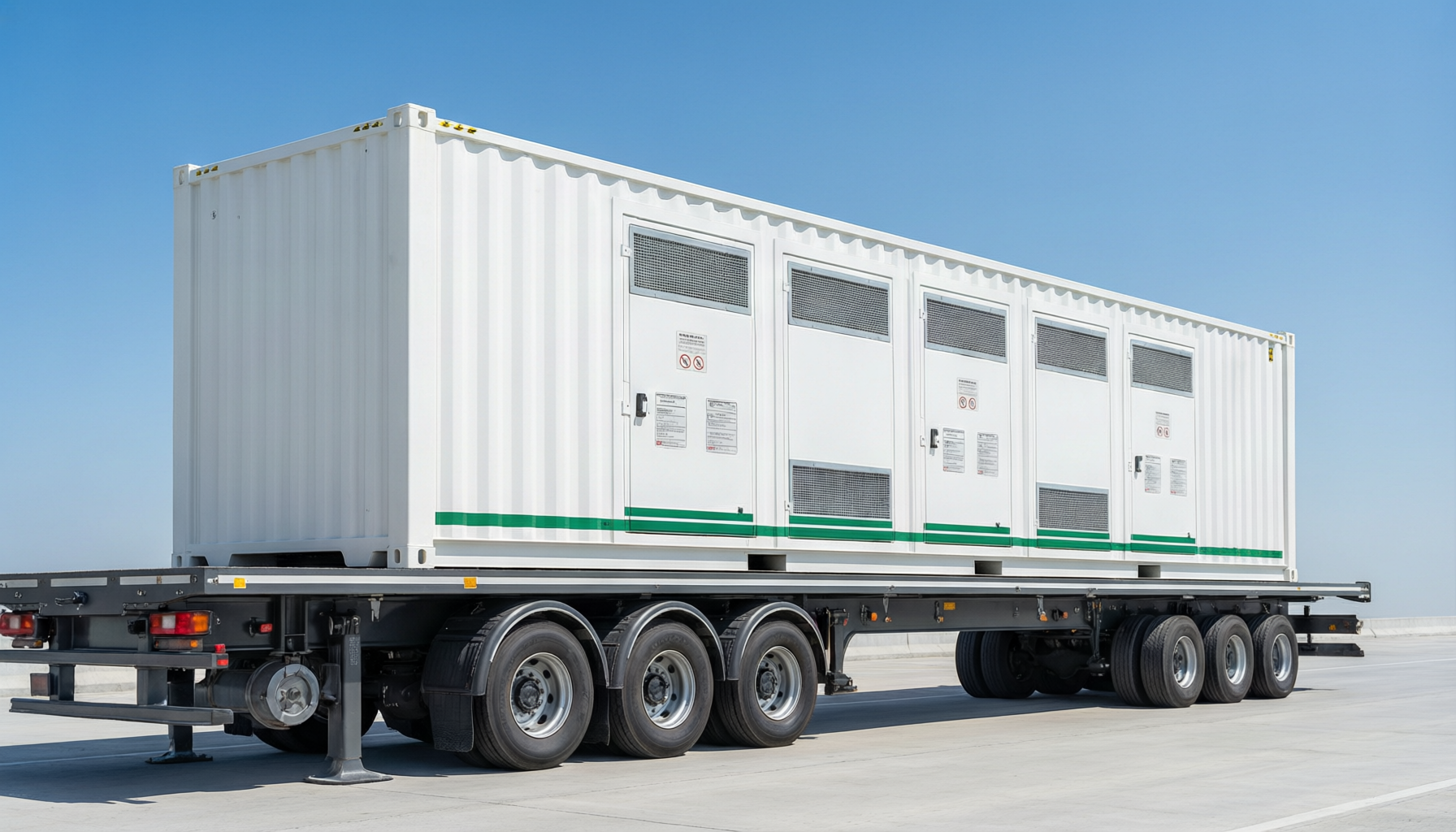
A container transport trailer — also called a container chassis, container carrier, or skeletal trailer — is a semi-trailer built specifically to carry one or more ISO shipping containers. Unlike flatbeds that require chains and binders, a container trailer uses twist-lock corner castings at precise 20 ft, 40 ft or 45 ft intervals so the box drops on and locks in seconds.
The global container chassis fleet is aging. In North America the average chassis is now 12.7 years old, and port congestion in 2024–2025 pushed many operators to order new units rather than refurbish. Chinese manufacturers, led by Shandong-based builders like Nanou Trailer, have responded with gooseneck designs, lightweight high-tensile steel frames, and multi-position locking systems that handle 20 ft, 40 ft and 45 ft boxes on the same frame.
Types of Container Transport Trailers — Which One Fits Your Operation?
Not every container carrier is built the same. Below are the five designs you will see from Chinese factories in 2026, ranked by how common they are in export orders.
1. Gooseneck Container Chassis
The gooseneck design drops the front platform below the fifth-wheel height, letting you load a 40 ft container at the legal 4,000 mm overall height in most jurisdictions while keeping the center of gravity lower than a standard flat deck. Nanou’s 3-axle gooseneck container transport vehicle uses this layout with three BPW or FUWA axles rated at 13 tonnes each, giving a combined payload around 55–60 tonnes depending on tractor spec.
Best for: Heavy 40 ft high-cube containers, routes with height-restricted tunnels or bridges, and markets where overall height enforcement is strict.
2. Standard Container Frame Semi-Trailer (Skeleton)
The classic skeletal trailer is nothing more than a steel ladder frame with twist locks and landing legs. It is the lightest option — tare weight can be as low as 4,200 kg for a two-axle 40 ft unit — which means more payload left for the container contents. Nanou’s 3-axis container frame semi-trailer adds a middle axle for markets that require tri-axle configurations on highways.
Best for: Port drayage, short-haul depot transfers, and weight-sensitive jurisdictions where every kilogram of tare matters.
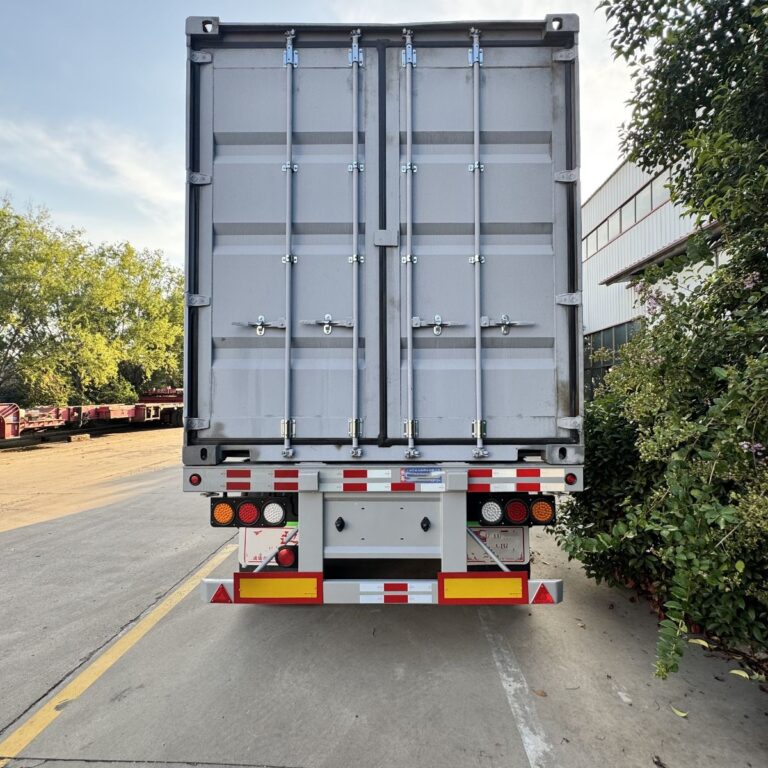
3. Van / Box Type Container Trailer
Some buyers need the container protected from weather and theft during overland legs. A van-type or box-type trailer uses a fixed enclosed body with rear doors, effectively turning the trailer itself into a rolling container. These are common in e-commerce logistics and parcel express lines where the cargo is loose-loaded rather than pre-packed into a steel box.
Best for: Express logistics, high-value electronics, and routes with frequent stops where unloading a steel ISO box is impractical.
4. Side Curtain Container Trailer
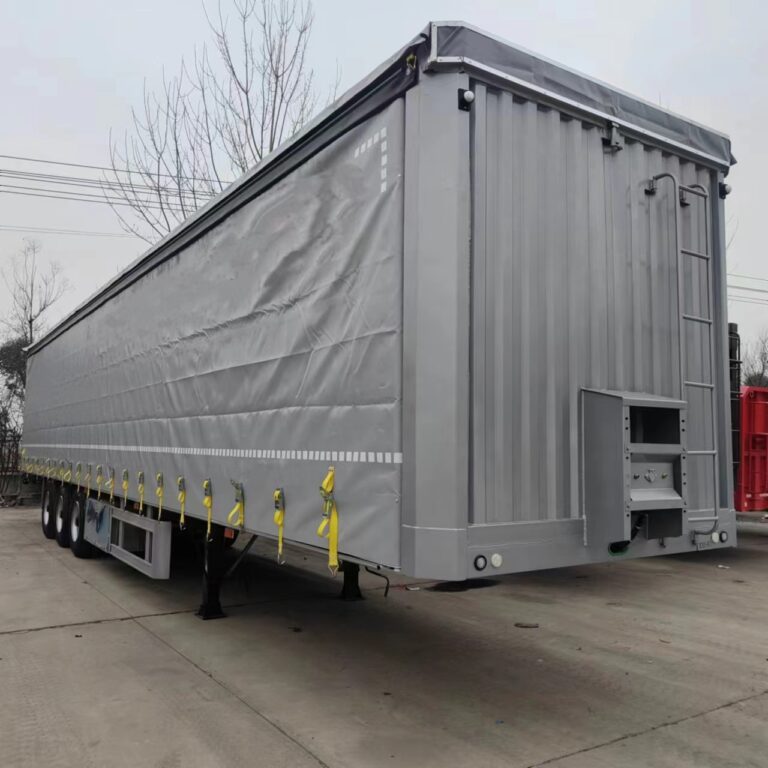
A side curtain trailer combines the fast loading of a flatbed with the weather protection of a van. Curtains on both sides slide open so a forklift can load pallets from the side, while the roof and rear remain enclosed. Many models also accept a 40 ft container on the bed when the curtains are retracted, giving dual-purpose flexibility.
Best for: Mixed freight operations that swing between palletized cargo and containerized loads.
5. Rollover Van Type Semi-Trailer
The rollover design lets the cargo body tilt sideways for bulk discharge — useful when the “container” is actually a swap body filled with grain, powder, or construction aggregate. Nanou’s rollover van type semi trailer offers this tipping function on a container-compatible frame.
Best for: Agricultural bulk export, construction material transport, and any operation where the load needs to empty by gravity rather than manual or mechanical offload.
Key Specifications & What to Look For
When you request a quote, these are the numbers that separate a usable chassis from a liability.
| Spec | 20 ft Chassis | 40 ft Chassis | 45 ft Gooseneck |
|---|---|---|---|
| Overall length | 7,200–7,600 mm | 12,400–12,600 mm | 13,900–14,200 mm |
| Tare weight | 3,500–4,500 kg | 4,500–5,800 kg | 6,200–7,500 kg |
| Payload (3 axles) | 35–40 tonnes | 45–55 tonnes | 50–60 tonnes |
| Axle config | 2 axles (13 t each) | 2–3 axles (13 t each) | 3 axles (13 t each) |
| Kingpin height | 1,240 mm (ISO) | 1,240 mm (ISO) | 1,240 mm (ISO) |
| Twist-lock spacing | 5,850 mm | 11,990 mm | 11,990 + 45 ft ext |
| Main beam steel | Q345 / Q460 | Q345 / Q460 | Q460 / Q550 high-tensile |
Steel grade matters. Q345 is the baseline structural steel used in most Chinese chassis. If you plan to haul max-weight 40 ft high-cube containers (30.48 tonnes gross) plus a heavy tractor in mountainous terrain, ask for Q460 or Q550 high-tensile steel. The frame weight drops roughly 8–12%, and fatigue life improves because the thinner web resists crack propagation better under cyclic loading.
Twist-lock grade is equally important. ISO corner castings exert a 25-tonne vertical load at each lock during a hard braking event. Cast steel locks rated below 30 tonnes have been known to shear. Nanou Trailer uses forged 45# steel twist locks rated at 35 tonnes per corner — above the ISO 668 requirement.
Price Guide — Container Transport Trailer Costs from China (2026)
Prices below are FOB Qingdao/Tianjin in USD, based on August 2026 raw-material indices (hot-rolled coil at roughly $520/tonne ex-mill Shandong). They assume standard BPW or FUWA axles, 12R22.5 tyres, and manual landing legs. Air suspension, ABS/EBS, and aluminium decks are quoted as add-ons.
| Chassis Type | Size | Axles | FOB Price (USD) |
|---|---|---|---|
| Standard skeleton | 20 ft | 2 | $12,500 – $14,800 |
| Standard skeleton | 40 ft | 2 | $14,200 – $16,500 |
| Standard skeleton | 40 ft | 3 | $16,800 – $19,500 |
| Gooseneck chassis | 40 ft / 45 ft | 3 | $22,000 – $26,000 |
| Van / box type | 40 ft | 3 | $24,500 – $29,000 |
| Side curtain | 40 ft | 3 | $26,000 – $31,000 |
| Rollover van type | 40 ft | 3 | $32,000 – $38,000 |
Common add-ons and their cost impact:
- Air suspension (vs mechanical leaf): +$2,800 – $4,200
- ABS / EBS braking system: +$800 – $1,400
- Aluminium alloy floor plates (vs steel): +$1,500 – $2,200
- Multi-position twist locks (20 ft + 40 ft + 45 ft combo): +$600 – $900
- Lift axle (steerable tag axle): +$3,500 – $4,800
Most African and Middle East buyers order the 3-axle 40 ft skeleton with mechanical suspension and ABS as the baseline spec. It hits the sweet spot of payload capacity, parts availability, and upfront cost.
How to Buy a Container Transport Trailer from China — 6-Step Checklist
- Define your container mix. Will you haul 20 ft, 40 ft, 45 ft, or all three? If the mix changes daily, order multi-position twist locks. If you only move 40 ft high-cubes, a fixed 40 ft gooseneck saves weight and cost.
- Match axle count to local law. Many African countries limit single-axle loads to 10 tonnes, so a 2-axle chassis with 13-tonne axles may be technically legal but leaves no margin. A 3-axle configuration spreads the same load across six tyres and avoids roadside penalties.
- Request a material certificate. Ask your supplier for a mill test certificate (MTC) showing the steel grade, yield strength, and chemical composition. Q460 steel should show a minimum yield of 460 MPa. If the factory cannot produce the MTC, treat it as a red flag.
- Specify landing-leg capacity. Cheap chassis often ship with 16-tonne landing legs. For a loaded 40 ft container, you need 25-tonne or 28-tonne legs. The extra $120 is cheaper than a bent leg and a dropped box.
- Confirm painting spec. Coastal ports and salt-laden roads destroy poorly painted steel. Demand shot-blasting to SA 2.5, zinc-rich primer (60–80 µm), and a polyurethane topcoat (80–100 µm). Total dry-film thickness should exceed 160 µm.
- Lock in Incoterms and payment. FOB China port is standard for 1–3 units. For 6+ units, ask for CFR or CIF to your nearest port. Typical payment is 30% T/T deposit, 70% before shipment. Avoid 100% upfront with any supplier you have not visited.
Get Your Container Transport Trailer Quote Today
Tell us your container size, route, and destination port. You will receive a custom spec sheet and FOB price within 24 hours.
WhatsApp: +86 15315477956
Online Inquiry Form
WeChat: +86 15315477956
Frequently Asked Questions
What is the average price of a container transport trailer from China?
In 2026, a standard 40 ft 3-axle skeleton container transport trailer from a Shandong manufacturer costs between $16,800 and $19,500 FOB. A gooseneck chassis runs $22,000–$26,000, while specialized units like rollover van types reach $32,000–$38,000. These prices assume standard mechanical suspension, steel construction, and 12R22.5 tyres.
Can one trailer carry both 20 ft and 40 ft containers?
Yes, if you order multi-position twist locks. Most Chinese factories install sliding or multiple fixed lock positions along the main beam so the same chassis accepts 20 ft, 40 ft, and sometimes 45 ft boxes. The trade-off is a slightly heavier frame (+150–250 kg) and a $600–$900 premium. For fleets that haul mixed sizes daily, this flexibility pays back within the first year.
How long does shipping take from China to Africa or the Middle East?
Sea freight from Qingdao or Tianjin to West Africa (Lagos, Tema, Abidjan) is typically 28–35 days. To East Africa (Mombasa, Dar es Salaam) expect 22–28 days. To Jebel Ali (UAE) or Jeddah (Saudi Arabia) the transit is 18–24 days. Add 5–7 days for customs clearance and inland haulage at the destination port.
What documents do I need to import a container trailer?
The standard export document pack from a Chinese manufacturer includes: commercial invoice, packing list, bill of lading, certificate of origin, and a chassis VIN/identification plate. Depending on your country, you may also need a conformity certificate (SASO for Saudi Arabia, SONCAP for Nigeria, or COI for Algeria). Reputable factories like Nanou Trailer can arrange third-party inspection (SGS, BV, or CCIC) before shipment.
Are Chinese container trailers compatible with European or American tractors?
Yes. The ISO 3842 kingpin height of 1,240 mm is universal. Fifth-wheel coupling dimensions (50 mm or 90 mm kingpin) are built to order. Brake systems can be configured for dual-line air (common in Europe and Africa) or single-line air with spring parking brakes. Electrical connectors are typically 24 V 7-pin ISO 1185, but 12 V SAE J560 adapters are available. Tell your sales contact which tractor brand you run (Volvo, Mercedes, Mack, Sinotruk, etc.) and the factory will match the coupling spec.
How many years will a container chassis last in harsh conditions?
A well-built steel chassis with proper paint protection lasts 12–15 years in moderate climates. In coastal or highly corrosive environments, life can drop to 8–10 years unless you specify hot-dip galvanizing of the frame (+$1,800–$2,500) or annual touch-up painting. The twist locks and landing legs are wear items: expect to replace bushings and pins every 4–5 years under heavy use.
Why Choose Nanou Trailer?
15+ years building container chassis for export. Nanou Trailer has shipped skeletal, gooseneck, and van-type container carriers to more than 40 countries. The factory is located in Shandong Province — China’s densest cluster of semi-trailer manufacturing — which means access to tier-1 steel mills, BPW/FUWA axle distributors, and tyre suppliers within a 200 km radius.
Steel you can verify. Every main beam ships with a mill test certificate. Q345 and Q460 grades are sourced from state-owned mills (Shougang, Baowu, or Shandong Steel) and cut on CNC plasma tables to minimize heat-affected zones.
Container-specific know-how. Nanou’s engineers understand ISO corner casting geometry, twist-lock fatigue testing, and the 2.5 g vertical load case that chassis must survive. The factory runs a 100% lock engagement test on every unit before it leaves the line.
Documentation support. Whether you need SASO, SONCAP, BV inspection, or a local-language user manual, the export team handles the paperwork so your containers clear customs without delay.
Ready to Add Container Chassis Capacity?
Send us your fleet size, container mix, and destination country. We will spec the right trailer and quote FOB, CFR, or CIF within one business day.
WhatsApp: +86 15315477956
Online Inquiry Form
WeChat: +86 15315477956
Related Articles
- Browse all container transport semi-trailers — 15 models from 2-axle skeletons to gooseneck chassis
- Semi Trailer Price Guide 2026 — FOB, CFR, and landed-cost breakdowns for every trailer type
- How to Import a Semi Trailer from China — step-by-step import guide with documentation checklists
- 3-axle gooseneck container transport vehicle — product page with video, photos, and downloadable spec sheet
- 3-axis container frame semi-trailer — lightweight skeletal chassis for port drayage and depot transfers