

Bulk Material Tanker Buying Guide 2026: How to Choose the Right Cement & Powder Transport Trailer
The global demand for bulk material transport equipment is surging in 2026, driven by massive infrastructure projects across Southeast Asia and Africa. With SHACMAN recently expanding its specialized bulk cement transport lineup for ASEAN markets and Dangote Cement announcing a $1 billion expansion across African nations, fleet operators and procurement managers face critical decisions about equipment selection.
This comprehensive buying guide cuts through the marketing noise to help you choose the right bulk material tanker for cement, fly ash, lime powder, and other dry bulk materials. Based on insights from Nanou Automobile’s engineering team and real-world fleet data, you’ll learn exactly what specifications matter, which configurations deliver the best ROI, and how to avoid costly purchasing mistakes.
Industry Trends Driving Bulk Material Tanker Demand in 2026
Southeast Asia Infrastructure Acceleration
The ASEAN Committee on Sustainable Infrastructure convened in early 2026 to advance regional connectivity projects, triggering increased demand for specialized transport equipment. According to SHACMAN’s recent announcement, the company expanded its bulk cement transport lineup specifically to meet ASEAN market requirements, signaling strong confidence in the region’s construction sector growth.
Fleet operators across Vietnam, Indonesia, and the Philippines are upgrading from general-purpose trailers to specialized bulk material tankers that reduce material waste, improve discharge efficiency, and comply with increasingly strict road weight regulations.
Africa’s Cement Production Boom
Africa’s construction materials sector is experiencing unprecedented growth. Industry reports indicate that cement production capacity across the continent will expand by 15-20% through 2027, with Nigeria, Ethiopia, and Tanzania leading the expansion.
This production surge directly impacts transport logistics. Bulk cement must move efficiently from production plants to construction sites, precast facilities, and distribution centers. The right tanker configuration can reduce turnaround time by 30-40% compared to bagged cement handling, making equipment selection a strategic decision rather than a simple purchase.
Bulk Material Tanker Types: Which Configuration Fits Your Operation?
Understanding the three main tanker designs is essential before evaluating specific models. Each configuration serves different operational requirements based on material type, discharge method, and route characteristics.
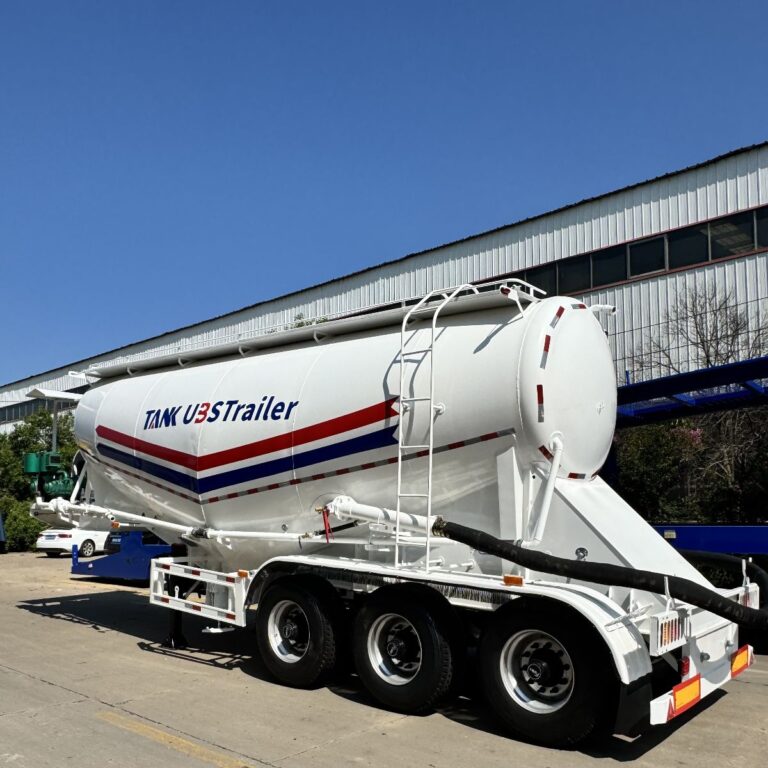
V-Shaped Tankers (Conical Bottom)
V-shaped tankers feature a conical bottom design that uses gravity to funnel materials toward the discharge outlet. These units excel with free-flowing materials like dry cement and fly ash. The design minimizes residual material after discharge, typically leaving less than 0.5% residue.
Best applications: Cement plants, fly ash transport from power stations, lime powder delivery
Typical capacity: 25-45 cubic meters
Discharge method: Pneumatic pressure (0.2-0.4 MPa) with gravity assist
W-Shaped Tankers (Dual Hopper)
W-shaped tankers incorporate two conical hoppers separated by a central ridge. This design allows faster discharge rates and can handle slightly cohesive materials that might bridge in single-hopper designs. The dual-outlet configuration reduces discharge time by approximately 25% compared to V-shaped units.
Best applications: High-volume cement distribution, bulk lime transport, mineral powder delivery
Typical capacity: 35-55 cubic meters
Discharge method: Pneumatic pressure with dual discharge points
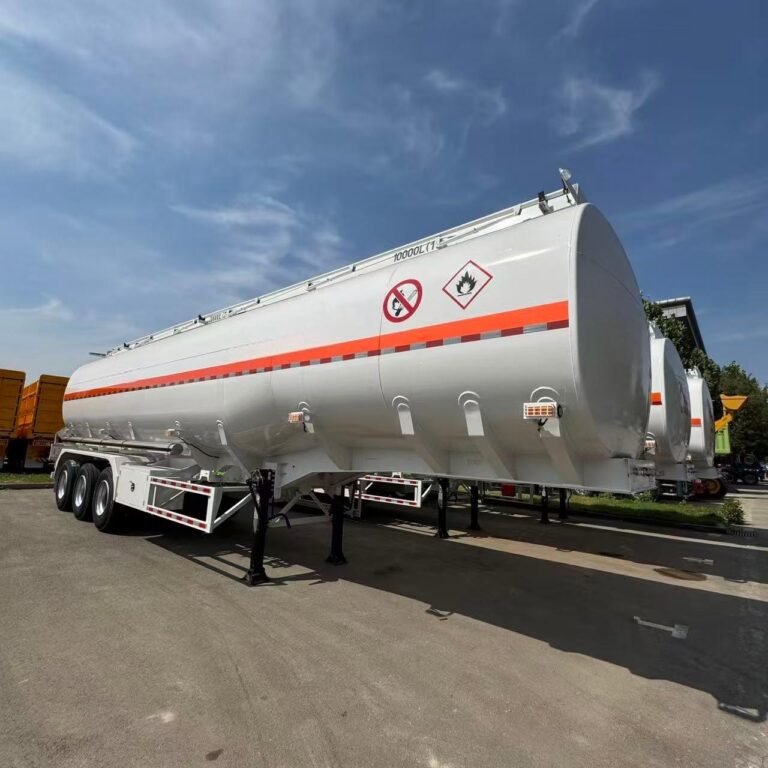
Horizontal Tankers (Cylindrical)
Horizontal cylindrical tankers use internal fluidization beds to move materials to discharge outlets. While they require more sophisticated pneumatic systems, they offer superior versatility across different material types and particle sizes.
Best applications: Multi-material transport operations, materials with varying moisture content, operations requiring frequent product changes
Typical capacity: 20-40 cubic meters
Discharge method: Fluidized bed with pneumatic pressure
Specification Comparison: Making the Right Choice
The following comparison table summarizes key specifications across popular configurations available from Chinese manufacturers in 2026:
| Specification | V-Shaped 3-Axle | W-Shaped 4-Axle | Horizontal 3-Axle |
|---|---|---|---|
| Capacity | 28-35 m³ | 40-50 m³ | 25-32 m³ |
| Tare Weight | 8,500-9,800 kg | 11,200-12,800 kg | 9,000-10,500 kg |
| Payload Capacity | 35-42 tons | 50-60 tons | 32-38 tons |
| Discharge Rate | 1.2-1.5 tons/min | 1.8-2.2 tons/min | 1.0-1.3 tons/min |
| Residual Rate | <0.5% | <0.8% | <1.0% |
| Compressor Power | 80-100 kW | 110-132 kW | 90-110 kW |
| Working Pressure | 0.2-0.3 MPa | 0.25-0.35 MPa | 0.3-0.4 MPa |
| Price Range (FOB) | $18,500-$24,000 | $28,000-$36,000 | $22,000-$28,500 |
| Best For | Standard cement routes | High-volume distribution | Multi-material operations |
Source: Nanou Automobile market intelligence, August 2026
For procurement managers evaluating options, exploring detailed bulk cement trailer specifications from established manufacturers provides baseline pricing and configuration data essential for informed decision-making.
Critical Factors in Bulk Material Tanker Selection
1. Material Characteristics Drive Design Choice
Different bulk materials present unique handling challenges. Cement powder typically ranges from 1.0-1.5 g/cm³ bulk density, while fly ash can be as light as 0.6-0.8 g/cm³. Heavier materials require robust structural design but allow smaller tank volumes for equivalent payload. Lighter materials demand larger tank volumes but place less stress on chassis components.
Nanou engineering team recommendation: “Always specify the exact material type and bulk density when requesting quotations. A tanker optimized for cement may underperform with fly ash, leading to longer discharge times and higher residual rates. We’ve seen operators lose 15-20 minutes per discharge cycle due to incorrect configuration matching.”
2. Pneumatic System Quality Determines Operational Efficiency
The compressor and pneumatic delivery system represent the heart of any bulk material tanker. Chinese manufacturers typically offer three compressor tiers:
- Standard tier: Belt-driven compressors with 80-100 kW output, suitable for operations with discharge times under 30 minutes
- Heavy-duty tier: Direct-drive compressors with 110-150 kW output, designed for rapid discharge and continuous operation
- Premium tier: Oil-free screw compressors with variable speed drives, offering 20-30% energy savings and extended service intervals
Investing in heavy-duty pneumatic systems pays dividends in high-frequency operations. A 20% faster discharge rate translates to one additional delivery per day in typical two-shift operations, generating $15,000-$25,000 in additional annual revenue per unit.
3. Chassis Configuration and Legal Weight Limits
Route characteristics and local weight regulations significantly impact chassis selection. Southeast Asian countries increasingly enforce strict axle load limits, making 4-axle configurations with load-spreading capabilities more attractive than traditional 3-axle designs.
Key considerations include:
- Axle configuration: 3-axle for standard routes, 4-axle for weight-restricted regions, 5-6 axle for specialized heavy-haul applications
- Suspension type: Mechanical leaf spring for cost-sensitive operations, air suspension for sensitive materials and improved ride quality
- Brake system: Dual-circuit air brakes with ABS mandatory for most export markets
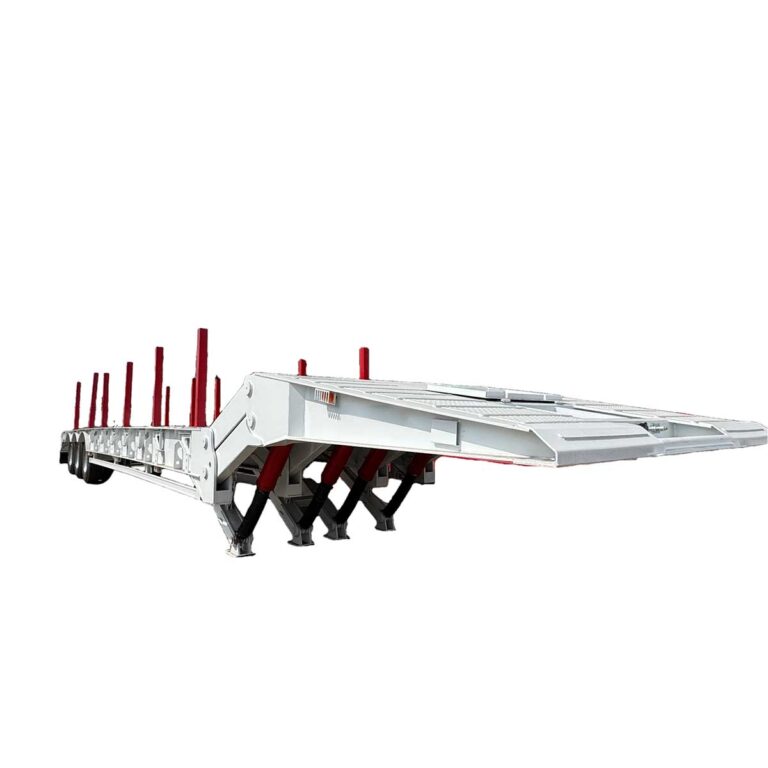
Operators evaluating flatbed semi-trailer options for mixed-use applications should consider whether dedicated bulk tankers might deliver better long-term economics through reduced material loss and faster turnaround.
4. Discharge Height and Distance Requirements
Not all delivery points are at ground level. Cement silos at concrete batching plants often require vertical lift of 15-25 meters, while ship loading operations may need horizontal discharge distances exceeding 30 meters.
Standard pneumatic systems typically achieve 15-meter vertical lift or 20-meter horizontal distance. Operations requiring greater reach need booster compressors or specialized pipeline configurations. Always specify maximum discharge requirements during the quotation stage to ensure adequate system capacity.
Cost of Ownership: Beyond the Purchase Price
Smart procurement decisions consider total cost of ownership (TCO) rather than just initial purchase price. Here’s a realistic TCO breakdown for a typical 40 m³ W-shaped bulk cement tanker operating 250 days per year:
Year 1 costs:
- Purchase price: $32,000
- Shipping and import duties: $6,500
- Registration and compliance: $1,200
- Total Year 1: $39,700
Annual operating costs (Years 2-7):
- Maintenance and parts: $3,500-$5,200
- Compressor service: $1,800-$2,500
- Tires and brakes: $2,200-$3,000
- Annual operating: $7,500-$10,700
Revenue potential:
- Daily revenue (2 loads): $350-$500
- Annual revenue (250 days): $87,500-$125,000
- Payback period: 4-6 months
The economics clearly favor investing in quality equipment. A $3,000-$5,000 premium for superior pneumatic components typically pays back within 8-12 months through reduced downtime and faster discharge cycles.
Frequently Asked Questions
What is the typical delivery time for bulk material tankers from Chinese manufacturers?
Standard production lead time ranges from 25-35 working days for common configurations. Custom specifications, specialized materials (such as aluminum alloy tanks), or orders placed during peak season (March-June) may extend to 40-50 days. Always confirm delivery schedules in writing and build buffer time into project planning.
How do I verify tanker quality before shipment?
Reputable manufacturers provide third-party inspection reports from organizations like SGS, Bureau Veritas, or TÜV. Essential verification points include tank pressure testing certificates, weld quality reports, pneumatic system performance data, and dimensional inspection records. Many buyers engage independent inspection services for pre-shipment verification, typically costing $800-$1,500 but providing valuable assurance.
What certifications are required for bulk material tankers in different markets?
Certification requirements vary significantly by destination. Southeast Asian markets typically require ISO certification and local type approval. African nations often accept CE marking and manufacturer certificates. Middle Eastern markets may require SASO (Saudi Arabia), ESMA (UAE), or equivalent local standards. Always confirm specific requirements with local transport authorities before placing orders.
Can bulk material tankers handle multiple material types?
While some operators use single tankers for multiple materials, cross-contamination risks and different flow characteristics make dedicated tankers preferable. If multi-material operation is unavoidable, specify horizontal tankers with fluidized beds and implement thorough cleaning protocols between material changes. Document cleaning procedures to maintain quality standards and customer confidence.
What maintenance schedule should I follow for pneumatic systems?
Compressor oil changes every 500 operating hours, air filter replacement every 1,000 hours, and complete system inspection every 2,000 hours represent baseline maintenance intervals. Monitor discharge times closely—increasing discharge duration often indicates worn compressor components or pipeline restrictions. Proactive maintenance prevents costly roadside breakdowns and extends equipment life by 30-40%.
How does climate affect bulk material tanker performance?
High humidity environments (common in Southeast Asia and coastal Africa) increase material caking risks, requiring more frequent tank cleaning and potentially heated air systems. Extreme heat accelerates compressor wear and may require upgraded cooling systems. Cold climates rarely affect dry bulk operations but can cause condensation issues if tanks aren’t properly sealed between loads.
Related Reading
For comprehensive guidance on importing heavy equipment from China, review our detailed guide on how to import semi-trailers from China, covering documentation, shipping logistics, and customs clearance procedures.
If your operations include dump truck requirements alongside bulk material transport, our dump semi-trailer types and specifications guide provides essential comparison data for aggregate and construction material handling.
About Nanou Automobile
Shandong Nanou Automobile Co., Ltd. operates from Liangshan County, Shandong Province—China’s recognized hub for semi-trailer manufacturing. With over 230 product configurations across 10 categories, we serve fleet operators, logistics companies, and construction contractors across 60+ countries.
Our bulk material tanker lineup includes V-shaped, W-shaped, and horizontal configurations ranging from 20-60 cubic meters capacity. Every unit undergoes 47-point quality inspection before shipment, and we provide comprehensive after-sales support including spare parts supply and technical consultation.
Contact our sales engineering team for customized quotations:
- Email: nanou-automobile@nanou-trailer.com
- WhatsApp: +86 159 7063 7777 (English service, 8:00-22:00 Beijing time)
- Phone: +86 153 1547 7956 / +86 159 7063 7777
- Адрес: Jiezhuang Village Industrial Park, Liangshan County, Shandong Province, China
Whether you’re expanding an existing fleet or entering new markets, our team delivers technical expertise and commercial insight to support your procurement decisions.