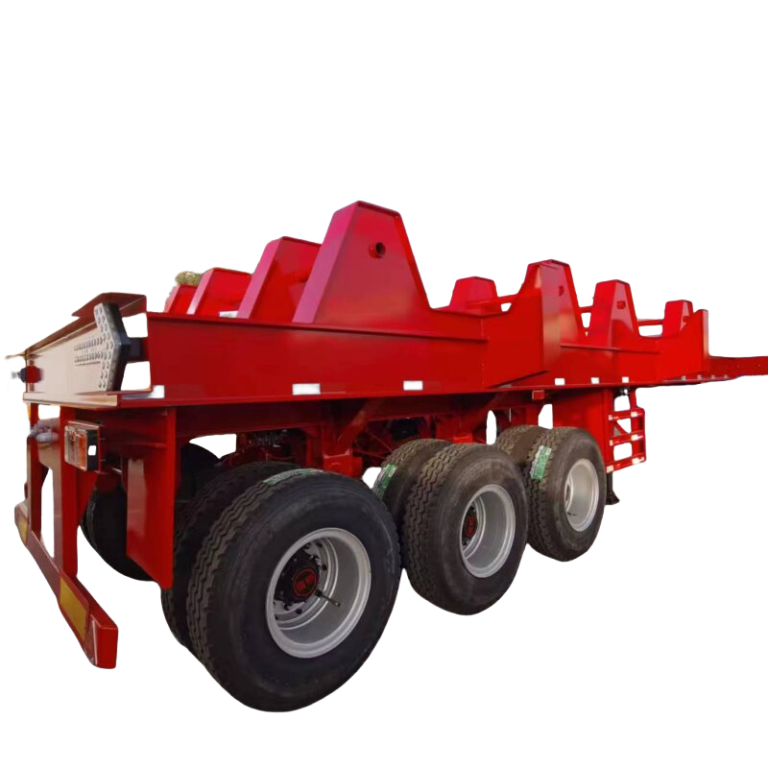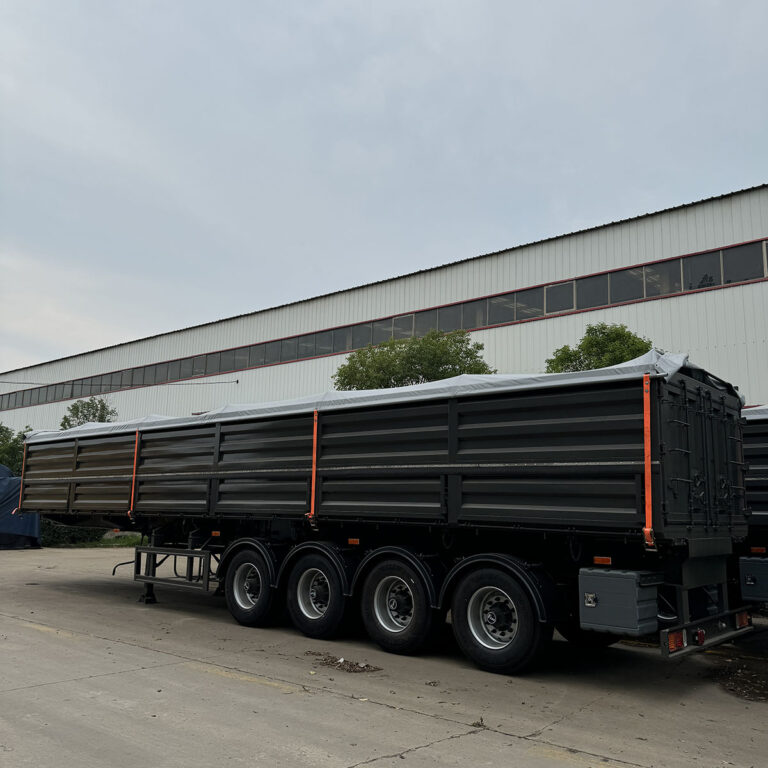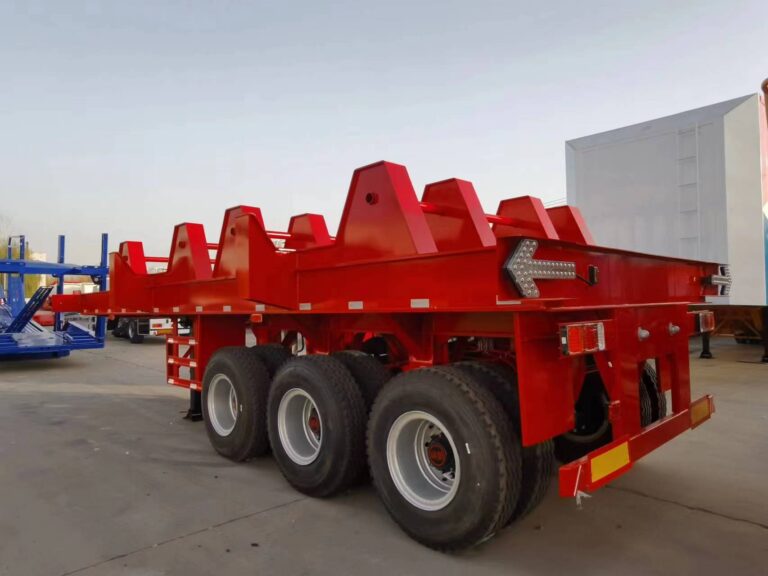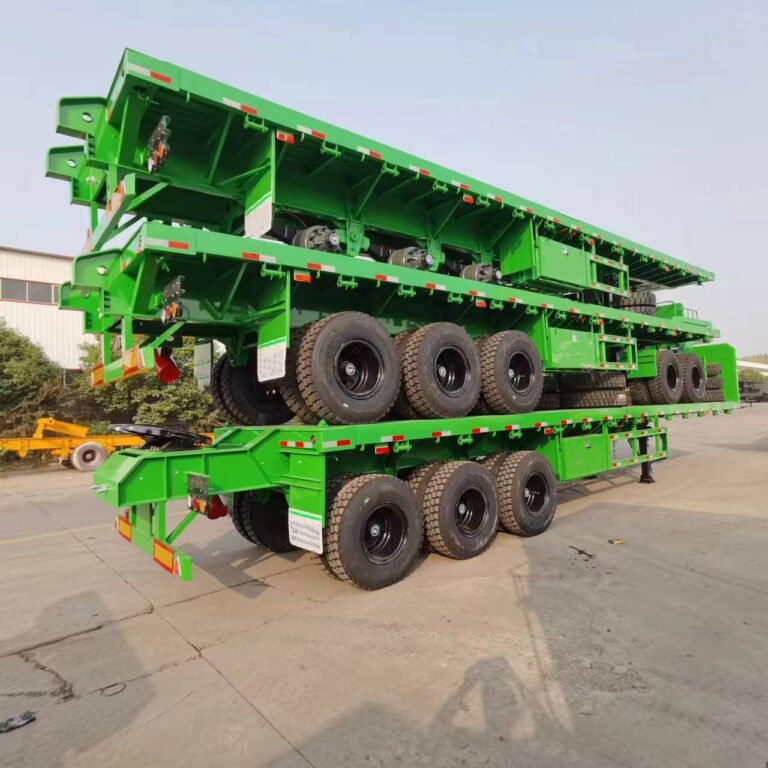


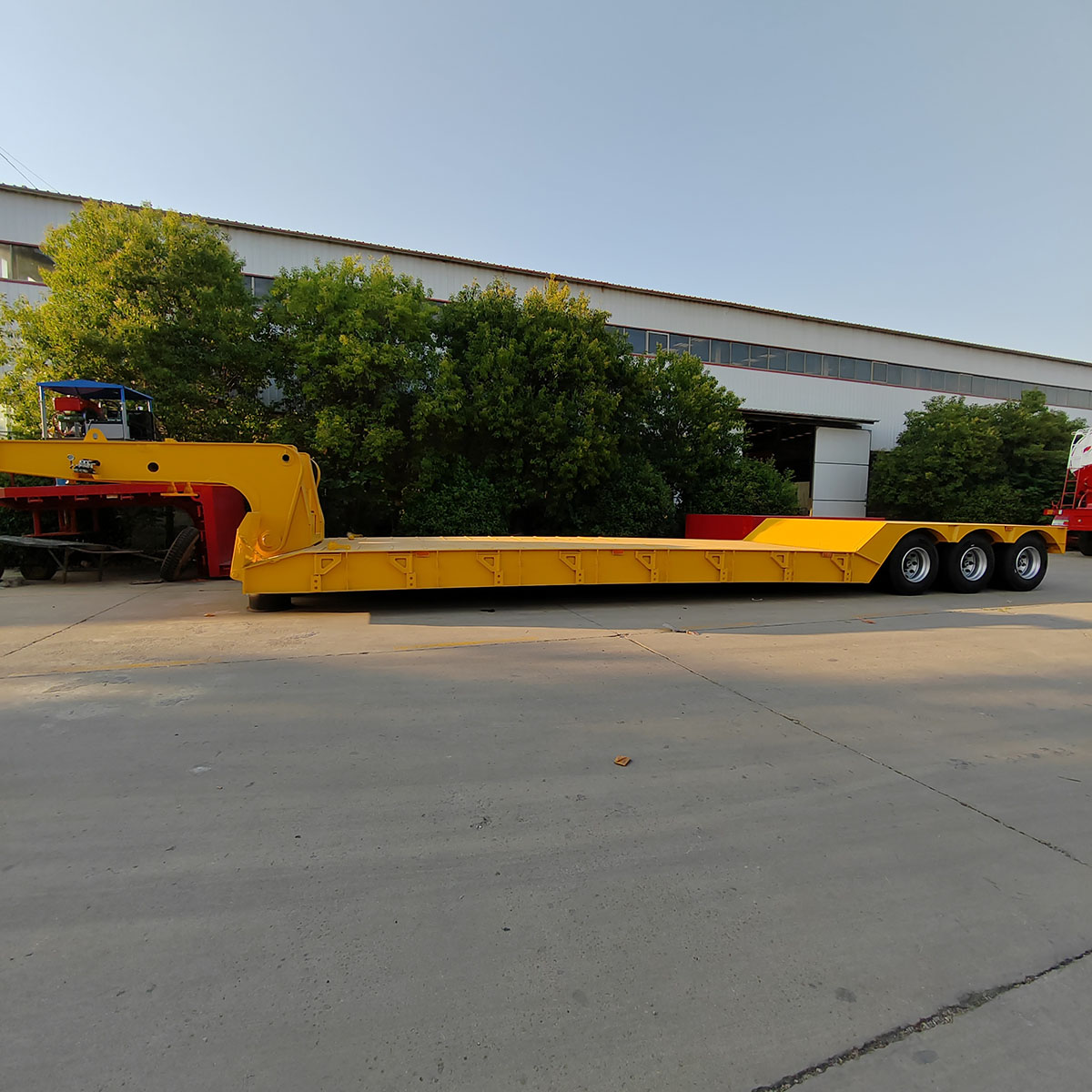
What are the advantages of low flatbed semi trailers for transporting large items
The low-bed semi-trailer for heavy-cargo transportation is a specialized vehicle designed specifically for transporting oversized and overweight goods. Its core advantages are reflected in five major aspects: carrying capacity, stability, adaptability, safety, and economy. The following is a detailed analysis:
- Superior load-bearing capacity: breaking through the weight limit
High-strength structural design
Frame material: Made of high-strength alloy steel such as Q690 and Q960, with a tensile strength of 690-960MPa, which is 2-3 times that of ordinary steel, capable of withstanding extreme loads.
Longitudinal beam section: I-shaped or box-type structure, optimized stress distribution through finite element analysis, with bending stiffness increased by more than 50%.
Multi-axle suspension system:
Balanced suspension: It automatically distributes axle loads through mass balance blocks, ensuring a uniform single-axle load within the range of 10-20 tons, thereby preventing local overload.
Hydraulic axle line vehicle: Equipped with hydraulic independent suspension, each axle can be independently raised or lowered, adapting to complex terrains. Its total load capacity can reach 150-300 tons, suitable for transporting nuclear power equipment, for example.
Typical application scenarios
Transporting wind turbine towers weighing over 200 tons per piece, mining excavators weighing over 500 tons, or bridge components exceeding 80 meters in length.
II. Low center of gravity design: Enhancing transportation stability
Structural optimization
Cargo platform height: The main plane is only 0.8-1.2 meters above the ground (compared to about 1.5 meters for a standard semi-trailer), with a 30%-40% reduction in center of gravity, significantly reducing the risk of rollover.
Gooseneck front section: The connection with the tractor saddle is recessed, forming a “concave” cargo platform. The lowest point of the middle section can be as low as 0.6 meters, accommodating ultra-high cargo (such as wind turbine blades).
The rear wheel frame is detachable: When transporting oversized goods, the rear wheel frame can be dismantled to extend the length of the cargo platform to over 60 meters.
Typical application scenarios
When transporting bridge components with a height exceeding 5 meters, low-bed trucks can pass over overhead obstacles, while ordinary semi-trailers need to detour or disassemble the cargo.
III. Flexible adaptability: meeting diverse needs
Modular splicing technology
Hydraulic axis vehicle: It is assembled from multiple standard modules (such as 2-axis and 3-axis units), and its body length can be extended from 20 meters to 60 meters, accommodating different cargo sizes.
Expandable cargo platform: Equipped with a hydraulic lifting system, the height of the cargo platform can be adjusted within a range of 0.5-1.5 meters, adapting to complex road conditions such as mountainous areas and bridges.
Multi-axis steering system
Hydraulic steering: The steering angle of the rear wheels is controlled by a hydraulic cylinder, enabling a 180-degree turn in place and providing enhanced maneuverability on narrow roads.
Crab mode: The rear wheels are steered in the same direction or in the opposite direction to the front wheels, reducing the minimum turning radius by 40%. It is suitable for urban alley operations.
Typical application scenarios
When transporting 80-meter wind turbine blades, the low-bed trailer’s extendable cargo platform can be adjusted to shorten the vehicle’s length, which can be restored to its original length after passing through height-restricted roads; on narrow roads in mines, the multi-axis steering system enables precise turning.
IV. Safety optimization: Reducing transportation risks
Professional fixture
Hydraulic clamping system: It applies lateral pressure to the cargo through a hydraulic cylinder to prevent it from sliding or overturning during transportation.
Combination of chain and rope: High-strength chain (breaking force ≥ 50 tons) and anti-slip rope are used to secure the cargo to the cargo platform anchor point.
Real-time monitoring system
BeiDou positioning: Track the vehicle’s location in real-time and plan the optimal route based on the electronic map.
Tilt meter and vibration sensor: Monitor the tilt angle of the cargo (accuracy ±0.1°) and vibration amplitude (range 0-5g), with automatic alarming in case of exceeding limits.
Tire pressure monitoring: Display tire pressure in real time to avoid the risk of tire blowout.
Shock absorption technology
Air suspension: It utilizes airbags to absorb vibrations, thereby minimizing damage to precision instruments such as magnetic resonance imaging (MRI) machines.
Hydraulic shock absorption: Suitable for ultra-heavy goods, with a shock absorption efficiency 60% higher than that of ordinary spring suspension.
Typical application scenarios
When transporting satellite components, the low-bed trailer utilizes a shock absorption system to keep the vibration amplitude below 0.1g, ensuring equipment safety. On mountainous roads, a real-time monitoring system warns of cargo tilt risks to prevent rollovers.
V. Economic Advantages: Reducing Comprehensive Costs
High efficiency for single trip transportation
Reduce the number of disassembly: transport oversized goods in one shipment, avoiding multiple loading, unloading, and transportation, thereby saving manpower and time costs.
Multimodal transport integration: Combining road, rail, and waterway transportation (such as “sea-land intermodal transport”) to reduce long-distance transportation costs.
classic case
When transporting blades for a certain wind power project, the “road + waterway” combined transportation was adopted, covering a total distance of 1,600 kilometers, resulting in a cost reduction of 18% and a time saving of 12 days.
When transporting heavy equipment, the low-bed trailer has a single-trip load capacity five times that of an ordinary semi-trailer, and its fuel efficiency is improved by 30%.
编辑译文
段落对照
笔记