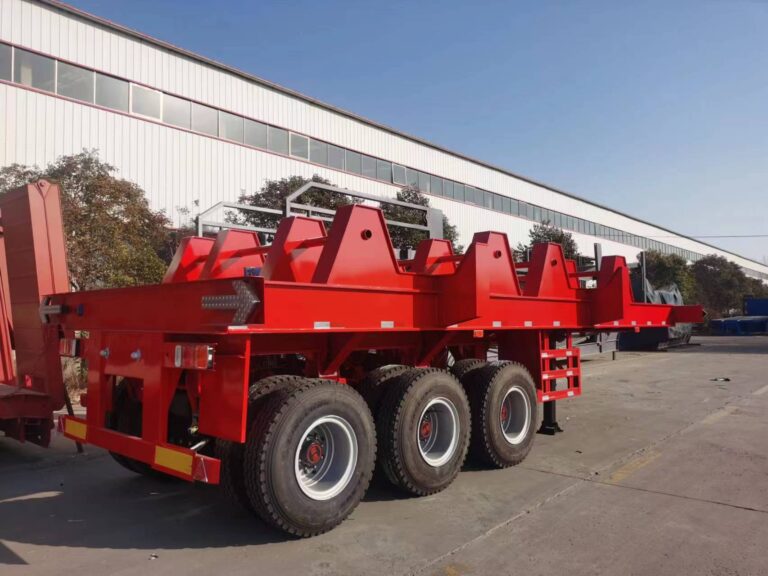


The structural core of semi-trailer for automobile transportation
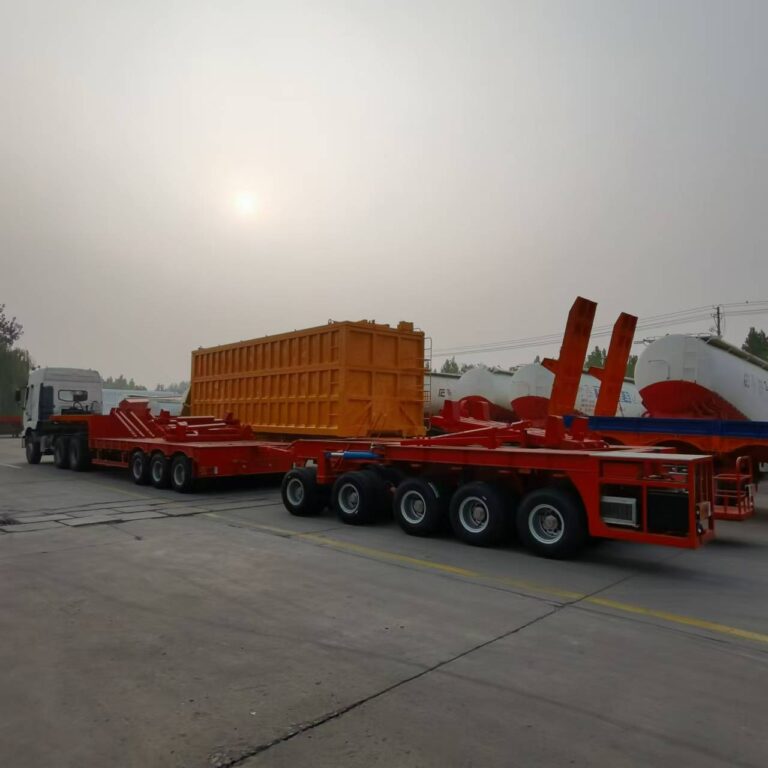
The structural core of a semi-trailer for automobile transportation can be summarized in one sentence: a set of “adjustable three-dimensional frames” are used to fit the entire vehicle of different lengths into a legally limited outer dimension.
All of its design choices are derived from this constraint.
Core 1: Stereoscopic Double Layer, Replacing Plane Area with Height
A passenger car occupies an area of 5 meters in length and 1.8 meters in width, with a maximum of two vehicles transported on a flat surface at a time. The full value of a sedan semi-trailer comes from stacking the upper and lower platforms to create 6-9 parking spaces on a trailer length of 13-17 meters. Therefore, the frame, columns, and platform are not three parts, but a set of “vertical load-bearing system” – the frame bears the total weight, the columns bear the interlayer load, and the platform distributes the load to the frame.
Core 2: Adjustable floor height, turning fixed structures into variable variables
The distance between the upper and lower layers is not constant. The upper layer is divided into 2-3 sections, and the height is adjusted by hydraulic cylinders or hoists. The gear position is determined by the column pin holes. This is the only “programmable” part in the entire structure – it determines whether the same route can mix cars SUV、MPV, It also determines whether the loading rate can be fully squeezed. The finer the gear adjustment, the higher the loading utilization rate, which is the most practical way to distinguish between high and low-end trailers.
Core 3: Connecting the springboard and turning vertical layers into passable ones
No matter how high the platform is, the goods still need to be shipped. The hydraulic flipping ramp at the beginning and end serves as the “passage between the upper and lower layers”, and its climbing angle (12 °~15 °) is a hard constraint. For every 1 ° increase in angle, there will be one less batch of low chassis models that can be installed. The springboard is therefore not an accessory, but a structural component that determines the scope of applicable vehicle models.
Core 4: Binding and locking, turning the movable structure into a safe state
Before the loading is completed, the platform is movable and the goods are movable; Running must be rigid. The tire groove, wheel block, and ratchet strap complete this step. The position of the binding point is more critical than the number of straps, given the high center of gravity and long body.
Core 5: The overall dimensions are the ceiling
The total length is 22 meters, the width is 2.55 meters, and the height is 4 meters. Different limits are applicable for installing 8 or more units. All structural designs are added within this framework: the weight saved by lightweighting is replaced with load-bearing capacity, and the space obtained by compressing the floor height is replaced with parking spaces.