

Car Carrier Trailer for Sale: Types, Specs & Prices from China Manufacturer (2026)
A car carrier trailer is the only piece of equipment that lets you move six to ten vehicles on a single tractor unit, cutting per-unit transport cost by 60% or more compared to driving each car individually. If you run a logistics fleet, an auto dealership, or an import-export business, choosing the right vehicle transport semi trailer directly affects your margin per load.
In this guide, you will learn the four main types of car carrier trailers, the exact specifications that matter for your route, 2026 FOB prices from Shandong manufacturers, and a six-step import checklist. Every price and spec in this article is based on current production data from Nanou Trailer’s factory.
Summary: What You Will Learn
- The difference between single-deck, double-deck, hydraulic-lift, and multi-axle car carrier trailers
- Specification tables comparing load capacity, deck length, axle brands, and hydraulic systems
- 2026 FOB price ranges from $9,500 to $28,000 depending on configuration
- A 6-step checklist for importing a car carrier trailer from China without customs surprises
- Answers to the most common buyer questions about loading angles, vehicle security, and maintenance
What Is a Car Carrier Trailer and When Do You Need One?
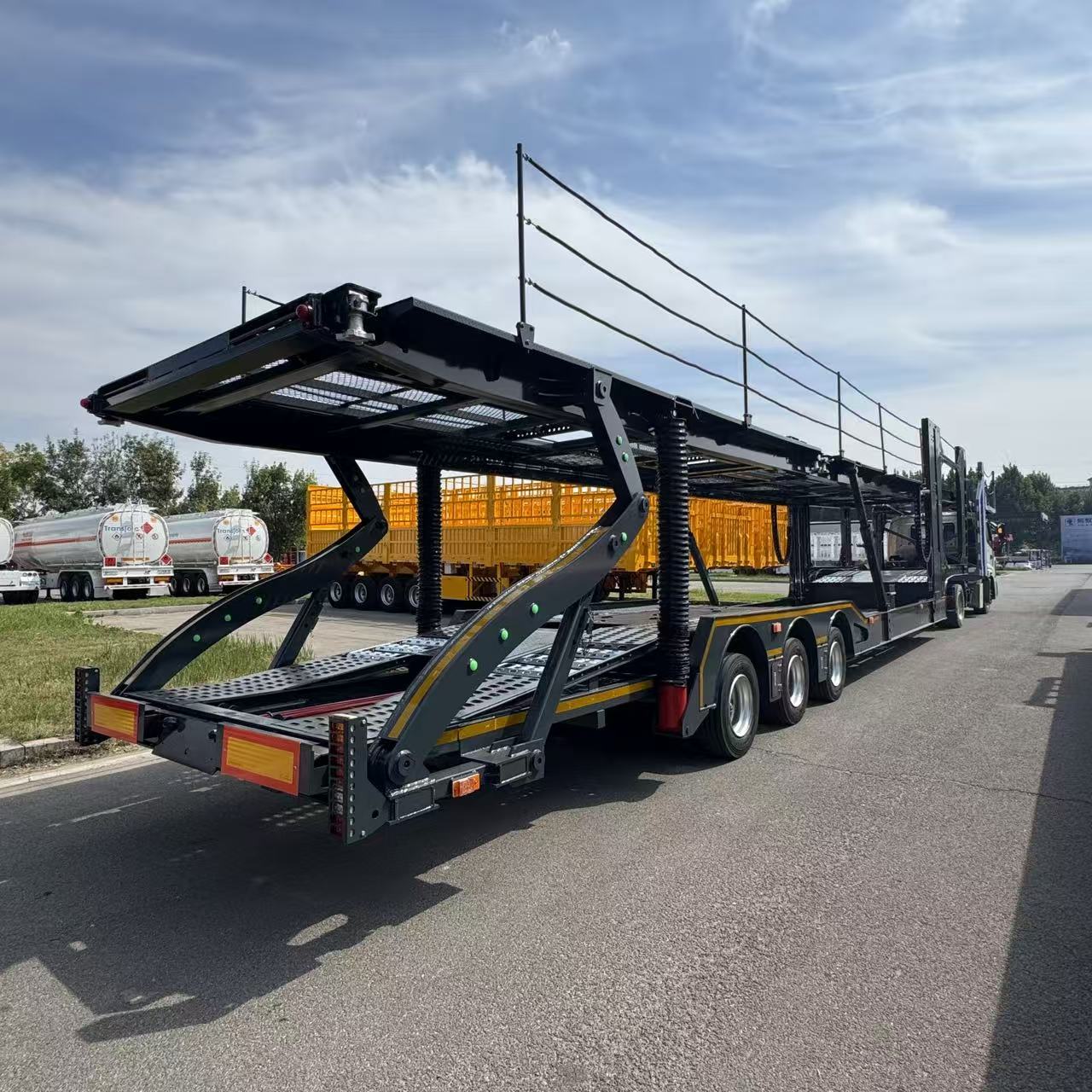
A car carrier trailer—also called a vehicle transport semi trailer or auto-transport trailer—is a specialized semi-trailer built with two or more stacked decks and integrated ramps. The upper deck can be raised or lowered hydraulically so that cars drive on at a shallow angle, typically between 9° and 12°, without scraping the underbody.
You need one if your operation matches any of these profiles:
- Auto logistics companies moving new or used cars between ports, dealerships, or auction yards
- Car rental fleets relocating inventory across cities or countries
- Import-export traders shipping vehicles from manufacturing hubs (China, Japan, Korea) to Africa, the Middle East, or Latin America
- Construction and mining contractors that need to transport pickup trucks, light SUVs, and small excavators to remote sites
One 3-axle double-deck unit carrying eight sedans replaces eight separate truck-and-driver combinations. On a 1,000 km route, that saves roughly 560 liters of diesel and eight driver-days.
Types of Car Carrier Trailers — Which One Fits Your Business?
Not every car carrier trailer is built the same. The four designs below cover 95% of global demand. Pick the type that matches your typical cargo mix and route conditions.
1. Single-Deck Car Carrier Trailer
The simplest format. One flat loading platform, usually 12 m to 13.5 m long, carries three to four sedans or two light trucks. Best for short-haul city distribution where overhead clearance is tight. Because there is no upper deck, total height stays under 3.2 m, making it legal on most urban roads without a special permit.
2. Double-Deck Fixed Car Carrier Trailer
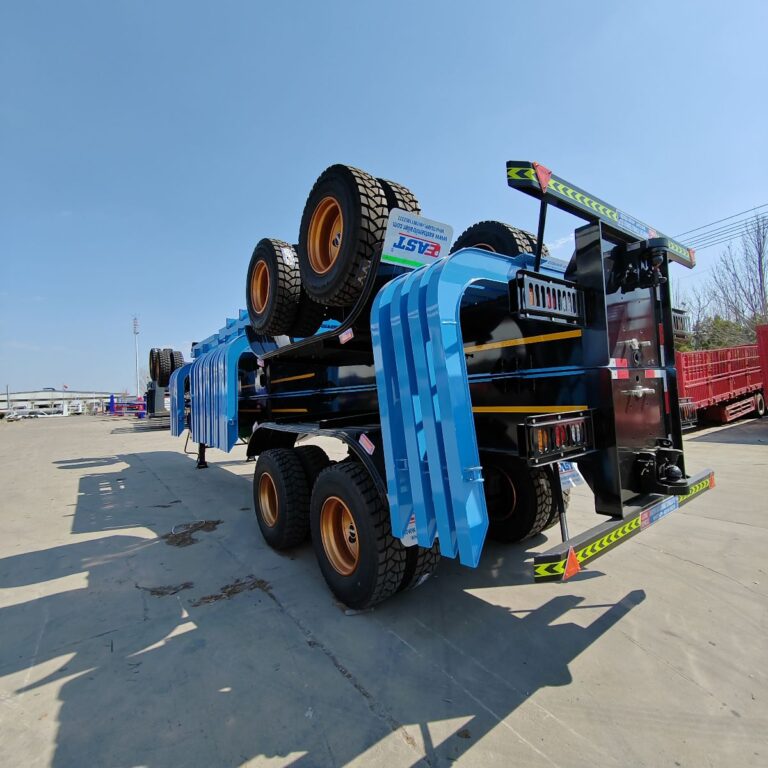
The industry standard. A fixed upper deck sits roughly 1.8 m above the lower deck. A typical 13.75 m unit holds six to eight passenger cars. The upper deck is loaded first via a rear ramp, then the lower deck is filled. This design is cost-effective and reliable, but the fixed deck height limits you to vehicles under 1.75 m tall on the lower level.
3. Double-Deck Hydraulic-Lift Car Carrier Trailer
The upper deck is mounted on a hydraulic scissor or cylinder system that lowers to ground level for loading, then raises into transport position. This eliminates the steep climb angle of fixed-deck models and allows you to load SUVs, vans, and light commercial vehicles up to 2.1 m tall. The trade-off is a $4,000–$6,000 higher purchase price and an extra 350 kg of tare weight.
4. Multi-Axle Heavy-Duty Car Carrier Trailer
Built on four or more axles with a reinforced frame, these units handle mixed loads of passenger cars plus light machinery such as forklifts or compact excavators. They are common in mining and construction logistics in Africa and Central Asia, where one trailer must serve multiple cargo types.
Key Specifications & What to Look For
When you compare quotes from Chinese manufacturers, these are the numbers that actually determine whether the trailer will last ten years or start cracking after two.
| Spec | Light Duty Single-deck 2-axle | Standard Double-deck 3-axle | Heavy Duty Hydraulic 3-axle | Multi-Axle 4-axle reinforced |
|---|---|---|---|---|
| Overall length | 12.0 m | 13.75 m | 13.75 m | 14.5 m |
| Loading capacity | 3–4 cars | 6–8 cars | 6–8 cars | 8–10 cars |
| Gross vehicle weight | 20 t | 35 t | 38 t | 45 t |
| Tare weight | 4.5 t | 7.2 t | 7.8 t | 9.5 t |
| Axle brand | FUWA 13 t | FUWA / BPW 13 t | BPW 13 t | BPW 13 t × 2 |
| Suspension | Mechanical | Mechanical / Air | Suspensión neumática | Suspensión neumática |
| Upper deck lift | None | Fixed | Hydraulic cylinder | Hydraulic cylinder |
| Max vehicle height (lower deck) | 1.9 m | 1.75 m | 2.1 m | 2.1 m |
| Ramp angle | 8° | 10°–12° | 9° | 9°–11° |
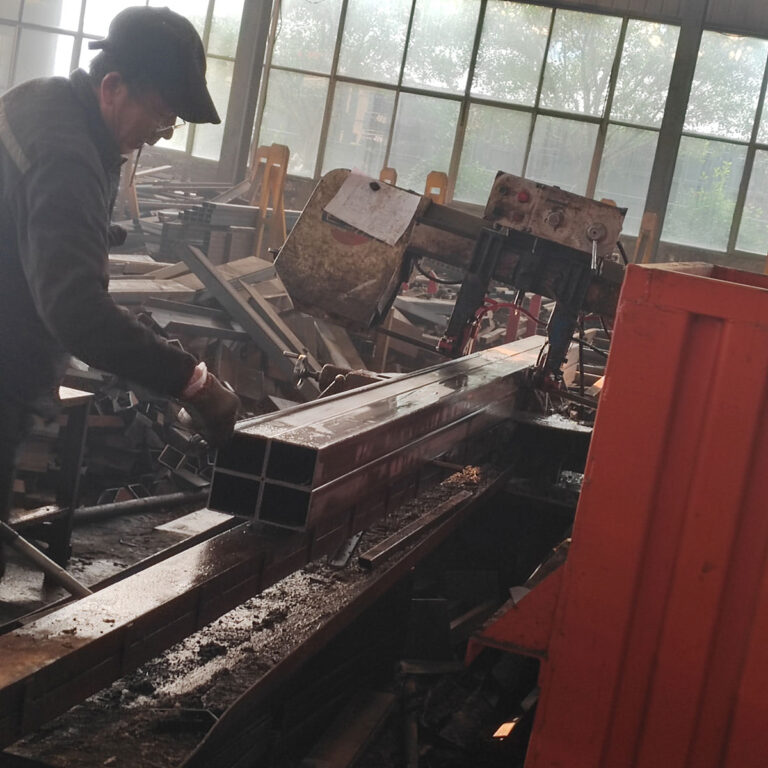
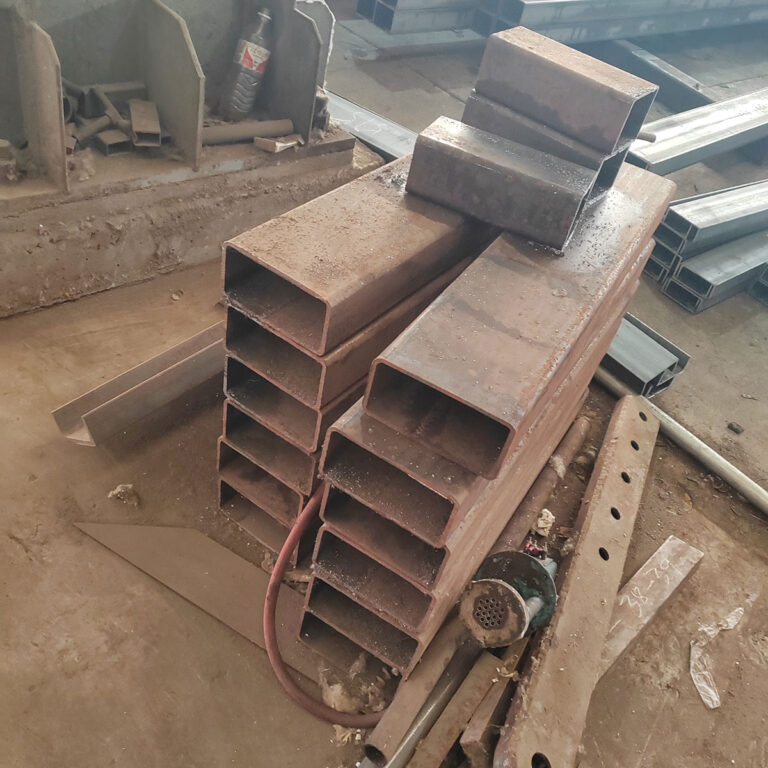
Frame material: The main longitudinal beams should be high-strength Q345B or Q460 steel, 8 mm to 10 mm thick. Some budget manufacturers use Q235 with a 6 mm wall to cut cost; those frames flex under full load and crack at the gooseneck weld within three years. Always ask for the mill certificate.
Deck surface: Checkered steel plate (3 mm–4 mm) with drainage holes is the standard. Some buyers in humid climates (West Africa, Southeast Asia) opt for hot-dip galvanized decks to prevent rust. Galvanizing adds roughly $800 to the unit price.
Price Guide — Car Carrier Trailer Costs from China (2026)
The prices below are FOB Qingdao/Tianjin in US dollars, based on current steel-index levels and Nanou Trailer’s September 2026 production schedule. They include the trailer, standard axles, mechanical suspension, and basic hydraulic power unit (where applicable). Optional upgrades are priced separately.
| Configuration | FOB Price (USD) | Best For |
|---|---|---|
| Single-deck 2-axle, 12 m, mechanical suspension | $9,500 – $11,500 | City distribution, tight-clearance routes |
| Double-deck fixed 3-axle, 13.75 m, FUWA axles | $14,000 – $17,000 | Standard sedan logistics, port-to-dealer |
| Double-deck hydraulic 3-axle, BPW axles, air suspension | $19,500 – $23,000 | Mixed fleets with SUVs, vans, light trucks |
| Multi-axle 4-axle reinforced, hydraulic lift | $24,000 – $28,000 | Heavy mixed cargo, construction logistics |
| Optional: hot-dip galvanized deck | +$800 | Coastal or high-humidity climates |
| Optional: ABS + EBS braking | +$1,200 | EU, GCC, and Australian regulatory compliance |
| Optional: WABCO valve set | +$600 | Premium braking response |
What drives the price gap? The single biggest cost factors are axle brand (BPW costs 18% more than FUWA), suspension type (air costs $2,200 more than mechanical), and the hydraulic power pack ($3,500–$4,500 for a complete cylinder, pump, and reservoir set). Steel price fluctuations account for roughly ±5% month-to-month variance.
For a landed-cost estimate, add sea freight ($1,800–$4,500 depending on destination), import duty (typically 5%–25%), and local clearance ($300–$800). We provide itemized landed-cost quotes on request.
🚛 Get Your Car Carrier Trailer Quote Today
Tell us your cargo mix, route, and country. You will receive a custom spec sheet and FOB price within 24 hours.
💬 WhatsApp: +86 15315477956
📋 Online Inquiry Form
📱 WeChat: +86 15315477956
How to Buy a Car Carrier Trailer from China — 6-Step Checklist
- Define your cargo profile. List the tallest and heaviest vehicles you will transport. If you move vans or SUVs taller than 1.75 m, a hydraulic-lift double deck is non-negotiable.
- Confirm axle and suspension requirements. Ask your freight forwarder or local transport authority which axle brands are accepted for registration. BPW and FUWA are recognized in most countries, but some African markets require locally certified equivalents.
- Request a detailed quotation. A proper quote breaks out the frame, axles, suspension, hydraulic system, paint, and tires as separate line items. If a supplier gives you only one lump-sum number, you cannot compare apples to apples.
- Review factory photos and video. Ask for photos of the welding station, shot-blasting booth, and paint line. Nanou Trailer provides factory walkthrough videos on request—no appointment needed.
- Specify destination-port delivery terms. FOB Qingdao is standard, but we also quote CIF to Lagos, Mombasa, Jeddah, Dubai, and Jakarta. CIF removes the risk of freight-rate spikes after you place the order.
- Confirm payment terms and production schedule. Typical terms are 30% T/T deposit, 70% balance before shipment. Production lead time for a standard double-deck car carrier is 20–25 working days; hydraulic-lift models take 30–35 days.
Before you sign anything, verify that the manufacturer holds an ISO 9001 certificate and a valid WMI (World Manufacturer Identifier) code. These are required for customs clearance in the EU, GCC, and many African countries.
Frequently Asked Questions
How many cars can a standard car carrier trailer hold?
A 13.75 m double-deck car carrier trailer with a fixed upper deck typically holds six to eight passenger sedans. If the vehicles are compact city cars (under 4.3 m long), you can fit eight. For mid-size SUVs or crossovers, count on five to six units. A multi-axle 4-axle unit with extended length can carry up to ten sedans or a mix of six cars plus two light trucks.
What is the loading angle, and why does it matter?
The loading angle is the slope of the ramp when a vehicle drives onto the trailer. Fixed double-deck trailers usually have a 10°–12° angle, which is acceptable for most sedans but can scrape the front bumper of low-clearance sports cars. Hydraulic-lift models reduce the angle to roughly 9° by lowering the upper deck to ground level during loading. If you transport luxury or modified vehicles, the hydraulic option pays for itself in avoided bodywork.
Can I transport SUVs and vans on a car carrier trailer?
Yes, but only on a hydraulic-lift or multi-axle model. Standard fixed double-deck trailers limit lower-deck vehicle height to about 1.75 m. Most mid-size SUVs are 1.78 m–1.85 m tall, and commercial vans run 1.95 m–2.15 m. A hydraulic-lift trailer raises the clearance to 2.1 m on the lower deck and 2.0 m on the upper deck, accommodating the majority of light commercial vehicles.
How do I secure vehicles so they do not shift during transport?
Every deck should have welded wheel chocks (stops) at 1.2 m intervals and four to six retractable ratchet straps per vehicle. The straps hook into D-ring anchors welded to the frame. Do not rely on rope or generic cargo nets—they stretch and can snap under emergency braking. Nanou Trailer’s standard specification includes 25 mm×50 mm D-rings every 400 mm along both sides of each deck.
What is the typical lifespan of a car carrier trailer?
With regular maintenance, a Q345B steel frame car carrier trailer lasts 12 to 15 years. The hydraulic cylinders on lift models need seal replacement every 5 to 7 years (cost: roughly $400–$600 for a full seal kit). Tire replacement is the largest recurring cost—plan for one full set every 80,000 to 100,000 km under normal highway use. If you operate on unpaved roads, halve that interval.
Do I need a special license to operate a car carrier trailer?
That depends on your country’s regulations. In most jurisdictions, a standard heavy-goods vehicle license covers semi-trailer combinations up to the national gross-weight limit. However, some countries classify double-deck car carriers as “special transport” because of the elevated center of gravity and require an additional endorsement. Check with your local road-transport authority before ordering.
Why Choose Nanou Trailer?
Nanou Trailer Manufacturing, based in Shandong Province, has produced and exported car carrier trailers to over 40 countries since 2008. Here is what sets our build apart:
- Frame warranty: We use Q345B high-strength steel with submerged-arc welding (SAW) on all longitudinal seams. Every frame is shot-blasted to SA 2.5 before painting. We back the frame with a 5-year structural warranty.
- Axle flexibility: You can choose FUWA, BPW, or locally certified axle brands. We do not force a one-size-fits-all spec on markets with specific registration rules.
- Knock-down (CKD) shipping: For buyers with local assembly capability, we ship car carrier trailers in CKD form inside 40 ft high-cube containers. This cuts sea-freight cost by 35%–45% compared to roll-on/roll-off shipment.
- Real-time production updates: From deposit to dispatch, you receive photo and video updates at welding completion, paint completion, and final assembly. No surprises, no hidden delays.
Browse our full car carrier trailer catalog to see current models, or view specific units like the 3-axis multifunctional sedan carrier and the 6-seat car carrier semi-trailer for detailed specs and photos.
🚛 Ready to Move More Cars Per Load?
Send us your vehicle list and destination port. We will spec the right deck height, axle count, and hydraulic system for your route.
💬 WhatsApp: +86 15315477956
📋 Online Inquiry Form
📱 WeChat: +86 15315477956
Related Articles
- Browse All Car Carrier Trailers — Full catalog with specs and photos
- Semi Trailer Price Guide 2026 — FOB prices, landed costs, and negotiation tactics for every trailer type
- How to Import a Semi Trailer from China — Step-by-step customs and shipping guide
- How to Choose a Dump Semi Trailer — If your fleet also handles construction logistics