

Skeleton Semi Trailer for Sale: Container Chassis Types, Specs & Prices (2026)
📦 Article Summary
A skeleton semi trailer — also called a container chassis trailer — is one of the most commonly used pieces of equipment in global freight logistics. This guide breaks down the different types (20ft, 40ft, 45ft, extendable, gooseneck), key specs like axle count and kingpin position, and real 2026 pricing from Chinese manufacturers. Whether you’re a shipping line buying a fleet of 50 or an independent owner-operator replacing a single unit, you’ll walk away knowing exactly what to look for — and how to avoid the 3 most expensive buying mistakes.
What Is a Skeleton Semi Trailer?
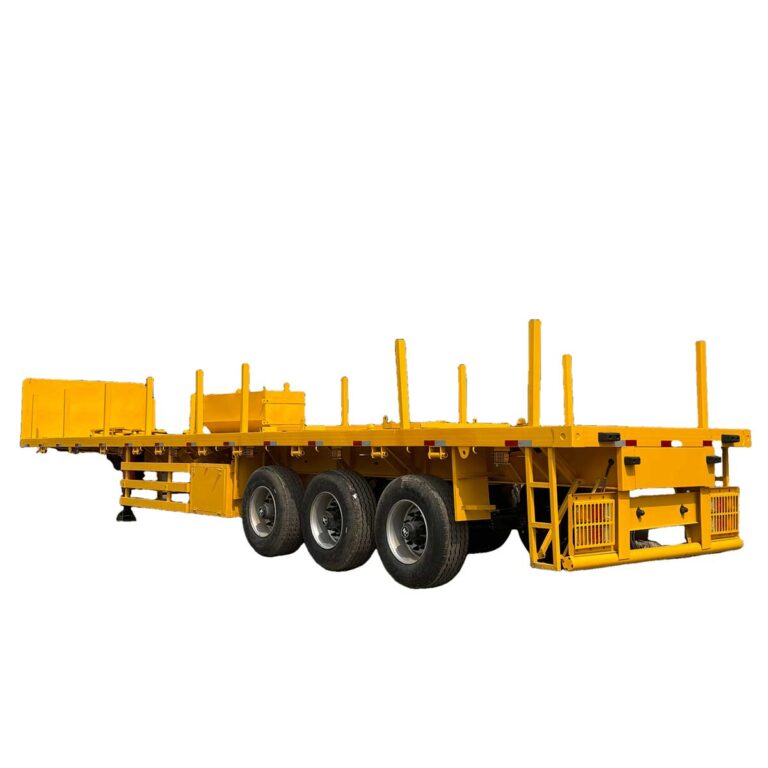
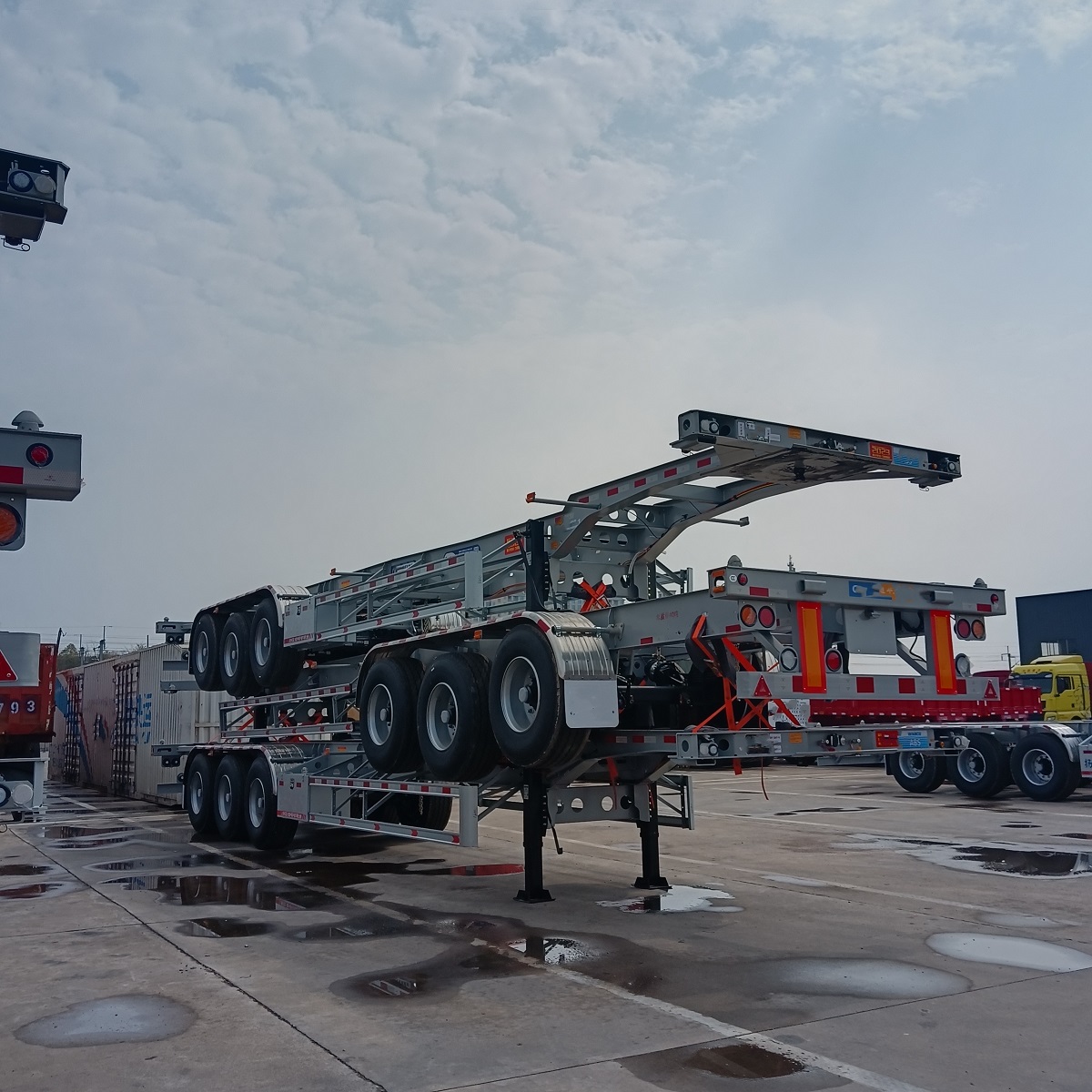
A skeleton semi trailer is a lightweight, open-frame trailer designed to carry ISO shipping containers. Unlike a flatbed trailer — which has a solid deck — a skeleton trailer has only the structural frame (the “skeleton”) with twist locks mounted at the corners. The container locks directly onto the chassis, and the frame does the rest of the work.
These trailers are the backbone of intermodal freight. Walk into any container yard at the ports of Mombasa, Jebel Ali, or Lagos, and you’ll see rows of skeleton trailers queued up, waiting to haul 40-foot boxes inland. They’re simple machines — no hydraulics, no tilting mechanisms — but the spec decisions you make at purchase time ripple through every kilometer of your operation.
The three things that define a skeleton trailer’s performance: weight (lighter frame = more payload capacity, critical when road weight limits are 40–50 tonnes), twist lock spacing (must match the container sizes you run), and axle configuration (determines load capacity and road legality in your country).
Types of Skeleton Semi Trailers — Which One Fits Your Business?
Skeleton trailers aren’t one-size-fits-all. The configuration you buy should match the container mix in your fleet and the roads you operate on. Here are the five main types:
1. 20ft Skeleton Trailer
Designed for a single 20ft ISO container. These are compact, highly maneuverable, and popular in markets where 20-foot containers dominate — think mining equipment exports from West Africa or bagged cement shipments across Southeast Asia. Typical axle configuration: 2 or 3 axles.
2. 40ft Skeleton Trailer (Most Common)
This is the workhorse. A 40ft skeleton carries one 40ft container or two 20ft containers stacked end-to-end. When we ship to customers in Nigeria and Kenya, the 40ft tri-axle skeleton is far and away the top seller — it handles the standard global container fleet while keeping tare weight under 6.5 tonnes on well-specced models.
3. 45ft Skeleton Trailer
Built for 45ft high-cube containers — increasingly common on Asia-Europe and trans-Pacific routes. The extra 5 feet gives you roughly 10% more internal volume, which matters enormously for lightweight, bulky cargo like furniture or automotive parts. Requires a longer wheelbase; typically 3 axles.
4. Extendable / Telescopic Skeleton Trailer
Adjustable length — typically extends from 40ft to 53ft or 20ft to 45ft. An extendable skeleton costs roughly 25–35% more than a fixed-length model but eliminates the need to own separate trailers for different container sizes. Operations that handle mixed container fleets (20ft, 40ft, and 45ft in the same yard) often find the premium pays for itself within 18 months.
5. Gooseneck Skeleton Trailer
Features a lowered front section (the “gooseneck”) that reduces overall trailer height — critical when hauling high-cube containers under low bridges or through tunnels with height restrictions. Preferred in markets with older infrastructure, including parts of South America and South Asia.
Key Specifications & What to Look For
When you’re comparing quotes from different skeleton semi trailer manufacturers, these are the specs that separate a trailer that lasts 10 years from one that develops cracks in year three:
| Specification | Standard Option | Heavy-Duty Upgrade |
|---|---|---|
| Main Beam Steel Grade | Q345B (yield ~345 MPa) | Q460C / QSTE700 (yield ≥460 MPa) |
| Main Beam Height | 450–500mm H-beam | 500–550mm deep-section beam |
| Axle Brand | FUWA 13-ton | BPW 14–16 ton (Germany) |
| Axle Count | 3 axles (40ft) | 4 axles (heavy loads) |
| Suspension | Mechanical leaf spring | Air suspension (BPW/Hendrickson) |
| Tare Weight (40ft, 3-axle) | 6.2–6.8 tonnes | 5.5–6.0 tonnes (high-strength steel) |
| Payload Capacity | 40 tonnes | 50–60 tonnes |
| Twist Locks | Standard manual | Semi-automatic / locking indicator |
| Kingpin | 2-inch (50mm), bolt-on | 3.5-inch (90mm), welded |
| Landing Gear | Two-speed, 28-ton capacity | JOST heavy-duty, 50-ton |
| Paint / Anti-Corrosion | Shot-blast + 2-coat alkyd | Shot-blast + zinc-rich primer + polyurethane topcoat |
The axle decision is the single most important spec on the sheet. A BPW axle adds roughly $1,500–2,000 per axle to the build cost, but in our service records across 200+ skeleton trailers shipped to Africa, BPW-equipped units average 40% fewer brake system repairs in the first 3 years compared to standard Chinese axles. If your trailers run 80,000+ km per year on rough roads, the math favors the upgrade.
For container chassis trailers operating in coastal or humid environments — think West African ports, Gulf states, or Southeast Asia — pay close attention to the anti-corrosion spec. Salt spray and humidity eat through cheap paint in 18 months. A proper 3-coat system (zinc-rich primer + epoxy mid-coat + polyurethane topcoat) can double the structural lifespan of the frame.
Price Guide — Skeleton Semi Trailer Costs from China (2026)
Chinese-manufactured container chassis trailers dominate the global market by a wide margin — roughly 60–70% of skeleton trailers sold in Africa, the Middle East, and Southeast Asia originate from Chinese factories. Here’s what you should expect to pay in 2026:
| Trailer Type | FOB China Price (USD) | Typical Freight to Africa | Landed Cost Estimate |
|---|---|---|---|
| 20ft Skeleton, 2-axle | $5,000–6,500 | $1,800–2,500 | $7,500–9,500 |
| 40ft Skeleton, 3-axle (Standard) | $7,000–9,000 | $2,500–3,200 | $10,000–13,000 |
| 40ft Skeleton, 3-axle (BPW) | $10,500–13,500 | $2,500–3,200 | $13,500–17,500 |
| 45ft Skeleton, 3-axle | $8,500–11,000 | $2,800–3,500 | $12,000–15,000 |
| Extendable (40–53ft), 3-axle | $12,500–16,000 | $3,000–4,000 | $16,500–21,000 |
| Gooseneck, 3-axle | $9,000–12,000 | $2,800–3,500 | $12,500–16,500 |
Note: Prices are FOB Qingdao/Shanghai, based on Q2–Q3 2026 market conditions. Steel prices are volatile — a $50/tonne swing in hot-rolled coil steel can move FOB prices by $200–400 per trailer. Sea freight rates fluctuate seasonally; the figures above reflect typical dry-season rates. Bulk orders (10+ units) typically qualify for 5–8% discounts.
How to Buy a Skeleton Semi Trailer from China — 6-Step Checklist
Step 1: Define Your Container Mix
Audit the last 12 months of your operation. What percentage of your containers are 20ft vs. 40ft vs. 45ft? This single data point determines whether you buy fixed-length or extendable trailers. A fleet running 80% 40-foot containers shouldn’t pay the extendable premium.
Step 2: Check Your Country’s Road Regulations
Each country has its own axle load limits, overall length restrictions, and vehicle width rules. In Kenya, the legal maximum gross combination mass is 49 tonnes; in Nigeria, 45 tonnes. Your axle count and beam spec need to match your local road laws. We routinely help buyers cross-reference our specs against their national transport authority requirements — send us your local regulations and we’ll confirm compliance before production.
Step 3: Choose Axle Brand and Count
Three-axle 40ft is the default. Upgrade to BPW or SAF axles if your trailers run over rough roads or you want to minimize maintenance downtime. More axles = lower per-axle load, which extends tire and brake life — but also adds tare weight and upfront cost.
Step 4: Specify Anti-Corrosion Package
If your trailers operate within 50 km of the coast, a standard paint job won’t cut it. Request hot-dip galvanized components (twist locks, landing gear brackets) and a marine-grade coating system. Cost adder: roughly $300–600 per trailer. Return: 3–5 extra years of structural frame life in corrosive conditions.
Step 5: Negotiate Tare Weight
Every kilogram of trailer weight is a kilogram you can’t use for paying cargo. When we spec high-strength QSTE700 steel for the main beams on a container chassis trailer, the tare weight drops by 500–800 kg versus a Q345B build — which translates to roughly $3,000–5,000 in extra payload revenue per trailer per year for a typical West African haulage operation. The steel upgrade costs $1,200–1,800 more upfront but pays back within 6 months.
Step 6: Arrange Inspection and Shipping
Always commission a third-party pre-shipment inspection (SGS, Bureau Veritas, CCIC — roughly $350–500 per inspection). Inspectors verify weld quality, dimensional accuracy, axle alignment, and coating thickness against your purchase order. For ocean freight, RORO (roll-on/roll-off) shipping is generally $400–800 cheaper per unit than flat-rack container shipping for skeleton trailers, but availability depends on your departure port and destination.
🚛 Get Your Skeleton Semi Trailer Quote Today
Tell us your container sizes, axle preference, and destination country. You’ll get a custom spec sheet and FOB price within 24 hours.
💬 WhatsApp: +86 15315477956
📋 Online Inquiry Form
📱 WeChat: +86 15315477956
Frequently Asked Questions
What’s the difference between a skeleton trailer and a container chassis?
They’re the same thing — the terms are interchangeable in the industry. “Skeleton semi trailer” is more common in European, African, and Asian markets, while “container chassis” is the preferred term in North America. Both refer to a lightweight frame trailer with twist locks designed to carry ISO shipping containers. Some operators use “chassis” specifically for road-going container transport vehicles and “skeleton” for yard trailers, but in practice the terms overlap 95% of the time.
How much weight can a 40ft skeleton semi trailer carry?
A standard 40ft 3-axle skeleton trailer can handle a 40-tonne payload when paired with the right tractor unit. With a BPW axle upgrade and high-strength QSTE700 beam steel, that rating increases to 50–60 tonnes. The real constraint in most countries isn’t the trailer’s structural limit — it’s the legal gross combination mass (GCM). In East Africa, for example, the maximum GCM is 49 tonnes, so your tractor + trailer tare + container + cargo must stay under that cap.
Can a skeleton trailer carry two 20ft containers?
Yes — this is one of the most common configurations. A 40ft skeleton trailer with twist locks positioned at the 20ft and 40ft positions can carry either one 40ft container or two 20ft containers. Just make sure the twist locks at the intermediate positions are specified on your purchase order. Some budget skeletons only include locks at the 40ft corner positions, which forces you into either 40ft-only or awkward container positioning.
What’s the lead time for a skeleton semi trailer from China?
Standard production lead time is 25–35 days from order confirmation. During peak shipping seasons (Q1 and Q3), this can extend to 40–45 days as factories process higher volumes. Sea freight to East Africa typically takes 25–35 days from Chinese ports; to West Africa, 35–45 days. Plan your purchase 3–4 months before you need the trailers on the ground. Rush orders (15–20 day production) are sometimes available at a 10–15% premium.
Are Chinese skeleton trailers compliant with African road regulations?
Yes, but you need to specify the destination country at the order stage. Compliance isn’t automatic — the manufacturer needs to know your local requirements for axle spacing, overall width (most African markets accept 2,500mm; some require 2,550mm), lighting configurations, and brake system standards. At Nanou, we maintain spec sheets for 15+ African countries and adjust the build accordingly. We also provide a compliance documentation package (Certificate of Conformity, test reports) to help with port clearance and roadworthiness certification.
What maintenance does a skeleton trailer need?
Skeleton trailers are mechanically simple — no hydraulics, no moving deck parts — so the maintenance burden is lower than for dump trailers or lowbeds. The main items: brake shoe replacement every 40,000–60,000 km (varies by terrain and load), twist lock lubrication every 2–3 months, kingpin wear inspection annually, and frame corrosion touch-ups in coastal environments. A well-maintained skeleton with a quality anti-corrosion finish should deliver 10–15 years of service before major structural refurbishment.
Why Choose Nanou as Your Skeleton Semi Trailer Supplier?
1. Engineering That Saves You Weight (and Money). We build skeleton trailers using QSTE700 and Q460C high-tensile steel on our main beams — materials that let us cut 500–800 kg of tare weight versus standard Q345B builds while maintaining structural integrity. For a fleet of 20 trailers running 12 loads per month, that extra payload capacity translates to roughly $35,000–60,000 in additional revenue per year.
2. From One Unit to Fleet Orders. We handle everything from single-unit trial orders (common for first-time buyers testing Chinese quality) to 100-unit fleet tenders. Our production line in Shandong runs 15–20 skeleton trailers per day, and we maintain an inventory of commonly requested configurations that can ship within 7–10 days.
3. Axle Flexibility. We install and warranty BPW, FUWA, and SAF axles. Buyers in price-sensitive markets can spec FUWA and save $4,000–6,000 per trailer; buyers who prioritize life-of-asset cost can spec BPW. We don’t push one over the other — we give you the total cost of ownership numbers and let your business case decide.
4. 40+ Countries, One Standard. Nanou exports to over 40 countries, predominantly in Africa (Nigeria, Kenya, Tanzania, Ghana, Zambia), the Middle East (UAE, Saudi Arabia, Iraq), and Southeast Asia (Philippines, Indonesia). Every trailer leaves our factory with an English-language owner’s manual, a spare parts catalog, and a compliance document package tailored to the destination country’s import requirements.
🚛 Start Your Skeleton Trailer Build Today
Tell us your container sizes, axle preference, and destination country. Custom specification and FOB pricing within 24 hours — no obligation.
💬 WhatsApp: +86 15315477956
📋 Online Inquiry Form
📱 WeChat: +86 15315477956
Related Articles
- Skeleton Semi Trailer Product Catalog — Browse all 10 skeleton trailer configurations
- Flatbed Semi Trailer Category — If you need a solid deck instead of a container chassis
- Lowbed Semi Trailer Category — For heavy equipment transport beyond container loads