

Freight Recovery Meets Africa’s Infrastructure Boom: Why Procurement Managers Are Sourcing Heavy-Duty Lowbed Trailers in Q2 2026
Freight Recovery Meets Africa’s Infrastructure Boom: Why Procurement Managers Are Sourcing Heavy-Duty Lowbed Trailers in Q2 2026
The global freight market is entering a decisive new chapter. According to FreightWaves’ June 2026 coverage, the freight recession is officially over as demand builds into the summer months, with truckload carriers now eyeing a multiyear rate upcycle. At the same time, Africa’s infrastructure pipeline has surged past $180 billion, driven by mega-projects across Nigeria, Kenya, and South Africa that require massive earth-moving equipment, road-building machinery, and industrial components. For procurement managers and logistics directors, these twin trends create both opportunity and urgency. The equipment that moves heavy cargo from port to project site, the lowbed semi-trailer, has become one of the most strategically important procurement decisions of 2026.
From Freight Recession to Multiyear Upcycle
After two years of overcapacity, bankruptcies, and freight distress that claimed more than 600 trucking jobs and pushed dozens of carriers into insolvency, the market has finally turned. Industry analysts note that truckload demand is accelerating faster than capacity additions, creating favorable conditions for rate increases that extend well beyond the typical seasonal summer peak. This structural tightening matters for fleet operators and construction contractors alike. When freight rates rise, asset utilization becomes the primary driver of profitability. Every day a trailer sits idle or fails to handle an oversized load is a day of lost margin.
The recovery is not uniform. While general freight volumes are strengthening, the most dramatic demand spikes are concentrated in project cargo tied to infrastructure development. The Africa Finance Corporation reports that the continent’s infrastructure gap remains one of the largest investment opportunities globally, with road construction, rail modernization, and energy projects consuming unprecedented volumes of heavy equipment. Transporting a 45-ton excavator from Dar es Salaam to a Nigerian road project, or moving wind-turbine components across Kenya’s Rift Valley, requires specialized equipment that standard flatbed trailers simply cannot handle.
Africa’s $180 Billion Infrastructure Pipeline Drives Trailer Demand
The numbers tell a compelling story. Mega-projects now under construction or in advanced procurement across sub-Saharan Africa are fueling demand for three specific commercial vehicle classes: low flatbeds rated for 40 to 80 tons, petroleum tankers in the 30,000 to 50,000 liter range, and skeletal container carriers for modular construction components. Procurement officers on these projects prioritize three technical specifications above all others: reinforced suspensions rated for continuous off-road operation, hydraulic ramps that reduce loading time and ground clearance requirements, and structural integrity under concentrated point loads from crawler tracks and outrigger pads.
Chinese trailer manufacturers have emerged as the preferred suppliers for these demanding applications. Industry benchmarks show comparable hardware at 30 to 50 percent lower cost than European alternatives, with delivery cycles measured in weeks rather than months. For contractors operating on thin margins and tight construction schedules, this cost advantage compounds across fleet purchases. A construction logistics fleet requiring ten heavy-haul lowbed units can realize capital savings of $300,000 to $500,000 while maintaining equivalent load ratings and safety margins.
Product Spotlight: Lowbed Trailers Engineered for Heavy Infrastructure Logistics
For procurement teams evaluating trailer investments in this high-demand environment, Shandong Nanou Automobile Manufacturer offers a purpose-built range of lowbed and heavy-transport solutions manufactured in Liangshan, China’s specialized commercial vehicle production hub. With over 230 trailer configurations exported to more than forty countries, Nanou’s product line addresses the specific challenges of African infrastructure logistics, cross-border heavy hauling, and project cargo distribution.
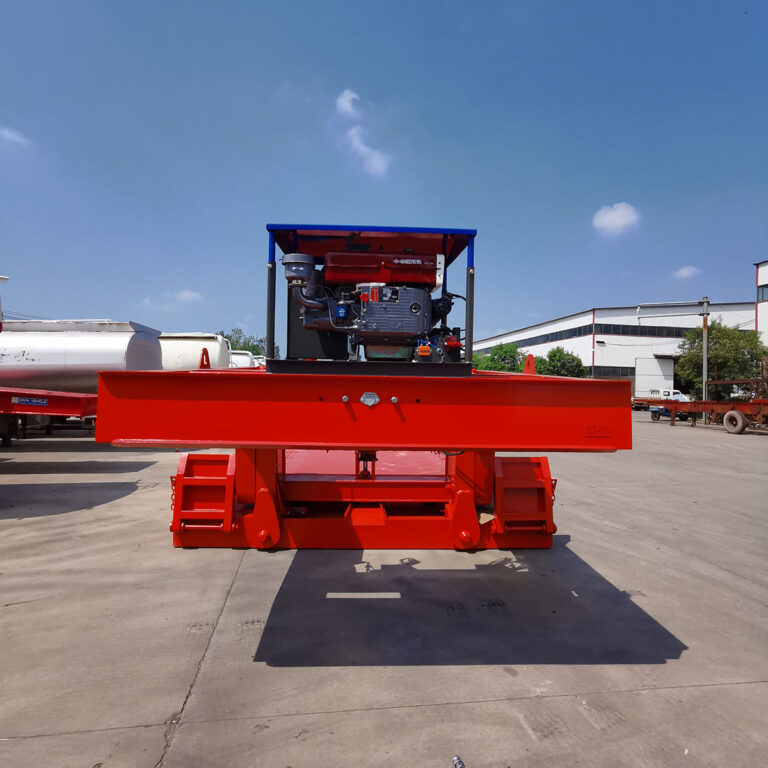
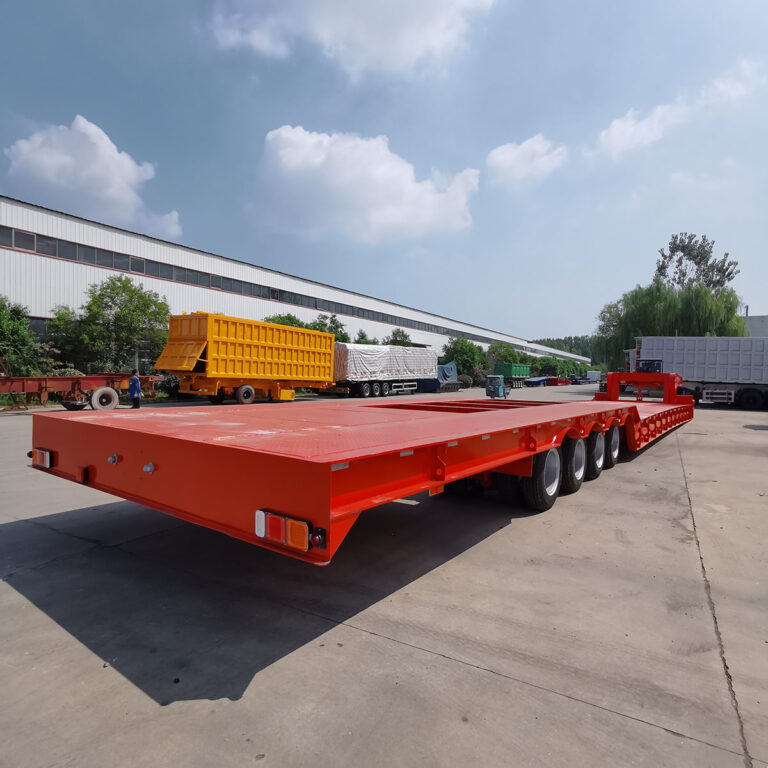
The 3-axle gooseneck low flatbed semi-trailer provides a versatile foundation for contractors entering the heavy-haul market. Rated for concentrated loads up to 60 tons, the gooseneck design lowers deck height to improve overhead clearance under bridges and power lines while maintaining a gradual loading angle suitable for tracked equipment. The reinforced main beam construction uses high-tensile steel to resist the twisting forces generated when loading uneven terrain machinery.
For projects requiring maximum flexibility, the 3-axle hydraulic folding forehead multifunctional low flatbed semi-trailer represents a significant operational upgrade. The hydraulically operated folding forehead converts between conventional lowbed configuration and extended deck length, allowing a single asset to transport both standard construction equipment and longer components such as bridge beams or wind tower sections. This adaptability reduces fleet size requirements and improves asset utilization during periods of mixed cargo demand.
When payload requirements exceed standard ratings, the 4-axle low flatbed semi-trailer distributes gross weights up to 80 tons across additional axles, reducing ground pressure and complying with stringent axle-load regulations in countries like South Africa and Kenya. The additional axles can be configured as self-steering or forced-steering to minimize tire scrub during tight site maneuvers, a critical consideration when navigating unpaved construction access roads.
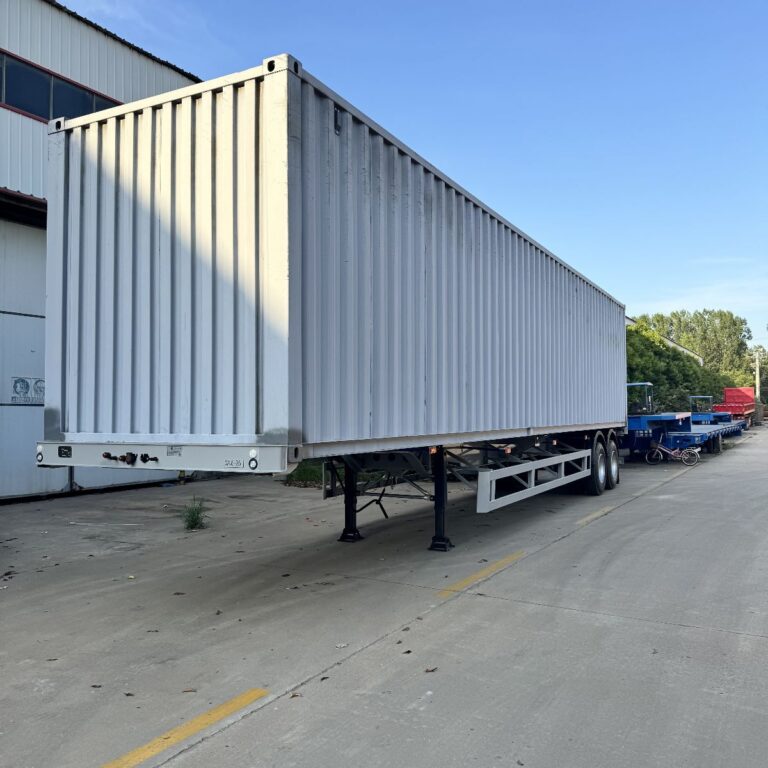
Infrastructure projects also require support vehicles for fuel logistics and bulk material transport. The 3-axle carbon steel gasoline tank semi-trailer provides reliable fuel delivery capacity for remote construction sites, while the 3-axle gooseneck skeleton semi-trailer enables efficient repositioning of ISO containers used for site offices, equipment storage, and modular worker housing.
Procurement Checklist: Selecting the Right Lowbed Trailer for 2026
Procurement managers facing the combined pressure of rising freight demand and infrastructure project deadlines should evaluate lowbed trailers against five criteria that determine total cost of ownership and operational reliability.
First, verify load concentration ratings rather than simply gross vehicle weight. A trailer rated for 60 tons distributed evenly may fail under a 45-ton excavator that concentrates 70 percent of its weight on two crawler tracks. Request engineering documentation showing maximum point loads and bending moment calculations for the main beam.
Second, specify suspension systems matched to operating terrain. Air-ride suspensions provide excellent vibration isolation for sensitive cargo but may lack the durability and ground clearance of mechanical suspensions on severely degraded roads. Many African infrastructure projects require hybrid configurations or reinforced mechanical suspensions with heavy-duty leaf springs and shock absorbers.
Third, evaluate ramp and loading systems for independence from external equipment. Hydraulic ramps allow a trailer to load itself using only the towing vehicle’s power take-off, eliminating dependency on site cranes or loading docks that may be unavailable on remote projects. The time savings compound across multiple daily loading cycles.
Fourth, confirm regulatory compliance for target markets. East African Community axle-load regulations, South African National Standard requirements, and Nigerian Federal Road Safety Corps specifications all differ in details. A trailer compliant in one jurisdiction may require modification for another. Reputable manufacturers provide certification packages addressing multiple regulatory frameworks.
Fifth, assess spare parts availability and manufacturer support infrastructure. The lowest purchase price loses its appeal if a critical component failure idles a trailer for weeks awaiting parts delivery. Manufacturers with established export experience maintain regional parts inventories and can provide technical documentation in English, French, or local languages as required.
Secure Your Fleet Before Peak Season
The convergence of freight market recovery and Africa’s infrastructure acceleration creates a procurement window that favors early movers. Trailer manufacturing lead times, while shorter than European alternatives, still extend four to six weeks for custom configurations. Waiting until peak construction season risks both price increases and delayed delivery that pushes project schedules into unfavorable weather windows.
Shandong Nanou Automobile Manufacturer invites procurement managers, fleet operators, and construction logistics coordinators to review detailed specifications for our complete range of lowbed trailers, tankers, and container transport solutions. Our engineering team can customize axle configurations, deck lengths, ramp systems, and suspension specifications to match the exact requirements of your operating environment and cargo profile.
Contact our export team today for a detailed quotation, technical drawings, and third-party inspection scheduling. With over 230 trailer configurations and delivery experience across more than forty countries, we provide the equipment reliability that infrastructure projects demand.
Website: nanou-trailer.com
Company: Shandong Nanou Automobile Manufacturer Co., Ltd.
Location: Liangshan County, Shandong Province, China
الوسوم lowbed trailer, semi trailer, heavy haul transport, Africa infrastructure, freight market 2026, construction logistics, procurement manager, low flatbed semi trailer, project cargo, Shandong Nanou