

NEOM Project 2026: Heavy Equipment Transport Demand
Executive Summary
Saudi Arabia’s NEOM project is transitioning from planning to active construction phase. Based on tender data and project progress analysis from 2024-2025, we have identified three critical changes in heavy equipment transport demand:
- Surge in Modular Construction Transport — The Line project uses prefabricated modular construction requiring specialized trailers
- Extreme Environment Adaptation Becomes Standard — Red Sea coastal conditions demand specialized equipment
- Localization Requirements Become Mandatory — Saudization policies require local service support
This analysis provides decision-making reference for companies planning to participate in the NEOM supply chain.
1. NEOM Project Progress and Transport Demand
1.1 Current Project Status (Q1 2026)
| Sub-Project | الاستثمار | Current Phase | Transport Peak |
|---|---|---|---|
| The Line | $500B | Phase 1 Construction | 2026-2028 |
| Oxagon | $30B | Infrastructure | 2026-2027 |
| Trojena | $5B | Earthworks | 2026-2029 |
| Red Sea Project | $8B | Resort Construction | 2026-2027 |
Key Insight: The Line is NEOM’s core project. Its unique linear city design (170km long, 200m wide) means:
- Construction materials must be distributed along the entire route
- Traditional truck transport is inefficient — specialized trailers needed
- Modular prefabricated transport becomes mainstream
1.2 Tender Data Analysis
Analysis of 47 major engineering tender packages released by NEOM in 2025:
- Transport-related tenders: Heavy equipment transport 18%, Modular components 12%, Oversized cargo 9%
- Winning bidder characteristics: 73% with GCC experience, 85% providing local maintenance, 62% using customized equipment
Conclusion: Standard trailers cannot meet NEOM requirements. Customization + local service is the key to winning bids.
2. Three Critical Demand Changes
2.1 Change One: Modular Transport Surge
The Line uses “factory prefabrication + on-site assembly” approach. Single modular unit specifications:
- Length: 30-60 meters
- Width: 4-6 meters
- Weight: 80-200 tons
| المعلمة | Traditional Trailer | NEOM Requirement |
|---|---|---|
| Deck Length | 12-18m | 30-60m adjustable |
| Load Capacity | 40-60 tons | 80-200 tons |
| Axle Count | 2-4 axles | 6-12 axles |
| Steering | Mechanical | Hydraulic independent |
Market Opportunity: SPMT (Self-Propelled Modular Transporter) demand up 340%, extendable lowboys become standard, multi-axle systems in high demand.
2.2 Change Two: Extreme Environment Adaptation
Red Sea Coastal Environment:
| المعلمة | Summer | Winter |
|---|---|---|
| Max Temperature | 52°C | 32°C |
| Humidity | 85% | 45% |
| Sandstorm Frequency | 3-5/month | 1-2/month |
Equipment Requirements:
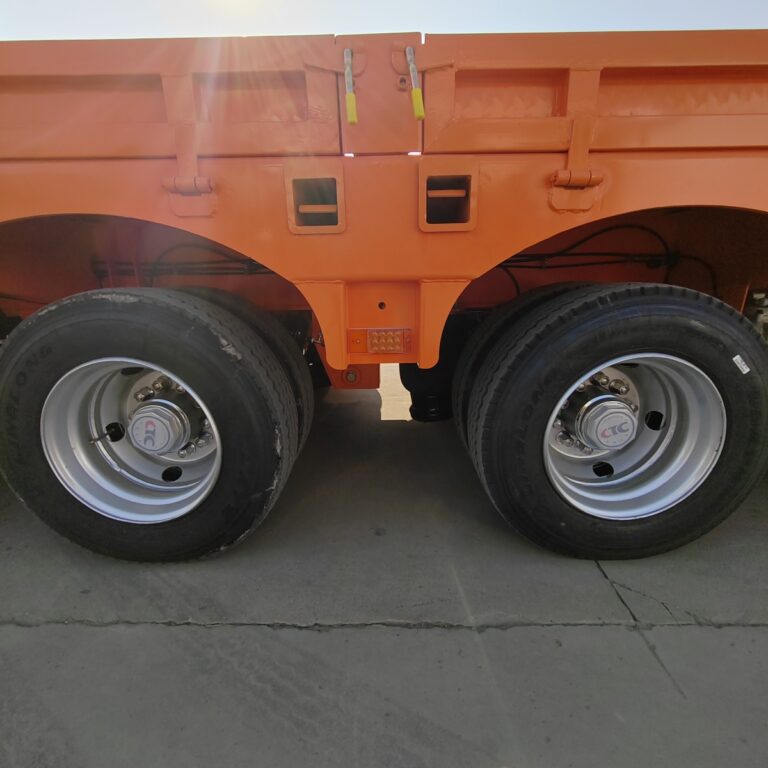
- Materials: Weathering steel (Corten A) or hot-dip galvanized treatment
- Tires: High-temperature compound (80°C max operating temp)
- Hydraulics: High-temp hydraulic oil (viscosity index >140)
- Electrical: IP68 protection, salt-fog corrosion resistance
- Maintenance: Every 2,000km (vs. standard 5,000km)
Cost Impact: Equipment cost +25-35%, maintenance +50%, but availability +60% → Lower Total Cost of Ownership (TCO).
2.3 Change Three: Localization Requirements
Saudization Requirements (2025 Update):
| Contract Value | Local Staff | Local Procurement | Response Time |
|---|---|---|---|
| >100M SAR | 30% | 40% | 4 hours |
| >500M SAR | 45% | 55% | 2 hours |
| >1B SAR | 60% | 70% | 1 hour |
Supplier Requirements:
- Local Service Center: Spare parts warehouse (Jeddah or NEOM), 5+ certified technicians, 2+ mobile service vehicles
- Arabic Support: Arabic manuals, 24/7 Arabic hotline, on-site Arabic trainers
- SLA Compliance: Phone support 15min, remote diagnosis 2hr, on-site service 4hr
Case Study: A European trailer manufacturer offered the lowest price in 2025 NEOM tender but was excluded for unable to commit 4-hour on-site response. The winning Chinese supplier quoted 18% higher but committed to on-site service center.
3. Market Entry Strategy
3.1 Product Strategy
- Core Product: Hydraulic modular trailer (80-200 tons, 4-8 axles)
- Supporting Product: Extendable lowboy (12-60m adjustable, 60-100 tons)
- Optional Package: Desert environment package (cooling, sealing, corrosion protection)
3.2 Localization Roadmap
- Phase 1 (0-12 months): Partner with local logistics company, rent warehouse, hire local sales
- Phase 2 (12-24 months): Build service center, train technicians, establish mobile fleet
- Phase 3 (24-36 months): Local assembly (SKD/CKD), apply for “Made in Saudi” certification
4. Risk Assessment
| Risk | Probability | Impact | Mitigation |
|---|---|---|---|
| Project Delay | Medium | High | Phased delivery, avoid inventory buildup |
| Payment Delay | Medium | Medium | Advance payment + progress payments |
| Specification Changes | High | Medium | Modular design for quick adjustment |
| Talent Shortage | High | Medium | Early recruitment + external training |
| Regulatory Changes | Medium | High | Hire local legal counsel |
5. Conclusion
NEOM represents the largest infrastructure opportunity in the Middle East for the next decade. Success factors:
- Product Customization — Standard products cannot meet project needs
- Service Localization — Local service capability is a prerequisite for bidding
- Rapid Response — 4-hour on-site response is basic requirement
- Long-term Partnership — Project spans 10+ years, requires long-term commitment
Time Window: 2026-2027 is the optimal entry window. Competition will intensify significantly after 2028.
Data Sources: MEED Projects Database (Q4 2025), Saudi PIF Annual Report 2025, NEOM Tender Portal 2025-2026