

What are the differences between low flatbed semi-trailer and full trailer
There are significant differences between low flatbed semi-trailer and full trailer in terms of traction mode, support structure, load-bearing capacity, application scenarios, and design complexity, as follows:
1、 Traction method
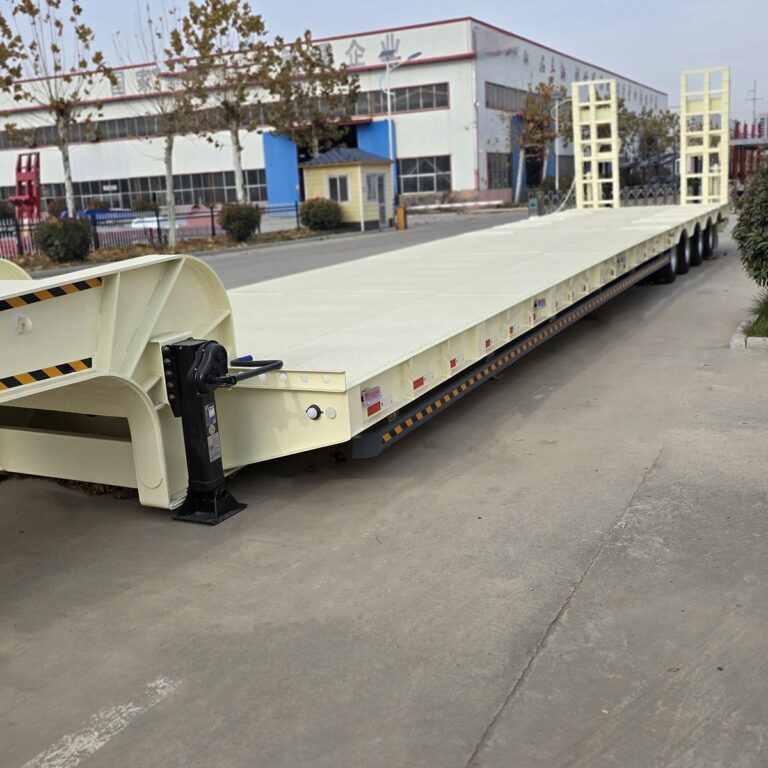
Low flatbed semi-trailer: The front part is connected to the tractor through a traction saddle (fifth wheel), and the rear axle of the tractor bears the weight of the front part of the trailer, forming a common load-bearing structure. This design is similar to the lever principle, ensuring transportation stability.
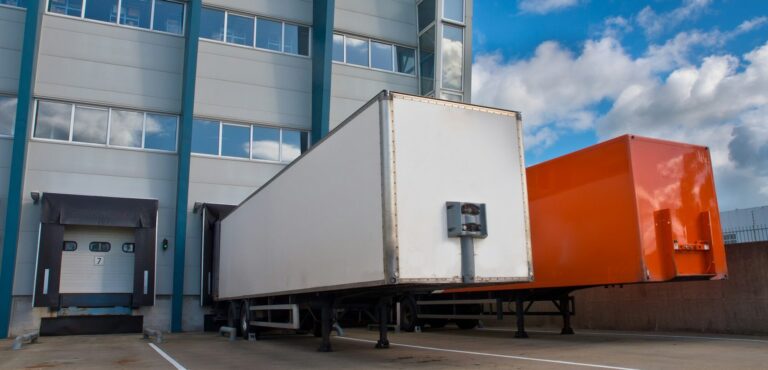
Full trailer: Connected to the tractor through a front-end hook, the tractor only provides power and does not bear the trailer load. The load is completely borne independently by the trailer itself.
2、 Supporting structure
Low flatbed semi-trailer: without front wheel system, adopts a single axle structure, and relies on the traction saddle to suspend the load at the front. When standing, it needs to rely on the front hydraulic support legs for support.
Full trailer: equipped with an independent front wheel system and a dual axle structure, it can stand upright through its own tires without external support.
3、 Carrying capacity
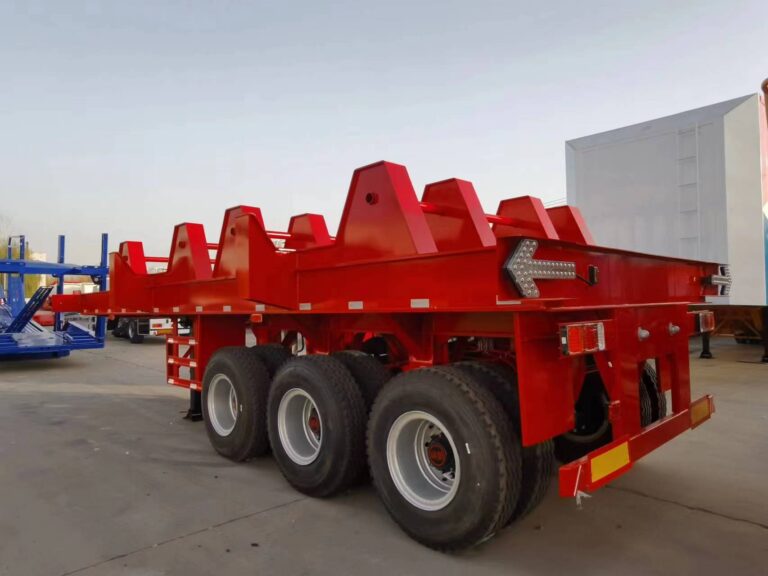
Low flatbed semi-trailer: The load range is usually 20-150 tons, and the more axles there are, the greater the load. It is suitable for the transportation of large items such as heavy-duty trucks, rail vehicles, and mining machinery.
Full trailer: Although it can independently carry all loads, its load-bearing capacity is limited by its structural strength. It is usually used for the transportation of bulk goods such as coal and grain, and its load-bearing capacity is smaller than that of a low flatbed semi-trailer.
4、 Application scenarios
Low flatbed semi-trailer:
Long distance transportation: suitable for long-distance transportation on highways, with a cargo capacity up to three times that of ordinary trucks.
Large item transportation: transporting non dismantling goods such as heavy vehicles, construction machinery, and large objects.
Special requirements: Strong ability to navigate overhead obstacles such as bridges and tunnels, suitable for transporting ultra-high cargo.
Full trailer:
Short distance transportation: mainly used for short distance translation operations within industrial parks, ports, docks, and other areas.
Complex terrain: The swinging characteristics of the tow bar are more suitable for scenarios with large turning radii, such as mountainous roads.
Bulk goods: Coal, grain and other bulk goods have high transportation efficiency.
5、 Design complexity and stability
Low flatbed semi-trailer:
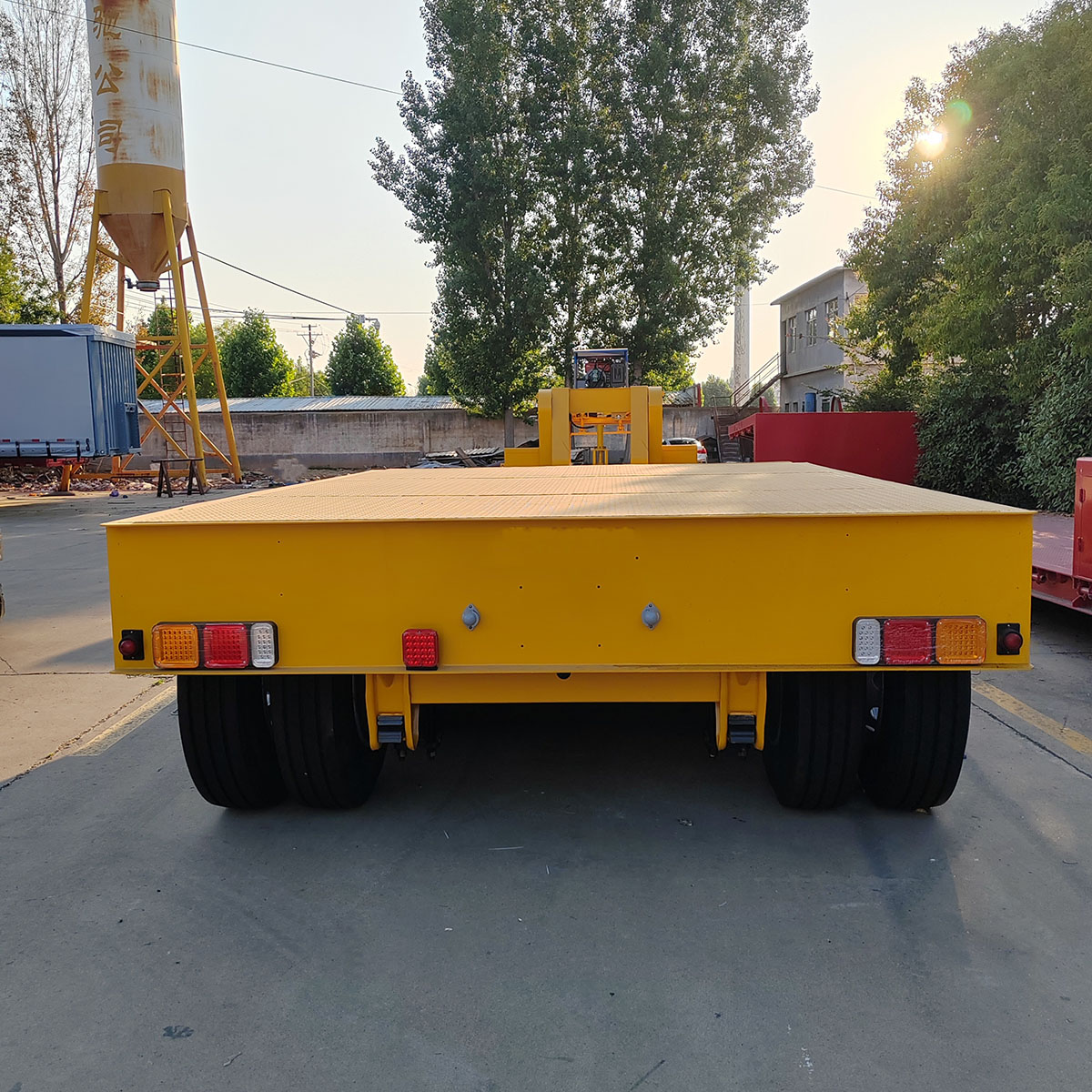
Structural optimization: Adopting a concave beam (well shaped) frame, the main plane of the cargo platform is low, the center of gravity is low, and the transportation stability is strong.
Suspension system: equipped with three-axis balanced, dual axis balanced or rigid suspension, with mass balance blocks installed between the front and rear steel plate springs to ensure balanced force on the front and rear axles.
Stability: Good stability during high-speed driving, suitable for long-distance transportation.
Full trailer:
Simple structure: composed of frame, body, traction device, etc., with relatively simple manufacturing process.
Flexibility: It can handle complex road conditions well, but it is prone to problems such as drifting and brake loss during high-speed driving, resulting in poor stability.
Safety: Due to the independent suspension characteristics, the high-speed safety is insufficient, and its application in road transportation in China is gradually decreasing.