

What are the disadvantages of low-bed semi-trailers for heavy cargo transportation
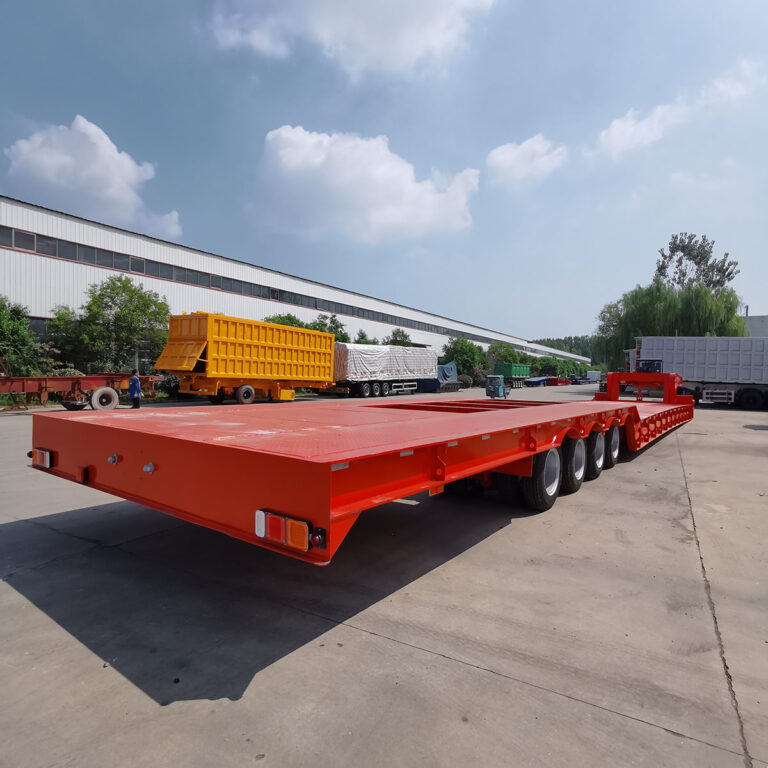
The disadvantages of low-bed semi-trailers for heavy-cargo transportation are as follows:
I. Policy restrictions and compliance risks
Strictly private attribute
Low-bed semi-trailers are specialized vehicles for heavy-cargo transportation. According to the “Limits of Dimensions, Axle Loads, and Masses for Motor Vehicles, Trailers, and Combination Vehicles” (GB1589-2016) and the “Regulations on the Administration of Highway Transportation of Oversized Vehicles”, they are designed for the transportation of large, non-dismantlable objects (such as wind turbine blades, bridge components, etc.). Using them for the transportation of ordinary goods (such as household appliances, building materials, etc.) is a violation and may result in fines, vehicle impoundment, and other penalties.
License and operational qualification restrictions
Temporary license plate restrictions: Low-bed semi-trailers can usually only apply for temporary driving license plates and cannot obtain long-term road transport permits. If they engage in ordinary cargo transportation in violation of regulations, they may be investigated and punished for operating without a license.
Complexity of over-limit approval: When transporting non-dismantlable large items, it is necessary to apply for an “Over-limit Transportation Vehicle Pass” in advance. This involves route planning, bridge reinforcement, traffic control, etc., making the process cumbersome and costly.
The proliferation of illegal modifications
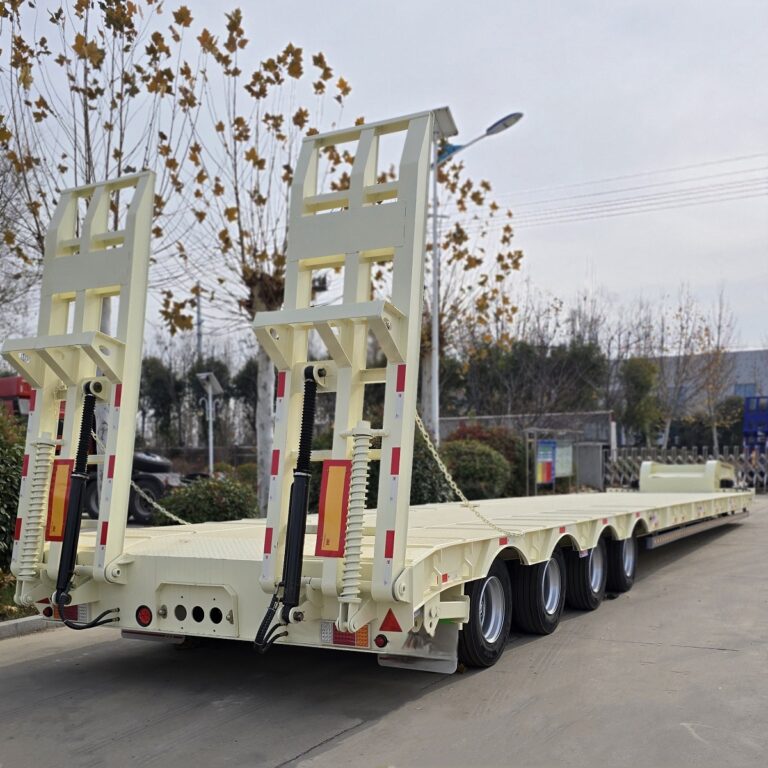
Some vehicle owners illegally modify low-bed semi-trailers (such as extending the cargo platform, adding guardrails, and implementing a pull-out extension design) in order to increase their loading capacity, resulting in parameters such as vehicle dimensions and axle load exceeding standards, further exacerbating compliance risks.
II. Prominent safety hazards
Vehicle stability risk
Center of gravity height issue: Despite the relatively low height of the cargo platform of low-bed semi-trailers, when transporting over-length and over-width goods, the center of gravity of the cargo may exceed the vehicle’s design limits, increasing the risk of rollover.
Turning and braking challenges: With a body length of up to 20 meters or more and a large turning radius, it is prone to scraping against obstacles on narrow roads or in complex road conditions; the large load capacity leads to extended braking distances, which can easily cause accidents in emergency situations.
Illegal modification exacerbates the danger
Decreased structural strength: Illegal extension and widening of cargo platforms may damage the original structure of vehicles, leading to insufficient bending stiffness and potential fracture on bumpy roads or during sharp turns.
Overload of the braking system: After modification, the total vehicle weight may far exceed the designed load capacity, leading to increased wear of the braking system components (such as brake pads and brake drums) and decreased braking efficiency.
The phenomenon of counterfeit and fake license plates is widespread
There are a large number of counterfeit and fake low-bed semi-trailers on the market. These vehicles evade taxes and inspections, have varying levels of condition, and are difficult to trace responsibility for, posing a hidden danger to road traffic safety.
III. High operating costs
Acquisition and maintenance costs
High vehicle price: The low-bed semi-trailer utilizes high-strength steel and a special suspension system, resulting in a significantly higher acquisition cost compared to ordinary semi-trailers.
High maintenance costs: The large load capacity leads to accelerated wear of components such as tires, axles, and suspensions, resulting in shorter replacement cycles and increased maintenance costs.
High fuel consumption
High-power engines require more fuel to drive overweight cargo, and fuel costs account for a high proportion in long-distance transportation, further compressing profit margins.
Increase in compliance costs
Over-limit approval fees: To apply for an “Over-limit Transportation Vehicle Pass”, an approval fee is required, and it may also involve road compensation fees, bridge reinforcement fees, etc.
Fines and loss due to vehicle suspension: After being caught for illegal transportation, fines must be paid and losses incurred during the suspension of the vehicle must be borne, affecting operational efficiency.
IV. Unfair market competition
Freight rate squeeze effect
Low-bed semi-trailers have a significantly higher loading capacity than ordinary semi-trailers. In order to seize market share, some owners adopt low-price competition strategies, which drive down the overall freight rate level in the industry and squeeze the living space of compliant transportation enterprises.
Disrupt market order
The proliferation of fake-licensed vehicles: A large number of low-bed semi-trailers with fake licenses evade taxes and regulations, participate in competition at low costs, and undermine market fairness.
Impact of illegally modified vehicles: The modified low-bed semi-trailers have increased loading capacity, further exacerbating the cut-throat competition in freight rates and creating a vicious cycle where “bad money drives out good money”.
- Policy supervision is becoming stricter, leading to increased compliance pressure
Special governance action
In recent years, the Ministry of Transport, the Ministry of Public Security, and other departments have repeatedly carried out special operations to address illegal modifications and overloading of trucks, focusing on investigating and punishing violations such as the transportation of general cargo and illegal modifications of low-bed semi-trailers.
Clear long-term planning
The “14th Five-Year Plan for National Road Traffic Safety” and other documents explicitly state that “low-bed trailers should be phased out of the bulk cargo transportation market”. In the future, compliance requirements will become stricter, and non-compliant vehicles will face the risk of being eliminated.