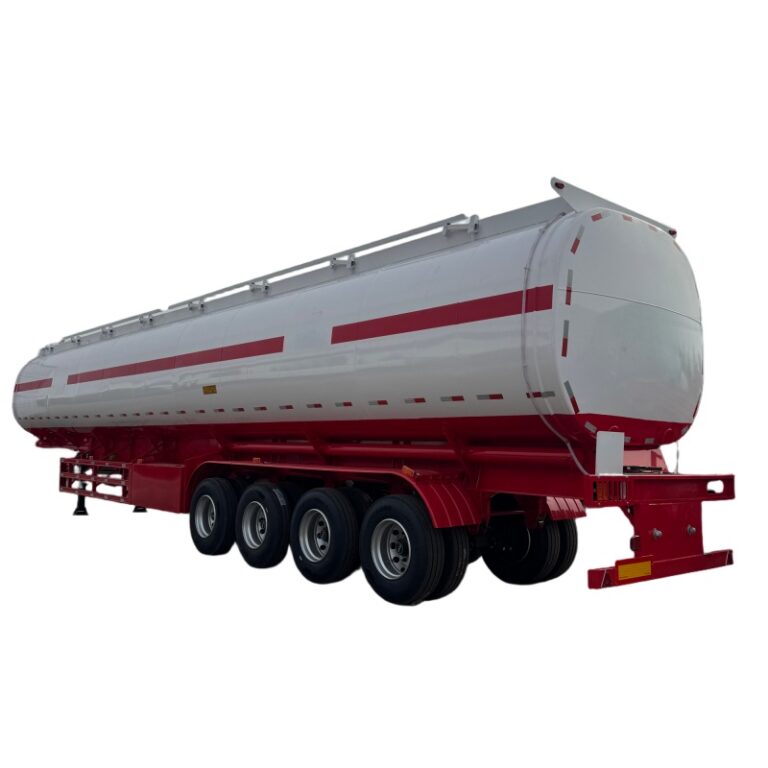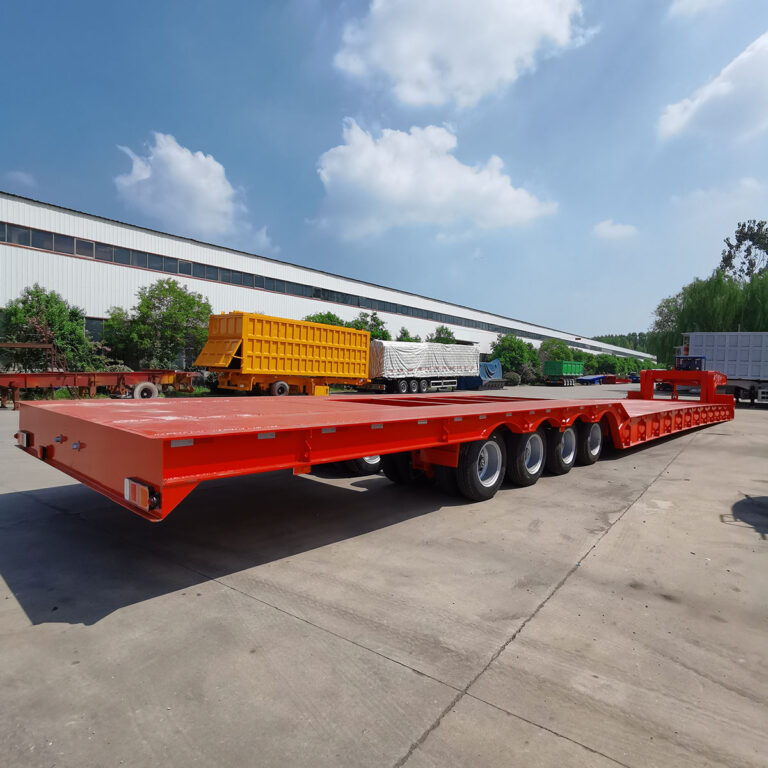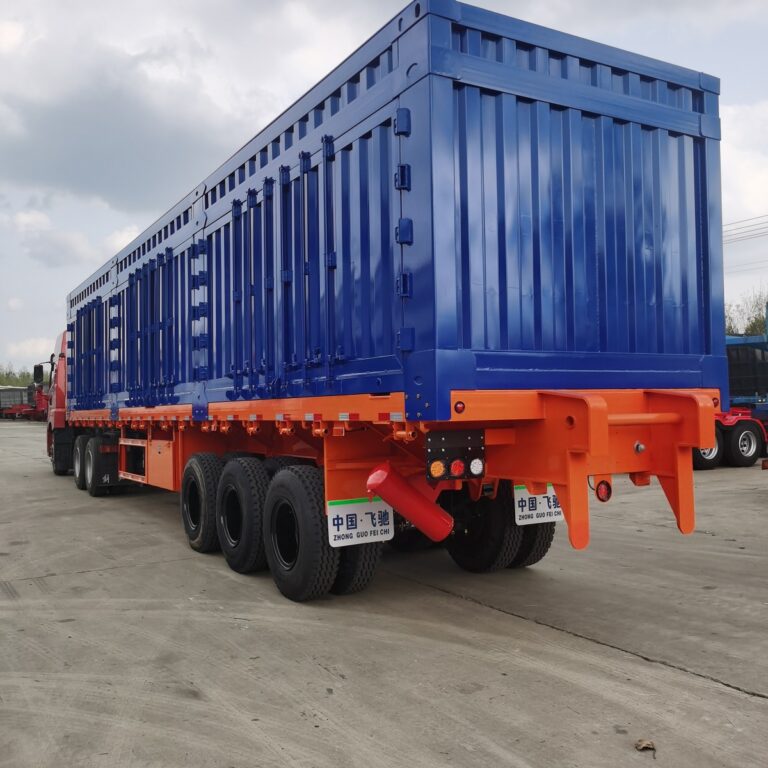


Box Semi Trailer for Sale: Types, Specs & Prices from China Manufacturer (2026)
Box Semi Trailer for Sale: Types, Specs & Prices from China Manufacturer (2026)
What you’ll learn in this guide: What a box semi trailer is and when it’s the right tool for your business, the four main types (dry van, refrigerated, curtain side, and drop-side box) and which one fits your cargo, the key specifications that actually change price and lifespan, a 2026 FOB price guide with eight real configurations, a six-step import checklist from RFQ to delivery, and answers to six common buyer questions about box trailers from China.
What Is a Box Semi Trailer and When Do You Need One?
A box semi trailer is a fully enclosed cargo trailer built on a welded steel frame, with a rigid side-walled cargo body, a fixed roof (steel or fiberglass), and lockable rear doors for forklift or manual loading. In the global trucking industry it’s commonly called a “dry van” because the body is completely sealed against weather and theft.
According to the China Federation of Logistics & Purchasing, the dry van segment accounts for roughly 52% of all semi trailer sales in Asia — and a similar share of fleet additions in Africa, the Middle East, and Central Asia — making the box trailer the workhorse of regional road freight worldwide.
You need a box semi trailer when:
- Cargo is palletized or cartonized — dry goods, FMCG, electronics, textiles, light manufactured goods, paper rolls.
- Cargo must stay dry — agricultural products (rice, wheat, maize, sugar, fertilizer), bagged cement, palletized consumer goods that suffer under humidity.
- Cargo is high-value and theft-prone — appliances, alcohol, branded goods. The fully enclosed body plus lockable steel rear doors reduces in-transit theft by an estimated 60–80% versus open flatbeds in markets like West Africa and parts of South America.
- You run multi-drop distribution — a 53 ft tri-axle dry van can split 24–28 standard EU pallets for last-mile delivery around a city or industrial zone.
A box trailer is the wrong tool when your cargo needs side-loading (use a side curtain semi-trailer), requires open-top crane loading of oversized goods (use a flatbed trailer), or has to be discharged under its own weight (use a dump semi trailer).
Four Types of Box Semi Trailer — Which One Fits Your Business?
1. Standard Dry Van (Closed Box) Trailer
The most common configuration globally. A fully welded steel frame supports a steel-clad rectangular cargo body with rear swing doors, a fixed roof, and an optional rear roller shutter for forklift access.
- Typical use: FMCG, palletized consumer goods, paper, packaged food, electronics.
- Typical dimensions: 40 ft / 45 ft / 53 ft length, 8 ft width, 8.5 ft or 9 ft interior height.
- Typical payload: 28–32 tonnes for tri-axle, 35–40 tonnes for quad-axle.
- Representative model: Van transport semi-trailer from Nanou — a 3-axle 40 ft dry van with BPW/FUWA axles and a 65-tonne gross rating.
2. Refrigerated Box Trailer (Reefer)
A dry van body upgraded with 80–100 mm polyurethane foam insulation, a refrigeration unit (US Thermo King / Carrier or Chinese Kingtec / Hol), and a stainless-steel or aluminum interior for food-safe transport.
- Typical use: Fresh produce, meat, dairy, seafood, pharmaceuticals, floral.
- Typical dimensions: Same as dry van; interior height slightly reduced by insulation.
- Typical payload: 26–30 tonnes (the reefer unit adds ~800 kg to 1,200 kg).
- Price premium: $4,500 to $8,000 over a standard dry van, depending on the reefer unit brand.
3. Curtain Side Box Trailer
A hybrid between a dry van and a flatbed. Instead of fixed steel walls, it has retractable PVC tarpaulin side curtains on a sliding rail system, a fixed roof, and removable rear posts. This lets you side-load pallets or oversized goods that wouldn’t physically fit through rear doors.
- Typical use: FMCG distribution, beverages, building materials, mixed loads requiring quick side access.
- Typical dimensions: 45 ft and 53 ft most common; up to 2.6 m internal side-opening width.
- Representative model: Side curtain semi-trailer from Nanou — 3-axle curtainsider with a KRONE-style sliding roof pole system.
4. Drop-Side / Stake Box Trailer
A box trailer with hinged side walls that can be lowered or fully removed for top-loading with a crane, then closed and locked for transit. Also called a “box stake” or “drop-side box” trailer. This is the body style used on the Nanou Grain carrier and Box truckBox truck models.
- Typical use: Bagged agricultural products (grain, rice, sugar, fertilizer), palletized heavy goods requiring crane-loading, military and humanitarian logistics.
- Typical dimensions: 40 ft / 45 ft / 53 ft length, 8 ft width, 8.5 ft interior height.
- Typical payload: 28–32 tonnes for tri-axle.
Tip: If your fleet also carries bulk loose loads, look at our dump semi trailer range for a heavier-duty tipping body. If you mostly carry stackable bagged cargo, drop-side box trailers offer much faster turnaround than fully enclosed dry vans.
Explore the full box trailer catalogue at the Cargo Trailer / Box Semi Trailer category page — 19 different configurations ready to quote.
Key Specifications — What Actually Matters
A box trailer that looks identical in pictures can vary by $4,000 in price depending on spec choices. Below are the seven specs that change price and lifespan the most:
| Specification | Economy spec | Mid-range (recommended) | Heavy-duty spec |
|---|---|---|---|
| Axle configuration | 2 axles (24 t payload) | 3 axles (32 t payload) | 4 axles (40 t payload) |
| Axle brand | FUWA 13-tonne Chinese | BPW 13 t or FUWA 16 t | BPW 16 t German |
| Wall steel grade | Q235 carbon, 1.5 mm | Q345 high-tensile, 2 mm | Q345/T610, 3 mm |
| Suspension | Leaf-spring mechanical | Airbag (FUWA or BPW) | Airbag + electronic lift axle |
| Rear door type | Single swing | Double swing | Double swing + roller shutter |
| Floor | 2 mm checker plate | 3 mm steel + bamboo overlay | 5 mm hardwood + steel underbody |
| Tire spec | 12R22.5 Chinese brand | 12R22.5 Triangle / Linglong | 12R22.5 Michelin / Bridgestone |
| Brake system | Dual-line air, no ABS | WABCO dual-line, WABCO ABS | WABCO EBS + electronic stability |
What buyers most often overlook:
- Cross-member spacing on the frame. A 600 mm spacing is the bare minimum; on rough African or Central Asian roads you want 400 mm spacing. It adds ~$700 but more than doubles the frame fatigue life under loaded cycles.
- King-pin location. A 1,400 mm king-pin (front) mount is the European standard. A 1,650 mm mount is the Asian/Chinese standard. Match the king-pin to the tractors in your fleet — most West African and GCC fleets use 1,400 mm, but Chinese and Russian fleets often use 1,650 mm. The wrong king-pin means you can’t couple the trailer to your tractor.
- Tail lift option. A 2-tonne tuck-away tailgate replaces a forklift at the receiver site. Adds $2,500–$3,800 but typically pays for itself in 18 months for last-mile operations.
- Tyre brand, not just size. Chinese 12R22.5 tyres cost $180–220 each; Michelin or Bridgestone cost $420–520 each. The premium brands deliver 40–60% longer tread life on tarmac long-haul, but this advantage disappears on dirt roads.
Price Guide — Box Semi Trailer Costs from China (2026)
Below is the FOB Qingdao price range Nanou quotes for export clients in mid-2026. Final price depends on axle count, refrigeration, components, finish paint, and order quantity.
| Configuration | FOB price (USD) | Typical applications |
|---|---|---|
| 2-axle 40 ft dry van, FUWA 13 t, leaf-spring | $7,800 – $9,500 | Light FMCG, last-mile distribution |
| 3-axle 40 ft dry van, BPW 13 t, airbag | $10,200 – $12,500 | Standard regional freight |
| 3-axle 45 ft dry van, BPW 13 t, hardwood floor | $12,500 – $15,000 | Palletized consumer goods |
| 3-axle 53 ft dry van, BPW 16 t, WABCO ABS | $14,800 – $17,500 | High-volume regional freight |
| 3-axle 40 ft reefer, Thermo King C-600 unit | $18,500 – $22,000 | Cold-chain food and pharma |
| 4-axle 53 ft dry van, BPW 16 t, EBS + lift axle | $20,500 – $24,000 | Heavy-duty regional haul |
| 3-axle curtain-side 45 ft, KRONE system | $13,500 – $16,000 | Multi-drop FMCG distribution |
| 3-axle drop-side 45 ft, BPW 13 t | $11,500 – $14,000 | Bagged grain & fertilizer |
What’s not in the FOB price: Sea freight ($1,800–$3,500 per unit depending on destination port), import duty (varies 5–25%; GCC 5%, Nigeria 20%, Kenya 25% + levies), pre-shipment inspection ($280–$400 per unit), destination trucking, and unpacking/crane hire at the receiver yard. Total landed cost is typically 1.3× to 1.6× the FOB figure.
Volume discount structure for 2026:
- 3–5 units: 3% volume discount on FOB price
- 6–10 units: 5% volume discount
- 11+ units: 7–10% volume discount (negotiated, depends on configuration)
- Mixed fleet (e.g., 3 box + 2 flatbed + 1 dump): extra 2% off as a one-time fleet bonus
For a deeper breakdown of how steel, axle, and freight inputs move these prices month by month, see our Semi Trailer Price Guide 2026 — including an input-cost component analysis.
How to Buy a Box Semi Trailer from China — 6-Step Checklist
This is the same import workflow Nanou’s export team has run with more than 800 fleet buyers since 2018. It works whether you’re buying 1 unit or 50.
Step 1 — Define your duty cycle. Before talking to any supplier, pin down: cargo type (dry, refrigerated, or cartonized), typical payload, average trip distance, road quality, climate, certifications you need (GCC SASO, Nigerian SONCAP, EU CE, EAC, or none for CIS countries). The clearer this brief, the more accurate your quotes will be.
Step 2 — Shortlist 2–3 manufacturers. Look for: (a) factories with 8+ years of export experience, (b) at least 1,000 dry vans a year of actual production capacity, (c) verifiable references in your destination market, and (d) willingness to send customized drawings to your spec. Avoid trading companies that rebrand factory output.
Step 3 — Request a complete technical offer. Ask for a spec sheet that explicitly names the axle brand, suspension brand, brake brand (WABCO / KNORR), king-pin size, wall steel grade, floor type, electrical system (24 V LED lights), tire brand, paint system (epoxy primer + polyurethane topcoat), and warranty terms. If a supplier can’t or won’t list these in writing, walk away.
Step 4 — Negotiate FOB price and Incoterms. Most Chinese suppliers quote FOB Qingdao. If you need CIF or CFR to a specific port, ask for both quotes and compare. CIF typically runs 8–15% above FOB because of freight, but the supplier takes responsibility for shipping logistics.
Step 5 — Pay deposit and request production photos. Standard payment terms are 30% T/T deposit, 70% balance against a B/L copy. Request weekly production photos so you can confirm specs are being followed before the unit is crated. For 5+ unit orders, you can usually arrange one factory-visit inspection in person at your cost.
Step 6 — Pre-shipment inspection and document set. Most buyers use SGS, BV, or TUV for third-party inspection ($280–$400 per unit). Required documents: B/L, commercial invoice, packing list, certificate of origin (Form E for ASEAN, FORM F for China-Pakistan FTA, or general CO), and technical conformity certificate.
For a complete walkthrough of the import paperwork and freight logistics, see our full guide: How to Import a Semi Trailer from China — Complete Guide.
🚛 Get Your Box Semi Trailer Quote Today
Tell us your cargo type, payload, body size, and destination country. You’ll get a custom spec sheet and FOB price within 24 hours.
💬 WhatsApp: +86 15315477956
📋 Online Inquiry Form
📱 WeChat: +86 15315477956
Frequently Asked Questions
What is the average price of a box semi trailer from China in 2026?
In 2026, a 3-axle 40 ft dry van from a verified Chinese manufacturer runs $10,200–$12,500 FOB for mid-range specs, $7,800–$9,500 for economy specs, and $14,800–$17,500 for heavy-duty BPW 16-tonne airbag configurations. Refrigerated models add $4,500–$8,000 depending on the reefer unit. Including sea freight, import duty, and inland delivery, the landed cost in West Africa is roughly $14,000–$22,000 per unit and in the GCC $11,000–$19,000 per unit.
Is a box semi trailer the same as a dry van?
In practice, yes — the two terms are interchangeable. “Box trailer” is the more common term in Asia, the Middle East, and Africa, while “dry van” is the standard term in the United States, Canada, and Western Europe. Both refer to a fully enclosed, weatherproof cargo trailer with rear doors. The only nuance: “dry van” sometimes excludes refrigerated versions, while “box trailer” can include them. Always confirm whether the unit you’re quoting is reefer-capable or refrigerated from the factory.
How many axles should I pick?
For payloads up to 24 tonnes, a 2-axle box trailer is sufficient and the cheapest to operate. For 24–32 tonnes (the most common spec across FMCG and palletized goods), choose a 3-axle. For 32+ tonnes on highways, choose a 4-axle with a lifting axle to reduce tyre wear when running empty. Match the axle configuration to your local road weight limits — many African corridors cap at 56 tonnes gross (tractor + trailer), which works perfectly with a 3-axle trailer at 32 t payload plus a 6×4 tractor at 24 t.
What certifications do I need for my country?
The most common certifications are: GCC SASO for Saudi Arabia, UAE, Qatar, Oman, Bahrain, and Kuwait; SONCAP for Nigeria; KEBS/PVoC for Kenya; EAC for Russia, Kazakhstan, and Belarus; CE marking for EU-27; and DOT for North America. Chinese factories typically include CE or EAC conformance at no charge; SASO and SONCAP are usually $400–$800 per unit extra. We can advise which certification package makes sense for your destination port — just message us with your country.
What is the typical lead time?
From approved drawing to FOB loading, lead time is 25–35 working days for a standard 3-axle dry van, 35–45 working days for a refrigerated box trailer, and 45–60 working days for a 50+ unit batch. Add 18–35 days for sea freight depending on destination (West Africa: 32 days; GCC via Jebel Ali: 18 days; Southeast Asia: 8 days; Mediterranean: 28 days). Custom paint jobs add 2–3 working days; custom logos add 1 working day.
Can I customize the body color and logo?
Yes. Standard RAL colors (white, blue, red, green, yellow) are no extra charge. Custom colors add $200–$400 per unit. Logo printing on the body adds $150–$300 per unit depending on size. Most GCC and African buyers print their company logo and phone number directly on the trailer — it doubles as mobile advertising and helps with brand visibility at border crossings. We can also print in Arabic, French, or Portuguese on request.
Why Choose Nanou Trailer?
- 12+ years exporting semi trailers to 40+ countries. Real references in Nigeria, Saudi Arabia, UAE, Kenya, Tanzania, Mozambique, Russia, and Southeast Asia. We’re not a trading company — we’re the manufacturer.
- Factory-direct pricing, no middlemen. Our Shandong factory runs 8 production lines and produces 25,000 units of annual capacity across the dump, flatbed, lowbed, tank, skeleton, and box trailer families.
- Custom specs, not just catalog units. Axle brand, tire brand, brake system, paint color, king-pin location, and suspension type can all be specified on the same production line — most economical in batches of 3+.
- Full document handling. We prepare the complete export set including Form E / FORM F / general CO, certificate of origin, PSI report, commercial invoice, and packing list. We’ve shipped to 40+ countries without a single compliance rejection since 2020.
📦 Ready to Order Your Box Semi Trailer?
Talk to a Nanou engineer about your payload, route, and certification needs — same-day reply, English-speaking team.
💬 WhatsApp: +86 15315477956
📋 Online Inquiry Form
📱 WeChat: +86 15315477956 | 🏭 Factory-direct pricing since 2012
Related Articles & Resources
- How to Import a Semi Trailer from China — Complete Guide (2026)
- Semi Trailer Price Guide 2026 — Real Costs, Specs & China Supplier Breakdown
- Skeleton Semi Trailer for Sale: Types, Specs & Prices (2026)
- Tank Trailer for Sale: Types, Specs & Prices (2026)
- How to Choose a Bulk Cement Trailer: Complete Buyer’s Guide (2026)
- Browse all Box Semi Trailer configurations →