

Special Purpose Vehicle Buying Guide 2026: How to Choose the Right Specialized Semi-Trailer for Mining, Construction & Infrastructure Projects
Special Purpose Vehicle Buying Guide 2026: How to Choose the Right Specialized Semi-Trailer for Mining, Construction & Infrastructure Projects
The global market for special purpose vehicles and semi-trailers is experiencing a period of extraordinary growth. According to recent industry data, the construction and mining vehicle sector reached USD 401.4 billion in 2025 and is projected to hit USD 670.2 billion by 2036, representing a compound annual growth rate of 4.7%. Asia alone accounts for 40.5% of global revenue, driven by massive urbanization and smart-city programs. Meanwhile, India’s medium and heavy commercial transport sector is forecast to grow 5-7% this year, propelled by fleet replacement cycles and accelerating infrastructure investment, as reported by OICA in July 2026.
For procurement managers, logistics directors, and engineering contractors, these numbers signal a critical window: demand is surging, lead times are lengthening, and choosing the right special purpose vehicle has never mattered more for project timelines and bottom-line costs. This guide breaks down the main categories of specialized semi-trailers, compares their specifications, and provides a practical framework for making the right purchase decision in 2026.
What Qualifies as a Special Purpose Vehicle or Semi-Trailer?
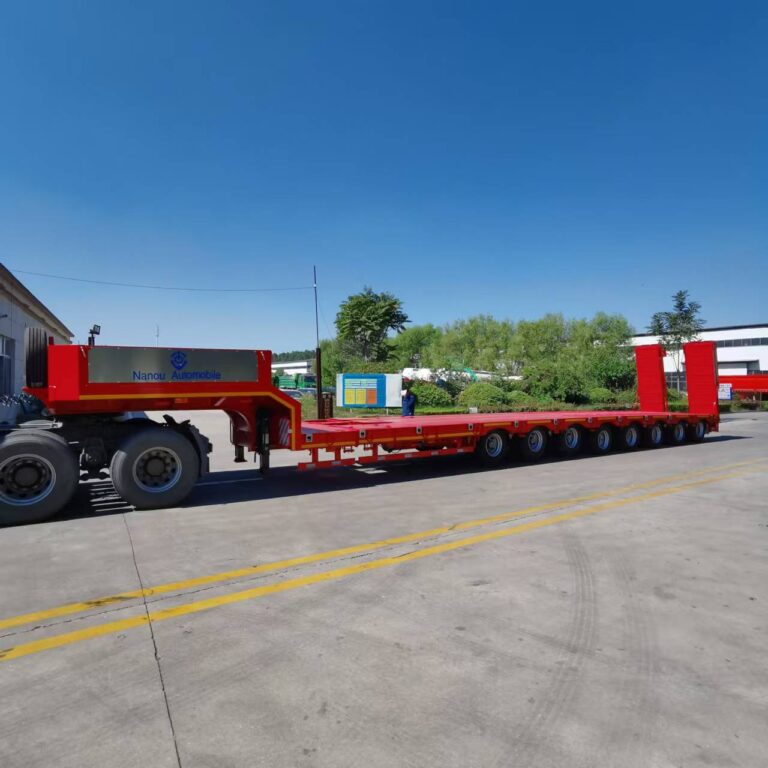
Special purpose vehicles (SPVs) are trailers and semi-trailers engineered for tasks that go beyond standard freight hauling. While a flatbed carries containers and a tanker carries liquid, SPVs are purpose-built for oversized, overweight, or operationally complex loads. Common examples include multi-axle low loaders for transporting heavy machinery, hydraulic modular trailers for abnormal-load projects, mining tipper trailers designed for extreme off-road conditions, and custom-built transport platforms for wind-energy components or prefabricated building sections.
The distinction matters because SPVs operate under different regulatory frameworks, require specialized coupling and braking systems, and often need to be specified on a project-by-project basis. Getting the specification wrong can mean permit violations, load damage, or costly project delays.
Market Trends Shaping SPV Purchasing in 2026
Three macro trends are reshaping how buyers approach special vehicle procurement this year.
Infrastructure investment across emerging markets. From Africa’s expanding highway networks to Southeast Asia’s new industrial corridors, governments are pouring capital into infrastructure. Nanou’s own analysis in our Africa infrastructure boom article detailed how demand for semi-trailers and heavy transport vehicles has surged across the continent, with mining and construction firms racing to secure reliable equipment before project deadlines.
Electrification and emissions regulation. China’s announcement to build over 3,000 charging and battery-swap stations for electric trucks, backed by $3.25 billion in government funding to replace older commercial vehicles, signals a broader shift. While most heavy SPVs remain diesel-powered for now, buyers in markets with tightening emissions rules should begin evaluating hybrid-ready or electric-compatible platform designs, especially for urban construction logistics.
Autonomous and telematics integration. The construction and mining vehicle market is seeing rapid adoption of AI-assisted fleet management, remote monitoring, and telematics systems. Modern SPVs increasingly come equipped with load-sensing axles, GPS-tracked suspension systems, and real-time tire-pressure monitoring — features that reduce downtime and improve safety on remote job sites.
Comparison Table: Major Special Purpose Semi-Trailer Types
| Trailer Type | Typical Axles | Payload Range (tons) | Best For | Key Consideration |
|---|---|---|---|---|
| Multi-Axle Low Loader | 3–10 axles | 40–200+ | Heavy machinery, transformers, mining equipment | Permit requirements vary by axle count and load width |
| Hydraulic Modular Trailer (HMT) | Modular (2–8+ axle lines) | 80–5,000+ | Abnormal loads, bridge beams, pressure vessels | Requires hydraulic power pack and trained operator |
| Mining Tipper Trailer | 3–6 axles | 30–80 | Ore haulage, overburden removal, quarry operations | Reinforced chassis and body for off-road abuse |
| Wind Blade / Tower Transport | 3–6 axles (extendable) | 20–60 | Wind turbine blades, tower sections | Extendable deck; escort vehicles often required |
| Heavy-Duty Lowbed with Ramp | 3–8 axles | 50–150 | Excavators, bulldozers, cranes (self-loading) | Hydraulic or spring ramp; check approach angle |
| SPMT (Self-Propelled Modular Transporter) | Modular (4+ axle lines) | 100–10,000+ | Ship modules, offshore platforms, plant relocation | Highest cost; requires specialist operator crew |
In-Depth Selection Guide: Five Factors That Matter Most
1. Load Profile and Dimensional Constraints
The starting point for any SPV specification is understanding the load — not just its weight, but its center of gravity, dimensions, and whether it can be broken down into smaller units. A 120-ton transformer, for example, may require a 6-axle lowbed with a low loading deck and hydraulic steering, while a set of precast concrete bridge segments might be better served by a modular trailer configuration that can be adjusted on-site.
The Nanou engineering team recommends that buyers create a load matrix before requesting quotations: list every piece of equipment or material that will be transported over the life of the trailer, including expected weights and dimensions. This prevents the common mistake of specifying a trailer that fits the first project but proves inadequate for subsequent contracts.
2. Axle Configuration and Legal Payload
Axle count directly determines how much weight a trailer can legally carry on public roads. Most jurisdictions impose per-axle weight limits, and exceeding them triggers fines, impoundment, or worse. In general, a 3-axle semi-trailer can carry 40-60 tons depending on local regulations, while a 6-axle combination can legally haul 80-120 tons. For loads beyond that, multi-axle or modular configurations with 8 to 10+ axle lines become necessary.
For a deeper comparison of axle configurations, our Multi-Axle Lowbed Trailer Buying Guide provides detailed specifications for 2- through 10-axle options.
3. Suspension, Braking, and Safety Systems
Special purpose trailers carry heavier and more valuable loads than standard freight trailers, making suspension and braking choices critical. Air suspension is now the default for most on-road SPVs because it distributes load more evenly across axles and provides a smoother ride that protects sensitive cargo. Mechanical leaf-spring suspension remains popular for off-road and mining applications where durability matters more than ride quality.
On the braking side, dual-line air brakes with ABS are standard. For trailers operating in hilly or mountainous terrain — common in mining operations — consider adding retarder-compatible brake systems and load-sensing proportioning valves that adjust braking force based on actual load weight.
4. Material and Build Quality
The structural steel used in an SPV’s chassis and deck determines its lifespan, maintenance costs, and resale value. High-strength low-alloy (HSLA) steels such as Q690 or T700 offer superior strength-to-weight ratios compared to conventional Q345 carbon steel, allowing manufacturers to reduce tare weight while maintaining or increasing payload capacity. For corrosive environments — coastal construction sites, chemical plants, salt mines — specify hot-dip galvanizing or marine-grade paint systems.
Nanou Automobile uses T700 high-strength steel as standard across its heavy-duty trailer range and offers customizable material upgrades for extreme-duty or corrosive-environment applications.
5. After-Sales Support and Spare Parts Availability
A special purpose trailer is a long-term capital asset, and downtime can cost thousands of dollars per day on a stalled project. Before committing to a purchase, evaluate the manufacturer’s spare-parts logistics, warranty terms, and technical support reach in your operating region. Key questions include: Does the manufacturer stock commonly needed parts (axles, brake chambers, hydraulic cylinders) in regional warehouses? Is there a local service partner who can perform warranty repairs? What is the typical lead time for replacement components?
For buyers also evaluating standard trailers to complement their SPV fleet, our Flatbed Semi-Trailer Buyer’s Guide covers selection criteria for general-purpose flatbeds that pair well with specialized equipment.
Frequently Asked Questions
What is the difference between a special purpose vehicle and a standard semi-trailer?
A standard semi-trailer (flatbed, sidewall, tanker) is designed for uniform cargo within standard weight and dimensional limits. A special purpose vehicle is engineered for specific operational requirements — oversized loads, extreme weights, off-road conditions, or unique cargo geometries — and often requires special permits and escort vehicles for road transport.
How do I determine how many axles my special trailer needs?
The axle count depends on total payload, per-axle legal weight limits in your operating jurisdiction, and road conditions. As a rule of thumb, divide your maximum payload by the per-axle limit (typically 10-13 tons per axle for road use) and add a safety margin. The Nanou engineering team can run a full axle-load calculation based on your specific route profiles and cargo data.
Can special purpose trailers be used across different countries with different regulations?
Many SPVs can be designed for multi-country operation, but this requires careful specification of lighting configurations, braking standards, coupling heights, and width/length limits for each target market. Buyers operating across borders in Africa or Southeast Asia should specify trailers to the most restrictive standard in their operating area and obtain necessary permits in advance.
What maintenance schedule should I follow for a heavy-duty special trailer?
A typical SPV maintenance schedule includes daily pre-trip inspections (tires, lights, brakes, hydraulic lines), weekly checks on suspension components and structural fasteners, and full servicing every 10,000-15,000 km or every three months, whichever comes first. Hydraulic systems on modular trailers require separate fluid and seal inspections.
Is it better to buy or rent a special purpose trailer for a one-off project?
For single-use or infrequent needs, renting can be more cost-effective, especially for high-value items like SPMTs. However, for ongoing projects or fleet operators with recurring heavy-transport requirements, ownership provides better long-term economics and operational control. Nanou offers both purchase and flexible lease-to-own arrangements for qualified buyers.
What lead time should I expect when ordering a custom special purpose trailer?
Standard-configured SPVs typically ship within 30-45 days from order confirmation. Fully custom designs — involving non-standard deck lengths, specialized hydraulic systems, or unique axle configurations — may require 60-90 days. During peak demand periods like the current infrastructure boom, earlier ordering is strongly recommended to secure production slots.
Related Reading
- Multi-Axle Lowbed Trailer Buying Guide 2026 — Deep dive into 2- through 10-axle lowbed configurations for wind energy, mining, and infrastructure projects.
- Africa’s Infrastructure Boom: Semi-Trailer and Heavy Transport Demand — Market analysis of surging demand across the African continent.
- How to Choose a Suitable Dump Semi-Trailer — Selection guide for dump trailers used in construction and mining operations.
—
## About Shandong Nanou Automobile Co., Ltd.
Shandong Nanou Automobile Co., Ltd. is a leading manufacturer of semi-trailers and special purpose vehicles based in Liangshan County, Shandong Province — China’s trailer manufacturing hub. With a catalog of over 230 product configurations, Nanou serves construction contractors, mining operators, logistics companies, and government agencies across more than 60 countries. All products are manufactured under ISO 9001 quality management and comply with international transport standards.
Get in touch with our engineering sales team for a customized quotation:
- Email: nanou-automobile@nanou-trailer.com
- WhatsApp: +86 159 7063 7777
- Phone: +86 153 1547 7956 / +86 159 7063 7777
- Address: Jiezhuang Village Industrial Park, Liangshan County, Shandong Province, China
—
Tags: special purpose vehicle, special semi-trailer, multi-axle trailer buying guide, hydraulic modular trailer, mining tipper trailer, heavy transport trailer 2026, abnormal load trailer, construction vehicle procurement