

How to choose a suitable dump semi-trailer
Self dumping semi-trailer is the core transportation equipment in industries such as engineering infrastructure, mining stone materials, slag removal, building materials, and agricultural inputs. With the advantages of hydraulic automatic unloading, large loading capacity, and efficient operation, it has become the main vehicle for short distance transportation of bulk materials. On the market, dump semi trailers are divided into two mainstream types: rear flip and side flip, with significant differences in cabin structure, material, axle, and hydraulic system configuration. Many users experience issues such as residual unloading, body deformation, non-compliance with regulations, and poor road adaptability after purchasing a car. The core reason is the lack of precise selection based on their own working conditions. This article comprehensively explains the selection method of self dumping semi-trailer from seven dimensions: core classification, cargo adaptation, hardware configuration, road conditions, compliance standards, industry solutions, and pit avoidance points, helping users choose suitable, durable, compliant, and high-yield vehicle models.
1、 Select the unloading form according to the homework scenario
The form of dumping is the core watershed of selection, which directly determines the applicable site, unloading effect, and safety of the vehicle. It is divided into two types: rear dumping and side dumping, with significant differences in adaptation scenarios.
- Rear dump semi-trailer
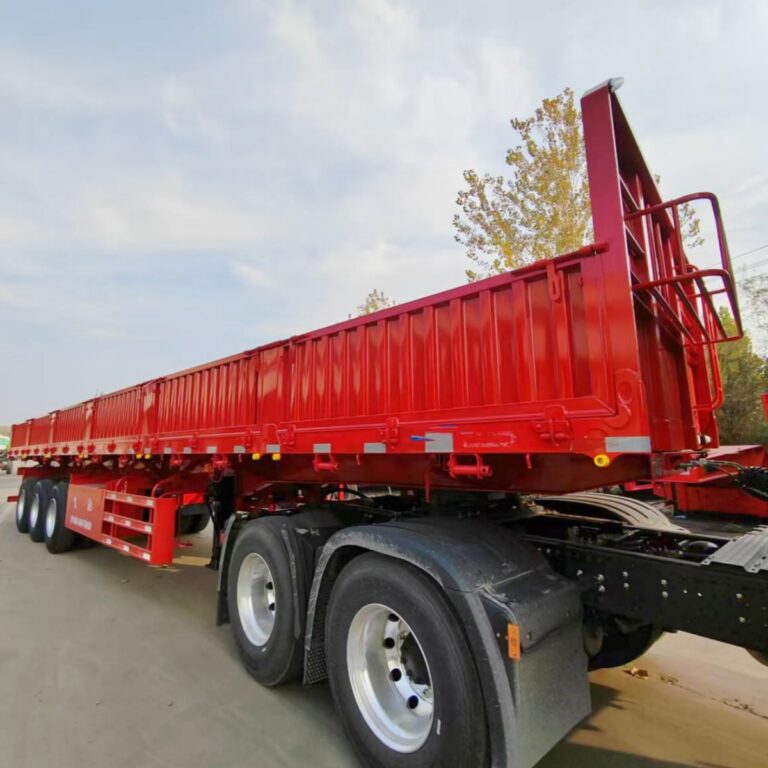
The rear flip model relies on the front hydraulic cylinder to lift the carriage as a whole and unload the rear part, making it the most versatile and lowest failure rate classic model. Its core advantages are clean unloading, strong load-bearing capacity, large carriage capacity, and no dead corners or residues during lifting operations. It is particularly suitable for viscous and block shaped heavy materials.
Applicable scenarios: open and flat construction sites, sand and gravel yards, mining areas, road infrastructure, slag removal, construction waste, coal and ore transportation.
Advantages and disadvantages: The advantages include simple structure, low maintenance cost, high upper limit of load capacity, no residue during unloading, and strong adaptability to working conditions; The disadvantage is that the lifting center of gravity is high, there is a risk of tipping over on uneven ground, and narrow areas and side material warehouses cannot be operated. - Flip dump semi-trailer
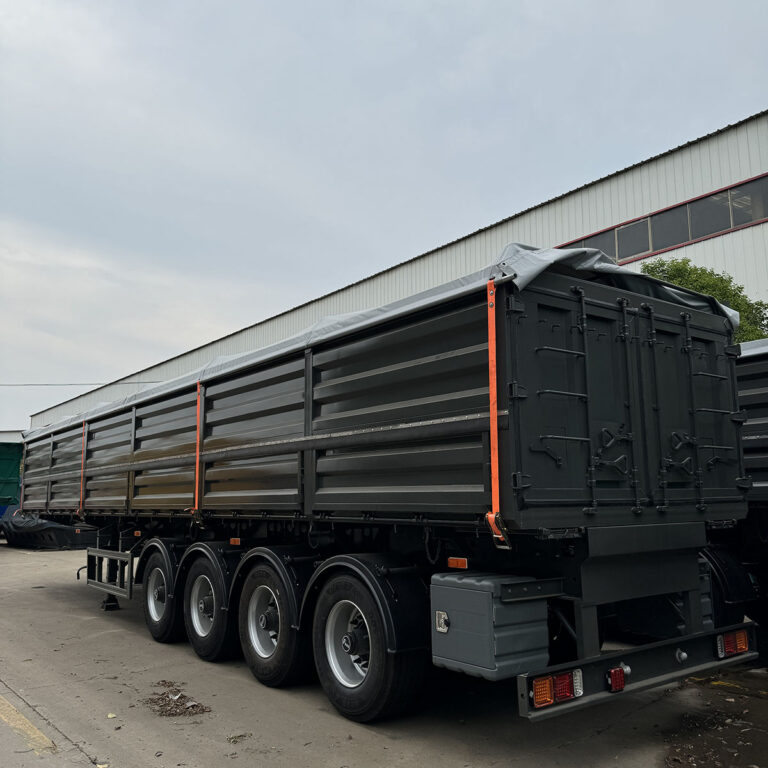
The rollover vehicle is lifted and unloaded laterally by a double-sided synchronous oil cylinder, with a low lifting height and a stable center of gravity, resulting in higher operational safety. The vehicle’s lightweight design is outstanding, with better compliance and a balance between transportation efficiency and driving stability.
Applicable scenarios: Narrow construction sites, narrow roads in mountainous areas, grain storage yards, municipal greening, urban alley clearing, suitable for lightweight bulk goods such as grain, building materials, dry materials, etc., suitable for standard load transportation combining long and short distances.
Advantages and disadvantages: The advantages include low center of gravity, low risk of rollover, wide adaptability to the site, light weight of the vehicle, and compliance with regulations; The disadvantages are that heavy load wet materials are prone to residue, the hydraulic synchronization system is precise, the maintenance cost is slightly higher, and the heavy load limit is lower than that of rear flip models.
Selection mnemonic: open construction sites, heavy-duty sand, gravel, and soil should be selected and flipped over; Narrow site, grain standard load, and pursuit of safety and stability, choose rollover.
2、 Determine the structure, material, and volume of the carriage based on the transported goods
The density, dry and wet state, and wear and tear of the goods directly determine the shape, steel plate material, thickness, and volume of the carriage. Choosing the wrong one can lead to problems such as unclean unloading of the box, wear and deformation of the box body, and non-compliance with overloading regulations. - Selection of carriage shape
U-shaped carriage (preferred for heavy load wet materials): The bottom has a circular arc structure without dead corners, and wet soil, clay, silt, and wet sand and gravel are not easily adhered, and there is no residue left during unloading; At the same time, it has a lower center of gravity, strong impact resistance, and better stability of the vehicle body, making it the first choice for construction projects such as slag, mining, and heavy loads.
Rectangular box (preferred for dry material loading): The square structure has a higher capacity utilization rate, a flat interior, and is convenient for forklift loading and unloading. It is suitable for dry bulk materials such as sand, gravel, grain, and fly ash, and has good lightweight effect and high cost-effectiveness. - Selection of Steel Plate Material and Thickness
The material of the steel plate in the carriage determines the service life of the vehicle, and different working conditions correspond to exclusive materials to avoid the problems of lightweight and non durable, and heavy load redundancy wasting costs.
T700/T750 high-strength steel: It focuses on lightweight, light weight, and high strength, suitable for standard load transportation of grain, building materials, and dry materials. It is compliant and fuel-efficient for long-distance transportation, and is the mainstream material for standard load vehicle models.
Q345 manganese plate: the most versatile, cost-effective, with balanced strength and wear resistance, suitable for ordinary sand and gravel, slag, and short distance engineering transportation, balancing durability and cost.
NM450/NM500 wear-resistant steel: ultra-high wear resistance and impact resistance, specially suitable for mining raw stones, large ores, and high wear and heavy load conditions. Its service life is increased by more than 50% compared to ordinary steel plates, with the only drawback being higher cost.
Conventional thickness reference: standard transport bottom plate 6mm, side plate 4-5mm; engineering heavy-duty bottom plate 8mm, side plate 5mm; mining ultimate heavy-duty bottom plate 10mm, side plate 6-8mm. - Compliant volume matching
The volume does not need to be blindly increased, it needs to be matched according to the density of the goods and the compliance standard of 49 tons of total weight, to avoid overloading and being fined for being unable to be registered on the road: sand and gravel (1.6-1.8t/m ³) are suitable for 28-33 cubic meters; Soil and debris (1.3-1.5t/m ³) suitable for 32-38 cubic meters; Grain and coal (0.7-1.0t/m ³) are suitable for 38-45 cubic meters. The mainstream sizes in the industry are 11 meters and 13 meters in length, with a standard width of 2.55 meters and a height strictly following the road registration standards.
3、 Core hardware selection: axle, suspension and hydraulic system
The axle and suspension determine the vehicle’s load-bearing capacity and road adaptability, while the hydraulic system is the core of self dumping operations. The three major hardware components directly determine the vehicle’s failure rate and service life, and are the key parts that cannot be saved in selection. - Axle configuration
Three axle 13 ton standard axle: mainstream compliant configuration in the market, suitable for 49 ton standard load, covering all scenarios of sand and gravel, slag, grain, and building materials. First line axles such as Fuhua and BPW have low failure rates and strong durability, making them suitable for road transportation.
Four axle 16 ton heavy-duty axle: specially designed for short distance heavy-duty transportation in mines and factory areas, with extremely strong bearing capacity, capable of handling large loads of 60-80 tons. It is only suitable for internal operations in mining areas and is prohibited from high-speed road standard load transportation. - Suspension system selection
Steel plate suspension: With strong bearing capacity, impact resistance, durability, and low maintenance cost, it is the only preferred option for unpaved roads in mines, earthworks, and construction sites, with full load stability.
Air suspension: light weight, good shock absorption effect, tire protection, suitable for paved roads, long-distance standard loads, grain transportation, better comfort and economy, but poor impact resistance, not suitable for heavy loads on construction sites.
Optional lifting axle: The empty vehicle can lift the axle to reduce tire wear and fuel consumption, while avoiding overloading inspections, suitable for long-distance and short distance mixed transportation scenarios. - Hydraulic lifting system
The hydraulic system is the heart of a dump semi-trailer, and inferior hydraulic systems are prone to safety hazards such as weak lifting, oil leakage, deviation, and cylinder collapse.
The rear folding model comes standard with a front multi-stage telescopic oil cylinder, and first tier brands such as Haiwo are preferred. The lifting angle can reach 45 ° or more, with thorough unloading and sufficient power; The rollover vehicle model must be equipped with double-sided synchronous oil cylinders and synchronous valves to prevent lifting and lowering differences and prevent rollover accidents.
The closed hydraulic system is preferred for heavy-duty and long-term operations, with dust and water resistance, stable oil temperature, minimal oil leakage, and low failure rate; A cost-effective open hydraulic system can be used for light load short distance reverse transportation. At the same time, it is necessary to equip an integrated forged base for the oil cylinder, 12.9 grade high-strength screws, and a buffering and falling device to avoid damage to the vehicle body caused by lifting impact.
4、 Vehicle body technology and safety configuration determine long-term durability - Main beam and welding process
The main beam is the load-bearing foundation of the entire vehicle. High strength steel beams with a height of over 500mm are selected for standard load vehicles, while double-layer main and auxiliary beams and thickened web plates are used for heavy-duty vehicles to effectively prevent lifting deformation and beam cracking. In terms of process, robot assembly line full welding is preferred, with uniform welds without pores or virtual welding. Compared with manual spot welding, it has higher structural strength and longer service life. - Principle of self weight selection
High speed standard load and long-distance transportation: T700 high-strength steel lightweight design is selected, and the overall tare weight of the vehicle is controlled at 4.8-5.5 tons, which complies with regulations and increases revenue; Overloading in mines and poor roads on construction sites: Abandoning extreme lightweight, choosing thick and wear-resistant materials, with a car body weighing 6.5-9 tons, exchanging strength with its own weight to avoid deformation and damage to the box. - Safety and Practical Configuration
Essential basic safety configuration: dual line air brake, ABS anti lock braking system, lifting limit, anti fall support, rear reflective sign. For heavy load overturning type, rear support legs need to be installed to eliminate the risk of lifting overturning; Mountain operations can be equipped with sprinkler water tanks to enhance braking safety. Practical configurations can be added as needed: sealed tarpaulin (for environmentally friendly waste transportation), toolbox, side door (for grain loading and unloading), widened ladder, raised fence board, etc.
5、 Front end matching and road condition adaptation plan
The dump semi-trailer needs to be accurately matched with the tractor, and the power configuration should be selected based on road conditions, transportation distance, and climbing requirements to achieve fuel-efficient, powerful, and efficient operation.
Short distance construction sites and mountainous areas with multiple climbing scenarios: The tractor uses 480-550 horsepower, with a high speed ratio rear axle, high starting torque, strong climbing ability, and is suitable for heavy-duty rough roads; Long and short distance mixed, high-speed standard load scenario: using 460-500 horsepower, small speed ratio rear axle, fuel-efficient on flat roads, balancing power, and better overall economy.
6、 Precise and complete selection plan by industry - General version for earthworks and gravel factories (mainstream in the market)
Rear dumping, U-shaped carriage, Q345/T700 material, three-axis 13 ton steel plate suspension, first-line brand front oil cylinder, 30-35 cubic meters compliant capacity, suitable for 49 ton standard load, taking into account the transportation of slag, sand and gravel, and backfill soil. - Mining Heavy Duty Special Payment
Rear dump truck, U-shaped carriage, NM450 wear-resistant steel, four axle 16 ton heavy-duty axle, thickened 10mm bottom plate, closed hydraulic system, reinforced double-layer beam, specially designed to deal with raw stones, slag, and high wear heavy-duty conditions. - Dual use standard payment for grain and building materials
13 meter overturned dump truck, rectangular carriage, T700 lightweight high-strength steel, air suspension+lifting bridge, large capacity of about 40 square meters, with a carriage capacity of ≤ 5 tons, suitable for long-distance standard load transportation of bulk grain and dry building materials. - Special funds for urban waste removal and transportation
Rear folding U-shaped carriage, environmentally friendly sealed tarpaulin, ABS anti lock braking, sprinkler water tank, 32-36 square meters compliant volume, fully meeting the requirements of urban environmental protection registration and road inspection, with no littering and clean unloading during transportation.